

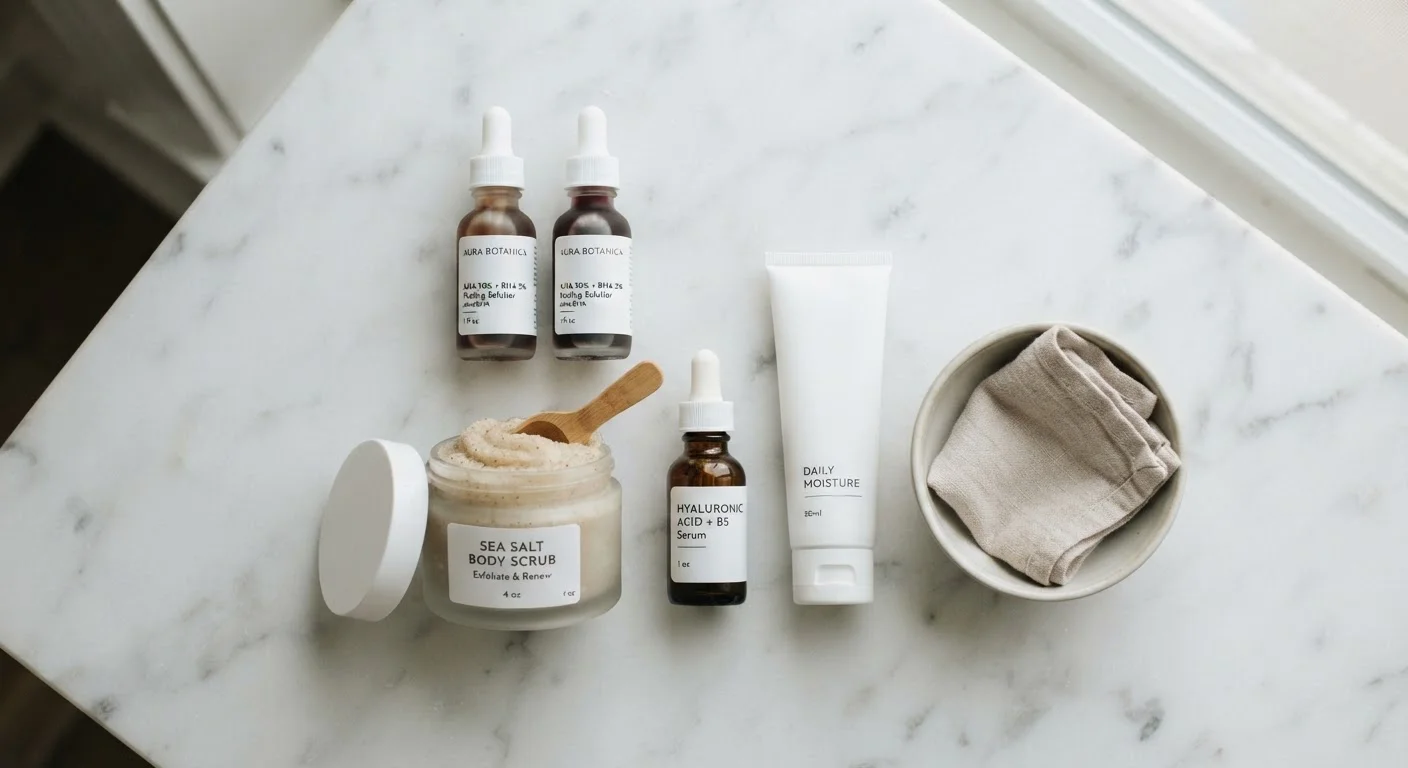
Option A
Chemical Exfoliants
The precision-driven, skin-type-versatile approach.
Best for: Best for sensitive, acne-prone, or uneven-toned skin that needs gentle, consistent cell turnover without friction.
Option B
Physical Scrubs
The hands-on, immediate-results option.
Best for: Best for normal or oily skin types that tolerate manual texture and want a quick, tactile cleansing ritual.
How Each Method Actually Works
Exfoliation — the process of removing dead skin cells from the surface of the skin — falls into two broad categories. Understanding the mechanism behind each helps you choose what genuinely fits your skin, rather than guessing based on marketing claims.
Chemical exfoliants use active compounds to break down the bonds that hold dead skin cells together. The most common types are:
- AHAs (alpha-hydroxy acids) — such as glycolic acid and lactic acid — work on the skin's surface and are water-soluble. They're commonly used to improve texture, brightness, and mild discoloration.
- BHAs (beta-hydroxy acids) — primarily salicylic acid — are oil-soluble, allowing them to penetrate into pores. This makes them a go-to for oily and acne-prone skin.
- Enzymes — derived from sources like papaya or pineapple — offer a gentler option that digests dead cells without acids, making them suitable for very sensitive skin.
Physical scrubs use abrasive materials — such as sugar, salt, oat flour, or synthetic microbeads — to manually dislodge dead cells through friction. The experience feels immediate and satisfying, but the results depend heavily on the particle shape and your technique.
| Criterion | Chemical Exfoliants | Physical Scrubs |
|---|---|---|
| Mechanism | Dissolves dead cell bonds via acids or enzymes | Physically buffs away dead cells via friction |
| Best skin types | Sensitive, acne-prone, dry, mature | Normal, oily (with gentle particles) |
| Pore penetration | Yes (BHAs penetrate pores) | No — surface only |
| Irritation risk | Low to moderate (depends on concentration) | Moderate to high (depends on particle type) |
| Sun sensitivity | Increased (especially AHAs) | Minimal added risk |
| Frequency | 1–3x per week | 1–2x per week |
| Learning curve | Moderate — concentration and type matter | Low — straightforward application |
The Risk Factor: What Each Method Can Get Wrong
Both exfoliation types carry real risks when misused, but the nature of those risks differs significantly.
With physical scrubs, the main concern is particle irregularity. Natural materials like walnut shell powder often have jagged, uneven edges that can create small abrasions in the skin — particularly problematic for inflamed or acne-prone skin where those micro-tears can worsen breakouts and spread bacteria. Smooth, rounded particles like jojoba beads or sugar are considerably gentler, but pressure and frequency matter just as much as particle type.
Chemical exfoliants, particularly higher-concentration AHAs, increase photosensitivity — meaning sun protection becomes non-negotiable when using them. Starting with too high a concentration or using actives daily without building tolerance can also compromise the skin barrier, leading to tightness, flaking, or increased sensitivity.
The universal rule: more is not better. Exfoliating more than two to three times per week with either method is rarely beneficial and often counterproductive. If you're layering exfoliants with other active ingredients, see our guide to pairing skincare ingredients safely to avoid interactions that can amplify irritation.
~30%
Skin cell turnover slowdown with age
Dermatology research suggests that cell turnover — which happens naturally every 28 days in younger adults — can slow by roughly 30–40% as skin ages, making regular exfoliation more relevant over time.
2–3x
Maximum weekly exfoliation frequency
Most board-certified dermatologists recommend limiting exfoliation to two to three times per week to preserve the skin barrier, regardless of the method used.
Matching Exfoliation to Your Skin Type
No single exfoliant method works universally — skin type and condition should drive the decision.
Sensitive or rosacea-prone skin: Avoid physical scrubs with harsh particles entirely. A low-percentage lactic acid (around 5%) or an enzyme-based formula used once weekly is a more cautious starting point. Always patch test first.
Dry skin: AHAs are well-suited here. Glycolic and lactic acid help improve moisture retention by stimulating surface cell renewal, whereas physical scrubs can strip already-limited natural oils.
Oily or acne-prone skin: BHAs are the evidence-backed option. Salicylic acid's ability to work inside pores gives it a functional advantage that no scrub can replicate mechanically.
Normal or combination skin: You have the most flexibility. A gentle physical scrub two times weekly, or a rotating AHA/BHA formula, can both work — the key is monitoring how your skin responds and adjusting frequency accordingly.
Mature skin: Chemical exfoliants tend to be better tolerated and more effective for improving the appearance of fine lines, as the enzymatic and acid-based turnover is less abrasive than physical friction on thinning skin.
This article provides general skincare education and is not a substitute for advice from a licensed dermatologist. If you experience persistent irritation or skin concerns, consult a qualified healthcare professional.
The content on this site is for informational purposes only and is not a substitute for professional advice. Always consult a qualified professional for guidance specific to your situation.