

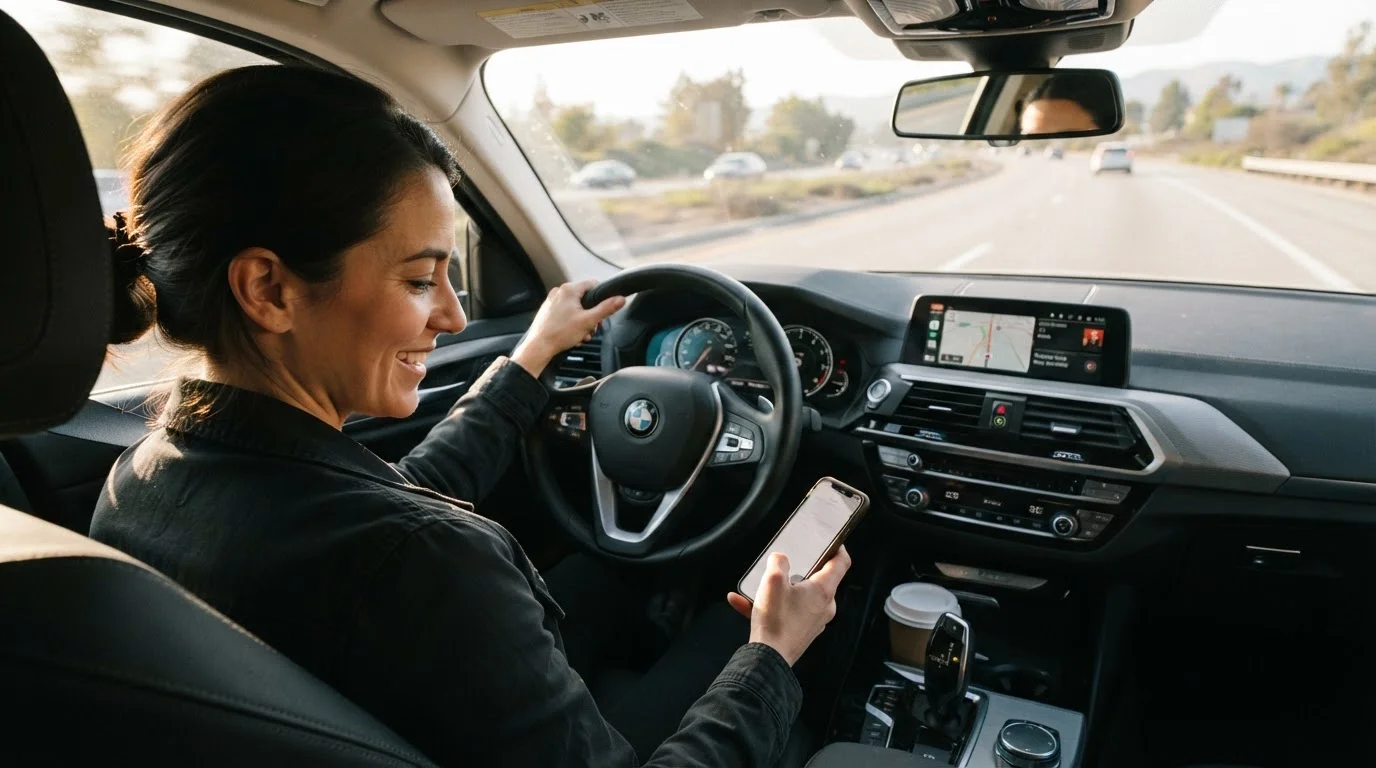
The Three Categories of Distraction
Most drivers think of distracted driving as a smartphone problem — and phones are indeed a serious hazard. But the National Highway Traffic Safety Administration (NHTSA) defines distraction across three distinct categories, and almost every driver encounters each of them on ordinary trips.
Visual distraction means taking your eyes off the road. Manual distraction means removing one or both hands from the wheel. Cognitive distraction means allowing your mind to disengage from the driving task, even if your eyes are forward and your hands are steady.
What makes smartphones uniquely dangerous is that they trigger all three types at once — you look at the screen, hold the device, and direct mental focus away from traffic. But plenty of other common behaviors hit one or two of these categories just as hard. Understanding the full picture is the first step toward driving more defensively on everyday roads.
Myth
As long as I use a hands-free device, I'm not distracted while driving.
Fact
Hands-free calls still create significant cognitive distraction, reducing a driver's ability to process hazards.
The hands-free myth is one of the most persistent in road safety. Removing the phone from your hand eliminates the manual and visual components of distraction, but the cognitive load of a conversation remains. Research from the AAA Foundation for Traffic Safety found that voice-based interactions — including hands-free calls — measurably impair driving performance. The brain narrows its field of attention when processing conversation, a phenomenon sometimes called "inattention blindness." Drivers can look directly at a hazard and fail to register it.
Myth
Eating or drinking while driving is only a minor distraction compared to phone use.
Fact
Eating while driving involves visual, manual, and sometimes cognitive distraction, and has been linked to increased crash risk.
A study by the Network of Employers for Traffic Safety found that eating or drinking while driving raised the likelihood of a near-collision or crash significantly. The act of unwrapping food, managing spills, or reaching for a cup combines multiple distraction types. Unlike a phone, eating doesn't feel like a dangerous activity — which is part of why it's so commonly underestimated.
Myth
If my eyes are on the road, I'm paying attention to driving.
Fact
Cognitive distraction means the brain can disengage from driving even when the eyes are forward.
"Inattention blindness" is well-documented in traffic research. Drivers in highly engaged conversations — including hands-free phone calls — show reduced detection of pedestrians, cyclists, and changing traffic conditions, even when their gaze is aimed at the road. Looking and truly seeing are two different things. Cognitive load from conversations, emotional stress, or active problem-solving all draw mental resources away from the driving task.
Myth
Distracted driving laws only apply to texting and handheld phone use.
Fact
Distracted driving laws vary by state and can cover a wide range of inattentive behaviors beyond phone use.
While many state laws focus specifically on handheld device use, law enforcement can often cite drivers for other inattentive behaviors under broader reckless or careless driving statutes. Some states have moved toward "distracted driving" laws that extend beyond phones. Regardless of what's explicitly illegal in your state, the liability and safety risks of any distraction are real. Drivers involved in crashes while eating, grooming, or engaged in other non-driving tasks have faced civil liability even when no specific statute covered the behavior.
Myth
Daydreaming doesn't count as distracted driving because you're not doing anything.
Fact
Cognitive distraction from mind-wandering slows reaction times and reduces hazard detection just like other distractions.
Passive mental drift is a recognized safety concern. On familiar routes especially, drivers can enter a kind of autopilot state where they navigate the road without consciously processing it. This is sometimes called "highway hypnosis" on long, monotonous stretches. Reaction times in this state can approach those seen with other cognitive distractions. Staying actively engaged — scanning intersections, checking mirrors, narrating hazards mentally — helps counteract this tendency. Defensive driving techniques are specifically designed to maintain this kind of active engagement.
Everyday Habits That Qualify as Distraction
Many drivers accept certain habits as routine without recognizing them as distractions. Eating a drive-through meal involves looking at the food (visual), holding it (manual), and sometimes problem-solving a messy spill (cognitive). Adjusting the climate controls or hunting for a radio station pulls visual and manual attention simultaneously.
Even passenger conversations can be distracting, though research generally shows they carry lower risk than phone calls. The key difference: passengers naturally pause conversation at critical moments — a merging truck, a light turning red — while a caller on the other end of the phone has no idea what's happening on the road.
3,000+
U.S. fatalities annually linked to distraction
The NHTSA consistently reports that driver distraction is a contributing factor in thousands of traffic deaths each year in the United States.
5 seconds
Average eyes-off-road time when reading a text
At 55 mph, looking away for five seconds covers the length of a football field — a figure cited repeatedly by road safety researchers and the NHTSA.
Daydreaming — what researchers sometimes call mind-wandering — is one of the most underestimated cognitive distractions. Studies using driving simulators show that a wandering mind can significantly slow reaction times even when a driver's eyes remain on the road. This is also why fatigued driving overlaps with distraction: fatigue accelerates mental drift.
External distractions — a billboard, an accident on the opposite side of the highway, or something unusual on the sidewalk — are visual by nature. The common phrase "rubbernecking" describes exactly this: drivers slowing to observe a roadside event and failing to maintain awareness of the cars directly ahead. This is a leading cause of secondary crashes near accident scenes.
For longer journeys where fatigue and distraction compound, the habits that keep night drivers alert apply to daytime driving too — planned breaks, managed distractions, and deliberate focus all make a difference.
Hands-Free Doesn't Mean Risk-Free
Many drivers assume that switching to a hands-free device fully eliminates distraction risk. It doesn't. Cognitive distraction from phone conversations persists regardless of how the phone is held. If a call feels urgent or emotionally charged, the safest option is to pull over safely before continuing the conversation.
The content on this site is for informational purposes only and is not a substitute for professional advice. Always consult a qualified professional for guidance specific to your situation.