

Why Fitness Jargon Matters More Than You Think
Walk into any gym or open a popular workout app and you'll be hit with a wall of abbreviations, technical terms, and trainer shorthand — RPE, AMRAP, supersets, periodization. It can feel like a foreign language designed to keep beginners on the sideline.
It isn't. Most fitness terminology exists because it makes communication precise and efficient. Once you know what these words actually mean, you can follow workout programs accurately, understand what your body is doing, and make smarter decisions about your training. You'll also be better equipped to spot overpromising claims — see common fitness myths debunked for a useful complement to this guide.
This glossary covers the terms you're most likely to encounter, organized so you can use it as a quick lookup reference anytime.
Rep (Repetition)
One complete execution of an exercise movement, from start position through full range of motion and back. For example, lowering into a squat and standing back up counts as one rep.
Set
A group of consecutive reps performed before resting. Most programs prescribe a specific number of sets per exercise (e.g., 3 sets of 10 reps).
HIIT
High-Intensity Interval Training. A format that alternates short bursts of intense effort with brief recovery periods. Sessions are typically shorter than steady-state cardio but demand higher exertion during work intervals.
Progressive Overload
The principle of gradually increasing training demands — through weight, reps, sets, or reduced rest — over time. It's the primary mechanism by which the body becomes stronger or fitter.
1RM (One-Rep Maximum)
The maximum weight a person can lift for exactly one complete repetition of a given exercise with proper form. Used as a benchmark to set training loads as percentages.
RPE (Rate of Perceived Exertion)
A self-reported scale — typically 1 to 10 — describing how hard an exercise feels. An RPE of 7 means you're working hard but could complete a few more reps; a 10 is maximum effort.
Superset
Performing two exercises back-to-back with little or no rest between them. Supersets can target opposing muscle groups (e.g., biceps then triceps) or the same group for added challenge.
AMRAP
As Many Reps (or Rounds) As Possible. A timed workout format where you complete as many reps or full exercise circuits as you can within a set time window.
VO2 Max
The maximum rate at which your body can consume oxygen during intense exercise. It's a measure of cardiorespiratory fitness — a higher VO2 max generally indicates greater aerobic capacity.
Compound Movement
An exercise that works multiple muscle groups and joints simultaneously — such as a squat, deadlift, or bench press. Contrasted with isolation exercises that focus on a single muscle.
Periodization
The structured planning of training across time — cycling phases of volume, intensity, and recovery to promote long-term progress and reduce injury risk. Common in strength and athletic programs.
Active Recovery
Low-intensity movement (such as walking, gentle stretching, or light cycling) performed on rest days to promote blood flow and reduce muscle soreness without adding significant training stress.
Key Numbers and Training Variables
Fitness programs are built around a handful of adjustable variables. Understanding these lets you read any workout plan without confusion.
| What "3×10" means in a workout plan | 3 sets of 10 repetitions |
| Typical RPE range for moderate training | 5–7 out of 10 |
| Common HIIT work-to-rest ratio | 1:2 (e.g., 20 sec on, 40 sec off) |
| VO2 max measures | Aerobic (cardiorespiratory) fitness capacity |
| Progressive overload applies to | Weight, reps, sets, tempo, or rest time |
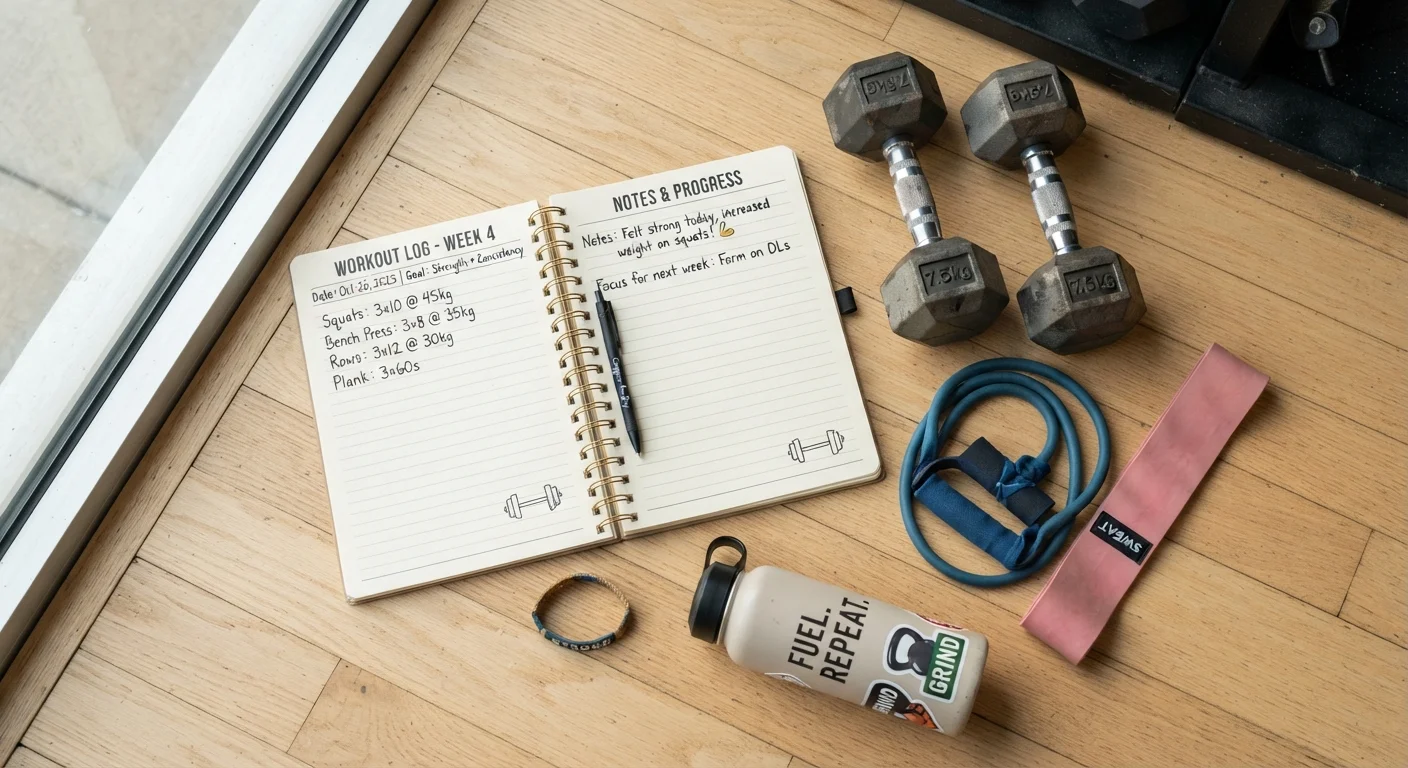
Reps and sets are the foundation of almost every resistance workout. A rep (repetition) is one complete movement — one squat, one push-up. A set is a group of reps performed consecutively before resting. "3 sets of 12 reps" means you perform the exercise 12 times, rest, and repeat that cycle twice more.
Rest intervals between sets aren't optional — they're programmed. Shorter rests (30–60 seconds) keep your heart rate elevated and suit endurance-focused goals. Longer rests (2–3 minutes) allow more recovery for strength-focused work.
Volume refers to the total amount of work in a session or week — typically sets × reps × weight. Intensity describes how hard that work is, often expressed as a percentage of your one-rep maximum (1RM) or using an RPE scale (Rate of Perceived Exertion, typically 1–10). Both variables are central to how progressive overload keeps your fitness advancing.
Before manipulating these numbers in a new program, it's worth running through a readiness checklist to make sure your body and schedule are prepared.
This article is for informational purposes only and is not a substitute for advice from a qualified fitness or healthcare professional. Consult a professional before starting a new exercise program, especially if you have an existing health condition.
The content on this site is for informational purposes only and is not a substitute for professional advice. Always consult a qualified professional for guidance specific to your situation.