

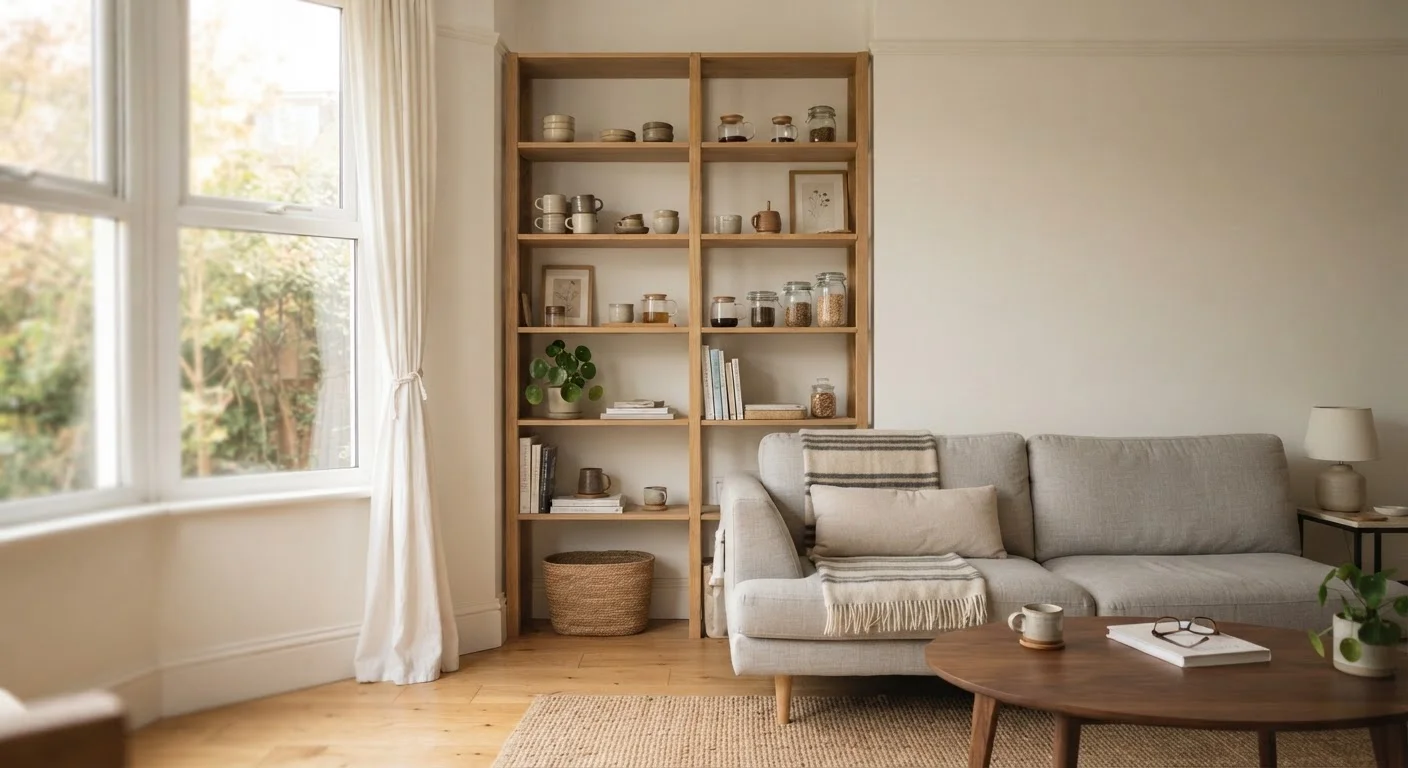
Why the Popular Definition of Organization Is Misleading
Ask most people what a well-organized home looks like and they'll describe something they saw in a magazine or on a home improvement show: matching containers, color-sorted closets, labeled everything. That image is aspirational—and largely unhelpful for everyday life.
Functional organization has a simpler definition: you can find what you need, use it, and put it back without friction. That's it. A junk drawer that you can navigate in ten seconds is more organized than a beautifully arranged shelf where nothing has a logical home. A laundry system that actually gets clothes washed, dried, and put away beats a decorative hamper that never gets emptied.
If the gap between the ideal and your reality is creating stress rather than reducing it, the ideal may be the problem. Starting with realistic expectations is one of the most important steps any first-time organizer can take.
Myth
Getting organized means your home should look immaculate and photo-ready at all times.
Fact
Organization means your home functions smoothly for the people living in it—not that it looks staged.
The gap between "organized" and "Instagram-worthy" is significant. A functional home has clear systems: items have designated homes, surfaces are workable, and daily routines don't require a search party. A spotless, decorated interior without those systems is just tidied-up chaos waiting to return. Real organization is measured by how easily you can locate your keys, pay a bill, or prep a meal—not by how your shelves photograph.
Myth
You need to buy a lot of storage bins, baskets, and organizers to get organized.
Fact
Storage products are the last step in organizing, not the first—and many homes need fewer containers, not more.
Retail marketing has convinced many people that organization is a product category. In reality, buying containers before deciding what to keep is a reliable path to more clutter. The sequence that actually works: decide what stays, find logical homes for those items, then—only if needed—choose a container that fits the space and quantity. Many everyday items can be corralled with what you already own.
Myth
If you were truly organized, you'd only need to do it once.
Fact
Organization is an ongoing habit, not a single event. All homes drift toward disorder over time.
Homes are lived in. Groceries arrive, mail accumulates, kids grow out of things, hobbies change. The idea that one big weekend overhaul will hold indefinitely sets people up for frustration. What sustains an organized home is a small set of consistent habits—returning items after use, doing brief weekly resets, and periodically reassessing what belongs. Simple rules like one-in, one-out are far more powerful than any single decluttering session.
Myth
Clutter is a storage problem—you just don't have enough space.
Fact
Clutter is usually a decision-making problem. More storage space without fewer decisions just hides the backlog.
When people move to a larger home expecting organization to follow, they're often surprised when clutter fills the new space just as quickly. That's because the underlying issue isn't square footage—it's the volume of unmade decisions sitting in physical form. Every item without a clear purpose or place is a deferred choice. Addressing clutter means making those decisions, not acquiring more room to postpone them. Decluttering one room at a time is a practical way to start working through the backlog.
Myth
There's one correct organizing method that works for everyone.
Fact
The best system is one that fits your habits, household, and lifestyle—even if it looks unconventional.
Organizing frameworks and methods can be genuinely useful starting points, but they're tools—not prescriptions. A system built around how you actually move through your home will outlast any method borrowed wholesale from a book or video. Organizing by activity-based zones, for instance, works well for many households precisely because it adapts to real behavior rather than ideal behavior. The measure of a good system is simple: do you actually use it?
What Functional Organization Actually Requires
Once you set aside the aesthetics-first mindset, organizing becomes a much more approachable task. Here's what it genuinely involves:
- Deciding what stays. Every item in your home takes up physical and mental space. Keeping only what you use, need, or genuinely value is the foundation of any workable system.
- Giving things a home. Each item you keep should have one consistent place where it lives. When everything has a designated spot, putting things away becomes automatic rather than effortful.
- Making the system easy to maintain. If returning something to its place takes more effort than just setting it down, the system will fail. Design for your laziest moment, not your most motivated one.
- Revisiting periodically. Life changes—so should your systems. A quarterly check-in to reassess what's working prevents gradual drift back to disorder.
25%
Of two-car garages that can't fit a car
The U.S. Department of Energy has noted that roughly one in four two-car garages is too full of stored items to park a vehicle inside.
~$10B
Annual U.S. spending on home storage products
The home organization retail sector generates an estimated $10 billion or more annually in the United States, reflecting widespread demand for organizing solutions.
Notice that none of these steps require purchasing anything. The work is primarily cognitive: making decisions, establishing habits, and designing systems that accommodate real behavior. Products can support a good system, but they can't create one.
Don't Shop Before You Sort
Purchasing storage products before deciding what to keep is one of the most common organizing mistakes. You'll likely buy the wrong sizes, store things you don't need, and end up with even more clutter. Always declutter first, then assess what containers—if any—you actually need.
Letting Go of Perfectionism to Make Real Progress
Perfectionism is one of the most common reasons people never start—or never finish—organizing their homes. When the mental bar is a flawlessly curated space, any imperfect result feels like failure. That all-or-nothing framing keeps people stuck.
Progress in organizing is not linear, and a partially organized home is still meaningfully better than a disorganized one. A cleared kitchen counter matters even if the pantry still needs work. A functional closet system matters even if the bins are mismatched. Incremental improvement compounds over time.
Organization Is About Function, Not Aesthetics
If you can find what you need within seconds and return it without effort, your home is organized—regardless of how it looks. Matching bins and color-coded labels are optional extras, not the goal. Chasing a picture-perfect look can actually undermine the practical systems that make daily life easier.
Give yourself permission to build a home that works for the people living in it right now—not a home optimized for some future, idealized version of your life. When your systems reflect your actual routines, maintenance feels natural rather than burdensome, and the calm you're after becomes something you can actually sustain.
The content on this site is for informational purposes only and is not a substitute for professional advice. Always consult a qualified professional for guidance specific to your situation.