

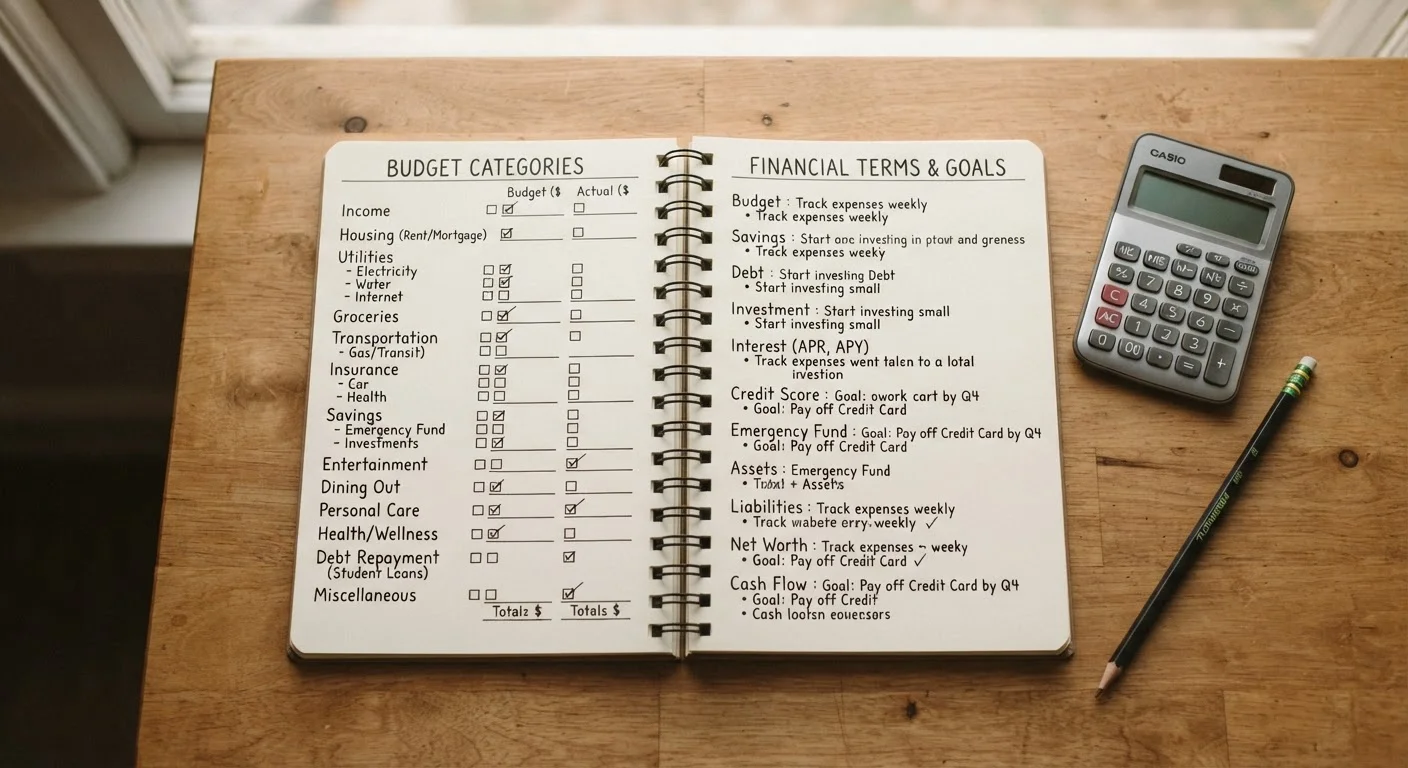
Why Budgeting Vocabulary Matters
Budgeting guides are full of words like discretionary income, cash flow, and sinking fund — terms that can feel like a foreign language if no one has ever explained them. When the language is unclear, the whole exercise feels harder than it needs to be.
This glossary is a plain-language reference for the terms you'll run into most often. Bookmark it, come back when something doesn't make sense, and use it alongside a step-by-step plan — like the one in Your First Budget in Seven Steps.
One important note: this article is general financial education, not personalized financial advice. For guidance specific to your situation, consider speaking with a licensed financial professional.
Net income
The money remaining from your paycheck after taxes and deductions are removed. This is the figure your budget should be built on — it's what you actually have to spend, save, and give.
Discretionary spending
Money spent on wants rather than necessities — dining out, entertainment, hobbies, and similar expenses. It's not inherently wasteful; it's simply spending you have more control over.
Fixed expense
A cost that stays the same each month, such as rent or a car payment. Fixed expenses are easier to plan around because the amount doesn't change.
Variable expense
A cost that fluctuates month to month, like groceries, utilities, or gas. Tracking these over several months helps reveal spending patterns.
Emergency fund
Savings reserved for unexpected financial shocks — job loss, medical costs, or urgent repairs. Financial educators often suggest three to six months of essential expenses as a general target.
Sinking fund
A pool of money saved incrementally for a planned future expense, such as holiday gifts or an annual insurance bill. The goal is to avoid surprises by spreading the cost over time.
Cash flow
The net movement of money into and out of your accounts. Positive cash flow means income exceeds outgo; negative cash flow means you're spending more than you earn.
Debt-to-income ratio (DTI)
Your total monthly debt payments divided by your gross monthly income, expressed as a percentage. It's a common measure lenders use, and a useful personal health check too.
Zero-based budget
A budgeting method in which every dollar of income is assigned a purpose — spending, saving, or debt paydown — until the balance reaches zero. It requires intentional planning but leaves no money unaccounted for.
50/30/20 rule
A percentage-based budgeting guideline suggesting roughly 50% of take-home pay for needs, 30% for wants, and 20% for savings and debt repayment. It's a starting framework, not a rigid rule — real budgets often need adjustment. See a plain-English breakdown for details.
Key Terms, Explained in Plain English
The definitions below cover income, spending, saving, and debt — the four pillars of almost every budgeting conversation. Each term is defined the way a knowledgeable friend would explain it, not a textbook.
| Budget foundation | Always build your budget on net (take-home) income, not gross income |
| Emergency fund target | 3–6 months of essential expenses (general guideline) (Consumer Financial Protection Bureau guidance) |
| Common DTI threshold | 43% is often cited as an upper limit by mortgage lenders (Consumer Financial Protection Bureau) |
| Budgeting methods covered | Zero-based, percentage-based (50/30/20), and sinking fund approaches |
Income Terms
- Gross income
- Your pay before any taxes or deductions come out. This is the number on your job offer letter.
- Net income (take-home pay)
- What actually hits your bank account after federal and state taxes, Social Security, Medicare, and any benefit deductions are removed. Your budget should always be built around net income — it's the money you actually have.
- Variable income
- Earnings that change from month to month — common for freelancers, hourly workers, and gig workers. Budgeting on variable income typically means planning around your lowest expected monthly amount.
Spending Terms
- Fixed expenses
- Bills that stay the same every month, like rent, a car loan payment, or a subscription at a set price. These are easier to plan around because they don't surprise you.
- Variable expenses
- Costs that change month to month — groceries, gas, utilities, and dining out are common examples. These require more active tracking.
- Discretionary spending
- Money spent on wants rather than needs: entertainment, hobbies, travel, or non-essential shopping. This is usually the first category people adjust when money is tight.
Saving and Planning Terms
- Emergency fund
- A dedicated savings cushion — often three to six months of essential expenses — set aside for unexpected costs like a medical bill or car repair. It prevents debt when life doesn't go to plan.
- Sinking fund
- Money saved gradually for a specific, known future expense — a holiday gift budget, car registration, or annual insurance premium. Instead of scrambling when the bill arrives, you've already saved for it.
- Cash flow
- The movement of money in and out of your accounts over a period. Positive cash flow means more is coming in than going out; negative cash flow means the reverse.
Debt Terms
- Minimum payment
- The smallest amount a lender requires you to pay each billing cycle. Paying only the minimum on revolving debt (like a credit card) extends repayment and increases total interest paid.
- Debt-to-income ratio (DTI)
- Your total monthly debt payments divided by your gross monthly income, expressed as a percentage. Lenders use it to evaluate creditworthiness; a lower DTI generally signals healthier finances.
Ready to put these terms to work? The zero-based vs. percentage-based budgeting comparison is a good next read — and if a misconception has been holding you back, common budgeting myths worth challenging is worth a look too.
This article provides general financial education only and is not personalized financial, tax, or legal advice. Consult a qualified financial professional for guidance tailored to your circumstances.
The content on this site is for informational purposes only and is not a substitute for professional advice. Always consult a qualified professional for guidance specific to your situation.