

Our Verdict
Envelope budgeting is a genuinely effective tool for anyone who overspends because abstract numbers feel disconnected from real money. Its physical or digital boundaries create spending friction that many people find more powerful than willpower alone. That said, it demands consistent upkeep and can feel clunky in a card-first economy.
This method suits people who are new to budgeting, have irregular spending patterns in specific categories like dining or entertainment, or have previously tried digital tracking tools without success.
What Envelope Budgeting Actually Is
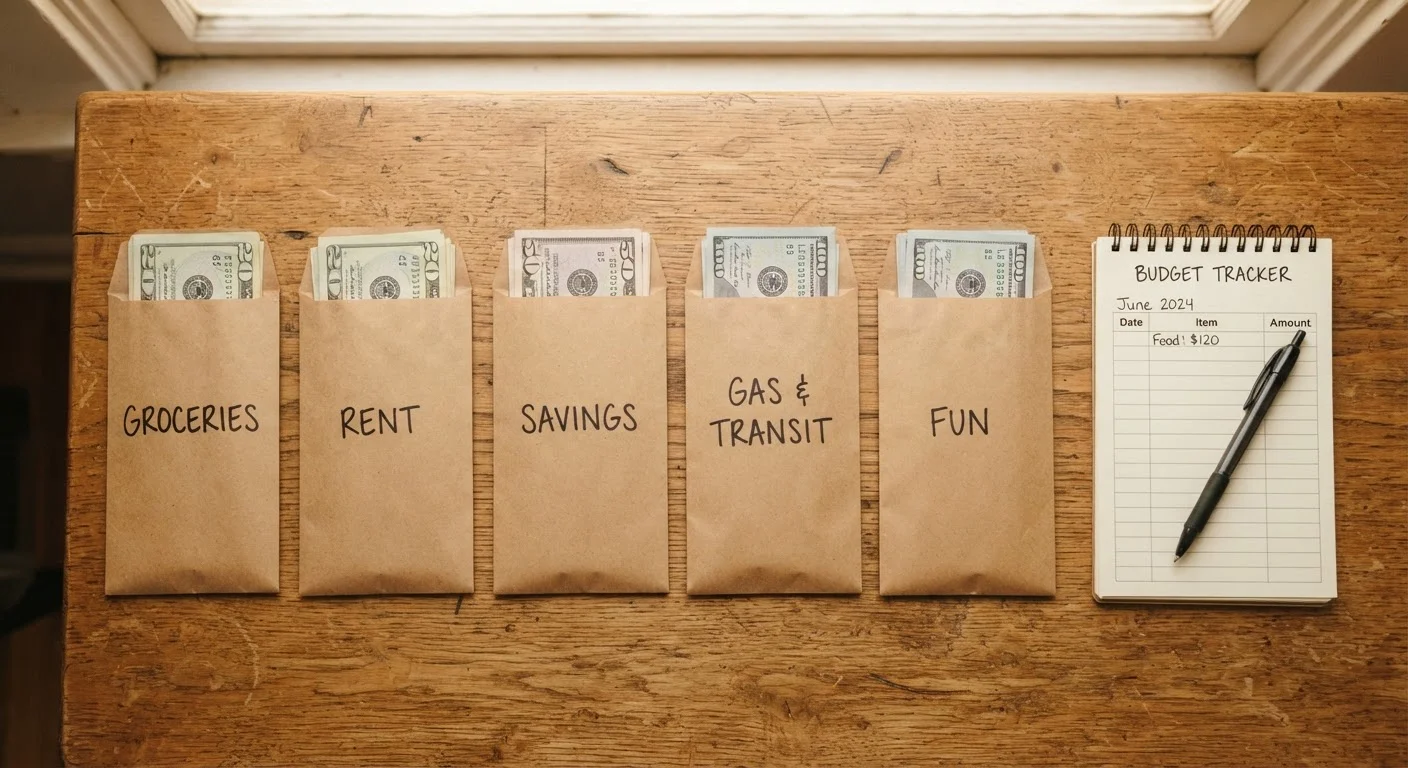
Envelope budgeting is a cash-allocation system where you divide your take-home pay into labeled envelopes — one for groceries, one for gas, one for dining out, and so on — at the start of each pay period. You spend only what's inside each envelope for that category. When it's empty, spending in that category stops until the next refill.
The method has roots in Depression-era household management, but it remains popular today because the core mechanic still works: seeing and touching physical money makes limits feel real in a way that bank balances often don't. Modern versions use apps or digital sub-accounts to mimic the same structure without requiring actual cash envelopes.
It's worth noting upfront that envelope budgeting is a spending management tool, not a savings or investment strategy on its own. Think of it as the front end of a broader financial plan. For a look at how it compares to other frameworks, see our comparison of zero-based and percentage-based budgeting.
The Genuine Strengths
Creates physical spending limits that are hard to ignore
When the grocery envelope is empty, there's no ambiguity — spending stops. This hard boundary removes the mental math that often lets overspending slide in digital systems.
Reduces impulse purchases through the pain of paying
Behavioral economics research suggests people spend more carefully with physical cash than with cards. Envelopes harness this tendency deliberately for everyday spending categories.
Provides instant, real-time visibility into category spending
No app login or statement review required — glancing at what's left in an envelope tells you exactly where you stand, which helps mid-period course corrections.
Simple enough to start with no financial background
The rules are easy to explain and follow: divide your pay, spend from the right envelope, stop when it's empty. That accessibility lowers the barrier for first-time budgeters.
Adaptable to digital tools for a cashless lifestyle
Apps and bank sub-accounts can replicate the category-allocation logic, allowing people to keep the structure even when most transactions are digital or automatic.
The most meaningful advantage is behavioral, not mathematical. Research in behavioral economics consistently finds that people spend more freely with credit cards or digital payments than with physical cash — sometimes called the "pain of paying" effect. Envelopes reintroduce that friction deliberately.
The system is also self-correcting in a visible way. If your grocery envelope runs low on the 20th of the month, you know immediately — no app login required, no statement surprise at month-end. That real-time feedback loop is one reason envelope budgeting tends to reduce impulse purchases in variable spending categories.
Finally, it's simple enough for someone with no financial background to start today. If you've felt intimidated by budgeting, this matters. Our article on common budgeting myths addresses why complexity often gets blamed for failure when the real issue is structure.
The Real Drawbacks
Difficult to use in a card-first, cashless economy
Online purchases, tap-to-pay, and automatic subscriptions don't mesh easily with physical cash envelopes, forcing workarounds that many people find unsustainable over time.
Requires consistent administrative effort every pay period
Withdrawing exact amounts, labeling envelopes, and managing category transfers takes real time and attention — a maintenance burden that increases the odds of abandonment.
Hard to calibrate on irregular or variable income
Freelancers, gig workers, and commission earners often can't predict category amounts in advance with confidence, making upfront allocation stressful or inaccurate.
Cash is not protected if lost or stolen
Unlike a bank account or credit card, physical cash in envelopes carries no fraud protection or recovery option — losing an envelope means losing that money outright.
Digital versions can be too easy to override
Moving money between digital envelope categories takes seconds, which can undermine the behavioral friction that makes the physical version effective in the first place.
The biggest practical challenge is that American spending is increasingly cashless. Splitting a grocery run between physical envelope cash and a card for the rest creates friction that most people abandon quickly. Online subscriptions, automatic bill payments, and digital wallets don't fit neatly into a cash envelope system.
There's also an administrative burden. Withdrawing exact amounts, keeping envelopes organized, and making change between categories takes real time and discipline every pay period. For people with irregular income — freelancers, gig workers, commission-based earners — estimating category amounts in advance is harder still.
If this kind of upkeep has tripped you up before, our piece on why budgets fall apart after month one identifies the specific habits that predict failure and how to plan around them.
Making It Work in a Digital World
For most people today, a hybrid approach is the most realistic path. Use actual cash envelopes for the two or three categories where you tend to overspend — typically dining, entertainment, or personal spending money — and manage fixed bills like rent and utilities digitally as usual. This concentrates the method's behavioral strength where it's most needed without creating friction on automatic payments.
Digital envelope apps replicate the category-allocation logic in a bank account or app environment. They don't carry the tactile weight of physical cash, but they do enforce the same rule: once the category balance hits zero, you stop. Some people find this sufficient; others find that the ease of moving money between digital envelopes undermines the discipline. Know yourself honestly before committing to one approach.
Don't Forget an Emergency Envelope
One often-overlooked category in envelope budgeting is an emergency fund allocation. Even setting aside a small fixed amount each pay period into a dedicated envelope — separate from all spending categories — builds a cushion over time. This money should stay untouched except for genuine, unplanned emergencies, not budget shortfalls. Treating it as a non-negotiable envelope from the start prevents it from being raided for everyday expenses.
Building an emergency fund works well alongside envelope budgeting — treat it as a dedicated envelope that you never spend from except in genuine emergencies. Our guide to incorporating an emergency fund into your budget explains how to size it and where it fits in the overall plan.
Is It the Right Method for You?
Envelope budgeting suits people who find that numbers on a screen feel abstract and that spending gets away from them despite technically knowing their balances. It's a strong starting point for anyone new to budgeting because it requires no spreadsheet skill — only the ability to count cash and stick to a category limit.
It's a harder fit for households with highly variable income, people who travel frequently for work, or anyone whose spending is already largely automated and consistent. In those cases, a percentage-based framework or zero-based approach on a spreadsheet may create less daily friction while still providing real structure.
Building the habits that make any budget sustainable matters as much as the method itself. Our article on habits that make budgeting easier over time covers the practical routines — envelope-based or otherwise — that reduce friction and help a system stick past the first month.
This article is for general informational and educational purposes only and does not constitute personalized financial advice. Consider consulting a qualified financial professional for guidance specific to your situation.
The content on this site is for informational purposes only and is not a substitute for professional advice. Always consult a qualified professional for guidance specific to your situation.