

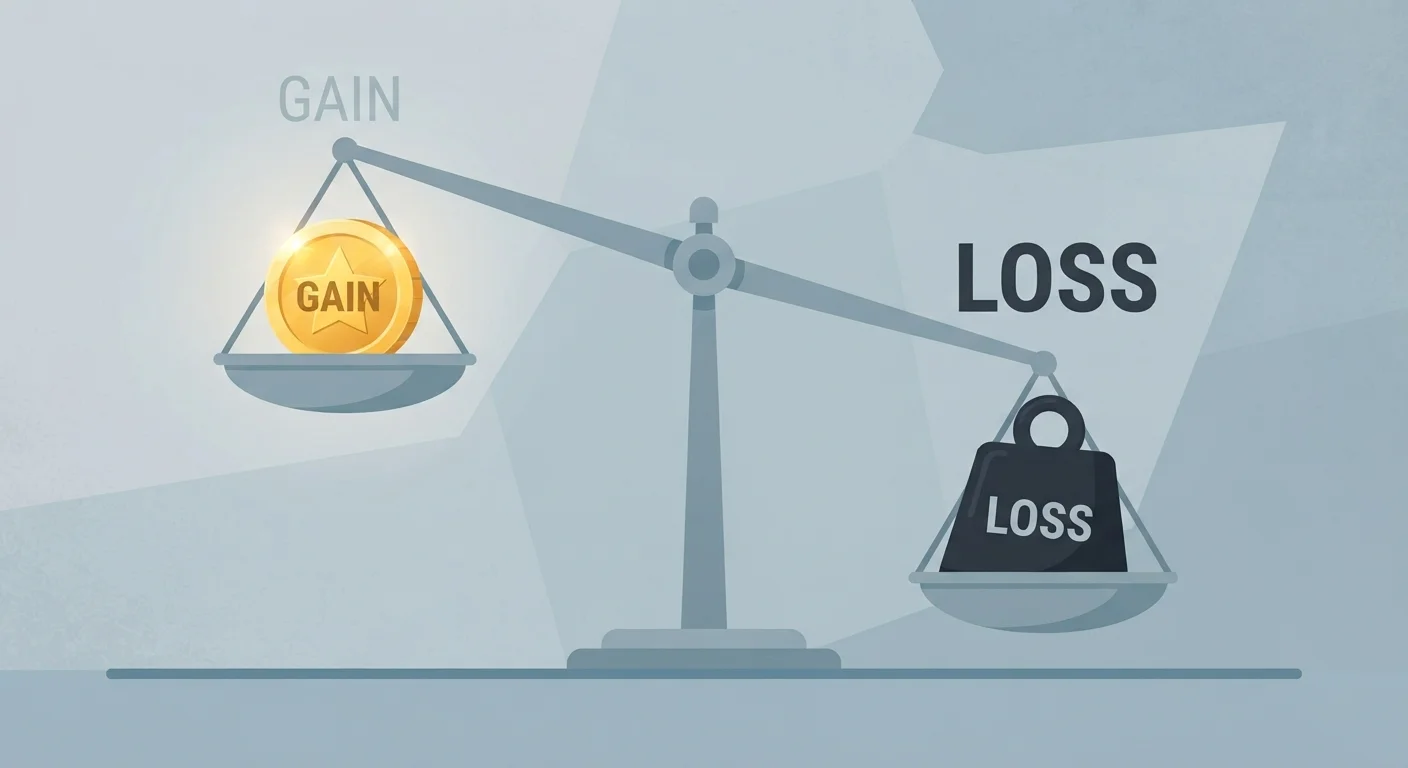
Why Losses Hit Harder Than Gains
Imagine you find $50 on the sidewalk. Now imagine you lose $50 from your wallet. Most people report that the second scenario feels significantly worse — even though the dollar amount is identical. That's loss aversion in action.
This isn't a quirk or a character flaw. It's a deeply embedded feature of human cognition. Kahneman and Tversky's Prospect Theory demonstrated that losses and gains are not processed symmetrically. Our brains weight potential losses far more heavily than equivalent gains, which means financial decisions made under this influence are systematically skewed toward avoiding loss — even when that avoidance costs us.
Understanding this pattern matters because it shows up constantly in everyday money decisions, often without us noticing. It's part of a broader set of cognitive tendencies covered in cognitive biases that shape financial judgment.
~2:1
Loss-to-gain emotional sensitivity ratio
Kahneman and Tversky's foundational research estimated that losses feel approximately twice as painful as equivalent gains feel rewarding — a finding replicated across numerous studies.
66%
Investors exhibiting disposition effect
A frequently cited analysis of trading accounts found that a majority of individual investors systematically held losing positions longer than winning ones, consistent with loss aversion.
$1.3T+
Left in low-yield savings accounts (U.S.)
Federal Reserve data has documented hundreds of billions sitting in near-zero-yield accounts, partly because the friction of switching feels riskier than the cost of staying — a loss aversion dynamic.
How Loss Aversion Shows Up in Real Financial Decisions
Loss aversion rarely announces itself. It operates quietly in the background of choices that feel perfectly reasonable in the moment.
Holding losing investments: One of the most studied effects is the "disposition effect" — investors' tendency to sell winning stocks too early and hold losing stocks too long. Selling a loser means admitting a loss; holding it keeps the loss theoretical. The result is often a worse return than a more dispassionate strategy would produce.
Avoiding beneficial changes: Many people stick with a suboptimal savings account, insurance plan, or employer benefit because switching feels risky — even when the numbers clearly favor making the move. The potential downside of change feels more real than the upside.
Over-insuring against small risks: Loss aversion can push people toward extended warranties, excessive coverage, or paying premiums for risks they could comfortably self-insure. The desire to avoid any loss, even a minor one, sometimes costs more than the loss itself would have.
These patterns connect to financial behaviors that quietly hold people back — many of which have loss aversion at their root.
The Connection to Budget Failures and Scarcity Thinking
Loss aversion also helps explain why budgets so often fail. When people view a budget as a series of restrictions — things they might "lose" — every spending limit feels like a sacrifice rather than a choice. That framing triggers resistance. Reframing a budget as directing money toward things that matter tends to work better, because it shifts focus from loss to allocation.
There's also a meaningful overlap with scarcity thinking. When someone feels financially precarious, their sensitivity to potential losses intensifies. Small setbacks feel catastrophic, which can lead to overly conservative decisions or — paradoxically — impulsive ones designed to avoid an anticipated loss. The difference between scarcity and abundance mindsets often determines how strongly loss aversion influences someone's day-to-day choices.
For a deeper look at the psychology behind budget resistance, see the behavioral science behind why budgets fail.
Working With Loss Aversion Instead of Against It
You can't simply decide to stop feeling loss aversion — but you can build systems and habits that reduce its influence on your decisions.
Automate what you can. Automatic contributions to retirement accounts, automatic savings transfers, and automatic bill payments eliminate the repeated moment of choice where loss aversion strikes hardest. When the decision is made once and then runs in the background, you sidestep the emotional friction each time.
Reframe the question. Instead of asking "what could I lose?" try asking "what is staying put actually costing me?" Inaction has a cost too — it's just less visible. Making that cost concrete often shifts the calculation.
Review less frequently. Checking an investment account daily guarantees you'll see more losses — because markets fluctuate constantly. Research consistently shows that investors who review portfolios less frequently make calmer, less reactive decisions.
Use pre-commitment. Setting rules for yourself in advance — "I will not sell if the market drops more than X%" — removes the decision from the emotional heat of the moment.
It's also worth examining whether your broader money beliefs are amplifying loss aversion. Separating money mindset myths from research can help you identify which beliefs are grounded in evidence and which are making the bias worse.
Try a "Cost of Inaction" Audit
Loss aversion makes the risks of acting feel vivid while the costs of doing nothing stay invisible. Once a year, list two or three financial decisions you've been avoiding — switching accounts, increasing retirement contributions, revisiting insurance coverage — and write down what staying put is actually costing you in concrete terms. Seeing inaction as a choice with a price tag often changes the calculation.
This article is for general informational and educational purposes only and does not constitute personalized financial advice. Consult a qualified financial professional for guidance specific to your situation.
Frequently Asked Questions
They overlap but aren't identical. Risk aversion is a general preference for certainty over uncertainty. Loss aversion specifically refers to the asymmetric emotional weight placed on losses versus equivalent gains. You can be moderately risk-tolerant and still be strongly loss-averse.
Research suggests loss aversion is widespread across cultures, but the intensity varies by individual, experience, and context. People who have experienced significant financial hardship may exhibit stronger loss aversion, while those with more financial security sometimes show less. It's a tendency, not a fixed rule.
It often causes investors to sell profitable positions too quickly to "lock in" a gain, while holding onto losing investments far longer than is rational — hoping to avoid realizing a loss. This pattern, called the disposition effect, can meaningfully reduce long-term portfolio returns.
In some contexts, yes. It can prevent reckless financial decisions or encourage people to protect what they've built. The problem arises when it consistently leads to paralysis, excessive caution, or holding onto bad financial positions out of fear of acknowledging a loss.
Automating financial decisions — like automatic retirement contributions or automatic transfers to savings — removes the repeated moment of choice where loss aversion strikes. Focusing on long-term goals rather than short-term account fluctuations also helps reduce its emotional pull.
The content on this site is for informational purposes only and is not a substitute for professional advice. Always consult a qualified professional for guidance specific to your situation.