

Start here
Why Personal Finance Feels Complicated (And Why It Doesn't Have to Be)
Next
Your First Financial Foundation: Know What You Have
Then
Budgeting Basics: Giving Your Money a Direction
Key challenge
Saving and Debt: Handling Both at the Same Time
Final step
Building Habits That Actually Stick
Why Personal Finance Feels Complicated (And Why It Doesn't Have to Be)
Most people don't grow up learning how to manage money in any structured way. School rarely covers it, families don't always talk about it openly, and the financial industry sometimes makes things sound more complex than they need to be. If you're starting from scratch, that's not a personal failure — it's an incredibly common starting point.
The good news: the core ideas behind sound personal finance are straightforward. You don't need an accounting background or a high income to get started. What helps most is understanding your own relationship with money before diving into tactics. How you think and feel about money shapes your habits more than any spreadsheet or app will.
This guide focuses on the practical foundation — what to look at first, how to build a simple structure, and how to handle the real tension most Americans face: wanting to save while also carrying debt.
Take-home pay
The amount of money you actually receive after taxes and other deductions are taken out of your paycheck. This is the figure to base your budget on, not your gross salary.
Emergency fund
A dedicated pool of savings set aside only for unexpected, necessary expenses — like a medical bill or car repair. It exists to prevent you from going into debt when the unexpected happens.
High-interest debt
Money owed on accounts with a high annual percentage rate (APR), most commonly credit cards. The higher the rate, the faster the balance grows if not paid down.
Budget
A written or tracked plan that assigns your income to specific categories — needs, wants, savings, debt — before you spend it. It's a tool for intention, not restriction.
Net worth
The difference between what you own (assets like savings or a car) and what you owe (liabilities like loans or credit card balances). Tracking it over time shows whether you're moving forward financially.
Your First Financial Foundation: Know What You Have
Before you make any plan, you need accurate information. That means knowing two things: your monthly income after taxes, and your actual monthly expenses. Many people underestimate their spending — especially on small, recurring purchases — until they write everything down.
Start with one month. Pull together your pay stubs or direct deposit records, then go through your bank and credit card statements line by line. Group spending into categories: housing, food, transportation, utilities, debt payments, and everything else. Don't filter or judge yet — just observe.
This exercise often surfaces a few surprises: subscriptions you forgot about, variable costs you hadn't accounted for, or a gap between what you thought you spent and what the numbers show. That gap is exactly the kind of information you need. The right budgeting approach always starts with reality, not assumptions.
One Month Is Enough to Start
You don't need a year of data to get a useful picture of your spending. One full month of statements is enough to identify patterns and set a realistic baseline. The goal is to get started, not to get it perfect before you begin.
Budgeting Basics: Giving Your Money a Direction
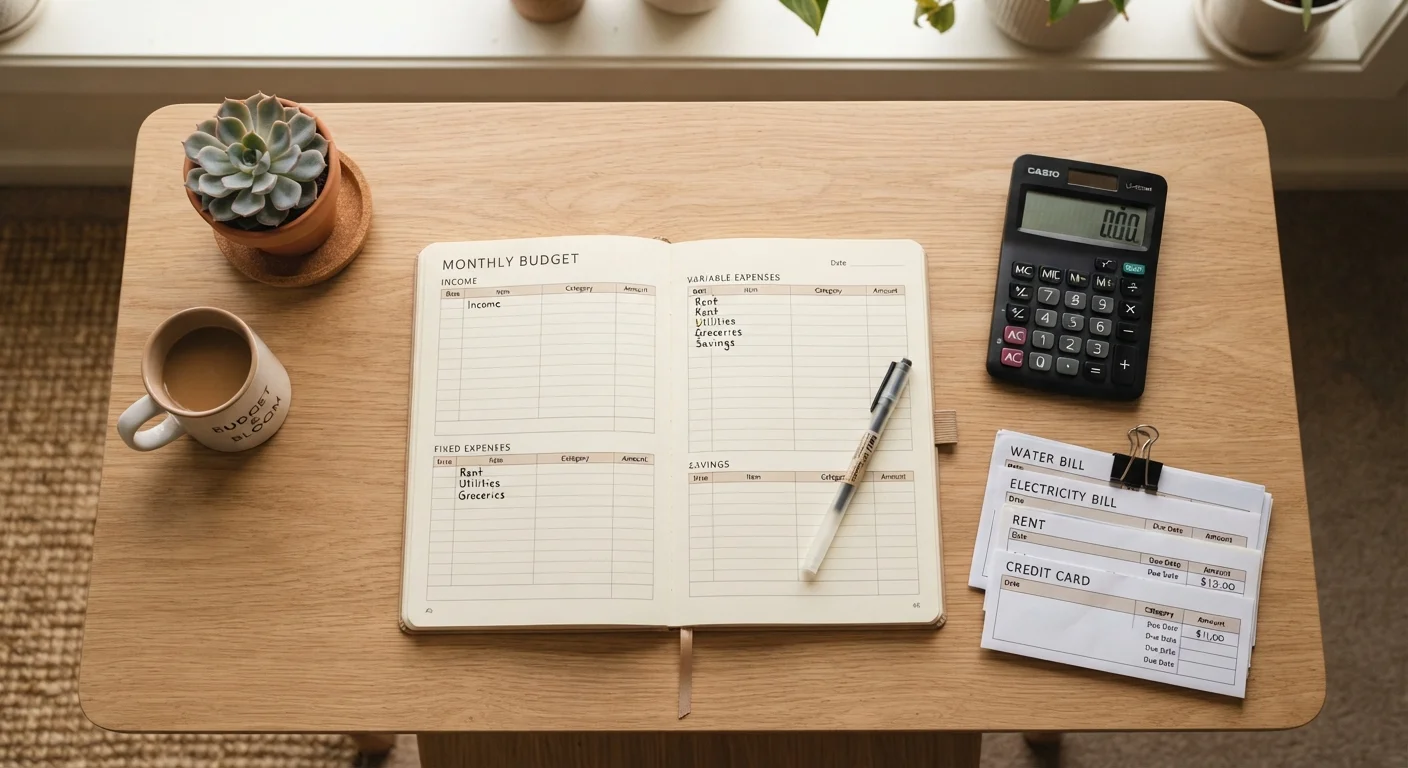
A budget is simply a plan for where your money will go before the month begins — rather than wondering where it went afterward. It doesn't have to be rigid or complicated. The goal is awareness and intention, not perfection.
One widely referenced framework divides take-home pay into three broad categories: roughly 50% toward needs (housing, food, utilities, transportation), 30% toward wants (dining out, entertainment, personal spending), and 20% toward savings and debt repayment. This is sometimes called the 50/30/20 rule. It's a general starting point, not a strict rule — your situation may require different proportions, especially if debt payments or housing costs are high.
What matters most is that your plan is realistic. A budget you can't sustain won't help. If you're ready to build one from scratch, a step-by-step first budget can walk you through the process in plain language.
Saving and Debt: Handling Both at the Same Time
This is the question that trips up most beginners: if I have debt, should I be saving anything at all? The answer, for most people, is yes — but with priorities.
High-interest debt, like credit card balances, costs more to carry than most savings accounts earn. Mathematically, paying it down aggressively makes sense. But if you put every extra dollar toward debt and have no savings cushion, any unexpected expense — a car repair, a medical copay — forces you back into debt. That cycle is frustrating and common.
A practical approach: build a small starter emergency fund first (many financial educators suggest $500 to $1,000), then shift focus toward high-interest debt while continuing to add to savings incrementally. Once high-interest debt is cleared, you can accelerate savings toward larger goals. For a deeper look at managing both sides simultaneously, a comprehensive guide to saving and debt repayment covers the trade-offs in detail.
Watch Out for the 'All or Nothing' Trap
A common mistake is abandoning a financial plan after one bad month. Missing a savings target or overspending in a category doesn't erase your progress — it's a normal part of the process. Adjust and continue rather than restarting from scratch or giving up entirely.
Building Habits That Actually Stick
Financial habits work a lot like other habits: small, repeated actions build into lasting change. Trying to overhaul everything at once usually leads to burnout. Instead, pick one or two concrete steps to start with — reviewing spending weekly, automating a small savings transfer, or setting up a simple tracking system.
Automation helps significantly. When savings transfers or extra debt payments happen automatically after your paycheck lands, you remove the need for willpower every month. Over time, you stop noticing the money is gone, and the progress accumulates quietly.
Progress also looks different at different income levels. If money is tight, a small consistent saving habit still matters — it builds both a financial buffer and a sense of agency over your finances. These same principles apply whether you're planning a vacation or just trying to keep the lights on. The discipline of intentional spending, for instance, is just as useful when traveling on a budget as it is at home.
This article is for general informational and educational purposes only. It is not personalized financial, tax, or investment advice. For guidance specific to your situation, consider consulting a licensed financial professional.
Frequently Asked Questions
Start by tracking what comes in and what goes out each month. Before you can budget or save effectively, you need an accurate picture of your actual income and spending. Once you know the numbers, every other decision becomes clearer.
For most people, the answer is both — in a balanced way. A small emergency fund (even $500–$1,000) prevents new debt when unexpected costs hit. After that, directing extra dollars toward high-interest debt typically saves more money than most savings accounts can earn.
There's no universal number. The goal is consistency over size — even saving $25 a month builds the habit and grows over time. Many financial educators reference a 50/30/20 framework as a starting point, though your situation may call for different proportions.
An emergency fund is money set aside specifically for unplanned expenses like a medical bill, car repair, or job disruption. Without one, unexpected costs often end up on a credit card, adding to debt. A common starting target is three to six months of essential expenses.
Yes, though it requires different trade-offs. The core principles — knowing your numbers, spending intentionally, and building savings gradually — apply regardless of income. Progress may be slower, but even small, consistent actions compound meaningfully over time.
They're essentially the same concept, just framed differently. A budget is a plan for how you'll allocate your income across expenses, savings, and debt repayment. Some people prefer the term 'spending plan' because it feels less restrictive and more proactive.
The content on this site is for informational purposes only and is not a substitute for professional advice. Always consult a qualified professional for guidance specific to your situation.