

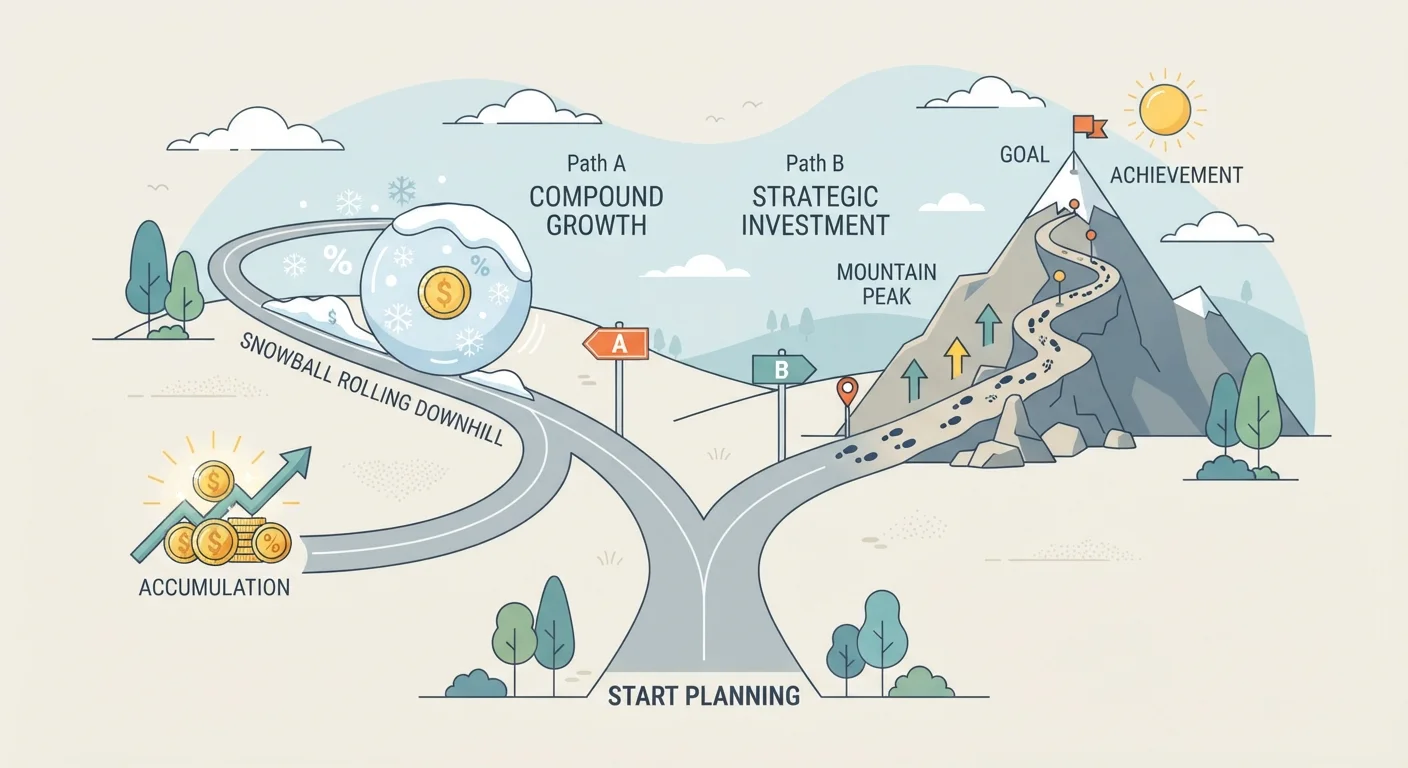
Option A
Debt Avalanche
The mathematically optimal approach to eliminating debt.
Best for: People who are motivated by long-term savings and can stay disciplined without frequent early wins.
Option B
Debt Snowball
The psychology-first method built on momentum and quick wins.
Best for: People who need visible progress to stay motivated and have multiple smaller debts to knock out.
How Each Method Works
Both strategies share the same core mechanic: you make minimum payments on all your debts, then direct any extra money toward one specific debt. The difference is which debt gets that extra payment.
Debt Avalanche: You rank your debts by interest rate and focus all extra payments on the one with the highest rate first. Once that's paid off, you roll that payment amount to the next highest-rate debt, and so on. Because interest is what makes debt grow, eliminating the most expensive debt first limits how much you ultimately pay.
Debt Snowball: You rank debts by balance — smallest to largest — regardless of interest rate. Extra payments go toward the smallest balance first. When it's gone, you add that freed-up payment to what you're putting toward the next-smallest debt. Each payoff feels like a clear win, which can help sustain effort over a multi-year repayment journey.
For a side-by-side look at the key differences, see the comparison table below.
| Criterion | Debt Avalanche | Debt Snowball |
|---|---|---|
| Payoff order | Highest interest rate first | Smallest balance first |
| Total interest paid | Lower overall | Potentially higher |
| Time to first payoff | Longer (if highest-rate debt is large) | Faster (small balances clear quickly) |
| Psychological reward | Delayed — felt over months or years | Quick — each cleared account is a win |
| Best motivational fit | Data-driven, long-term thinkers | Habit-builders needing visible progress |
| Complexity | Requires tracking APRs | Simple — sort by balance amount |
It's worth noting that neither method requires a large amount of extra money to be effective. Even an additional $25–$50 per month applied consistently to a targeted debt accelerates payoff. The strategy matters, but consistency matters more. For a broader look at how debt repayment fits alongside other financial goals, the comprehensive guide to saving and debt repayment covers the full picture.
The Real-World Trade-Off: Math vs. Motivation
On paper, the avalanche wins every time. When you carry high-interest debt — credit cards routinely charge 20% APR or higher — every dollar of interest you avoid is a dollar that stays in your pocket. Prioritizing those balances first is simply more efficient.
But personal finance research has repeatedly shown that behavior is the weak link in most debt payoff plans, not math. A study published in the Journal of Marketing Research found that consumers who focused on eliminating individual accounts — rather than reducing overall balances — paid off debt faster in practice. The psychological reward of a closed account appears to sustain motivation in ways that an interest calculation does not.
20%+
Average credit card APR in recent years
Federal Reserve data shows average credit card interest rates have exceeded 20% APR, making high-rate debt especially costly to carry.
77%
Americans carrying some form of debt
According to Experian's consumer credit research, the vast majority of U.S. adults are managing at least one form of debt at any given time.
This doesn't mean the snowball is the smarter choice for everyone. If you're the kind of person who can look at a spreadsheet showing $800 saved in interest and feel genuinely motivated by that number, the avalanche is straightforward and effective. If you've started debt payoff plans before and lost steam after a few months, the snowball's early wins may be worth the additional interest cost.
One practical middle ground: if your highest-interest debt happens to also be your smallest balance, both methods converge on the same target. Start there and you lose nothing by picking either label.
If you're also trying to save while paying down debt — a genuinely common situation — see how to balance saving and debt repayment for a realistic framework that doesn't force you to choose one over the other entirely. And if your debt is starting to feel unmanageable, it's worth reading about early warning signs that debt is outpacing your repayment ability before picking a strategy.
This article is for general informational and educational purposes only and does not constitute personalized financial or legal advice. Consider speaking with a licensed financial professional about your specific situation.
The content on this site is for informational purposes only and is not a substitute for professional advice. Always consult a qualified professional for guidance specific to your situation.