

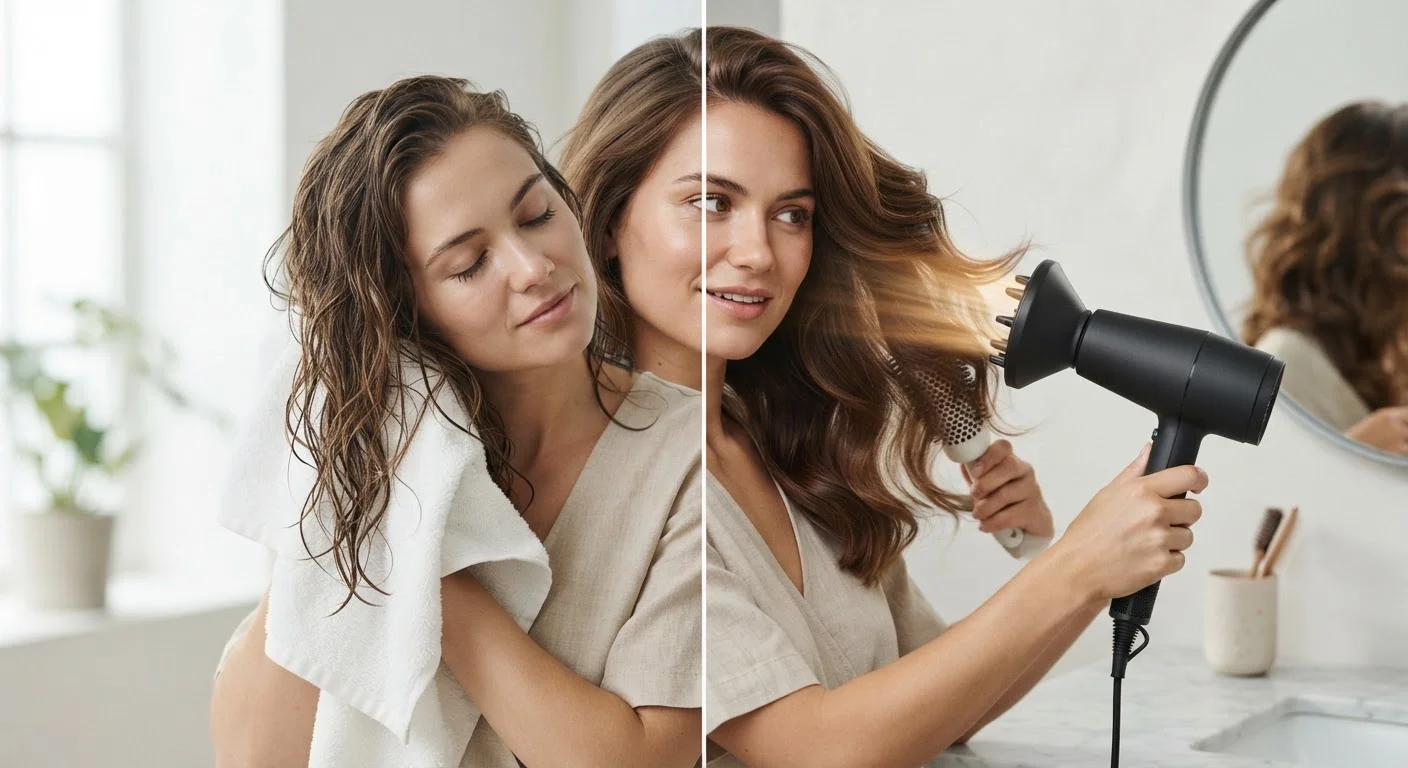
Option A
Air Drying
The low-effort, heat-free default.
Best for: People with low-porosity or fragile hair who want to minimize heat exposure and tool dependency.
Option B
Blow Drying
The controlled, faster-finish option.
Best for: People who need quick results, style definition, or have hair that stays wet for extended periods.
Why the "Air Drying Is Always Better" Assumption Deserves a Closer Look
Most people assume skipping the blow dryer is the automatically safer choice — and it's easy to see why. Heat equals damage, and no heat means no damage. But hair science complicates that tidy logic in a few important ways.
Hair is made primarily of keratin, a protein structure that is highly vulnerable to mechanical stress when wet. When water enters the hair shaft, it swells the cortex (the inner protein layer), temporarily disrupting the hydrogen bonds that give hair its structure. In this swollen, elastic state, hair stretches more easily and breaks more readily under friction and tension.
A study published in the Annals of Dermatology found that while blow drying does cause surface damage to the cuticle (the outermost protective layer), air drying for prolonged periods caused greater damage to the cortex — the part of the hair that determines strength and elasticity. The takeaway isn't that blow drying wins, but that both methods carry real trade-offs, and neither is universally superior.
Hair Is Most Fragile When Wet
Regardless of which drying method you use, the highest-risk moments for breakage occur during the wet phase. Avoid tight hair ties, aggressive towel rubbing, and fine-tooth combing on soaking wet hair. A wide-tooth comb or fingers on hair that's been gently blotted with a microfiber towel is a lower-risk approach before any drying begins.
For a deeper look at protecting hair during heat styling, see our guide to heat styling without the damage.
What Heat Actually Does to Hair — and When It Becomes a Problem
Blow drying causes damage primarily through two mechanisms: direct thermal degradation of the protein structure and moisture loss that leaves hair brittle. The severity depends heavily on temperature, distance from the scalp, and how long any one section is exposed to airflow.
Research generally identifies temperatures above 230°F (110°C) as the threshold where significant cuticle damage occurs. Many standard dryers set to high heat exceed this, particularly when held close to the hair. However, using a dryer on medium heat at a distance of 6 inches or more — and keeping the nozzle moving — substantially reduces surface damage.
| Criterion | Air Drying | Blow Drying |
|---|---|---|
| Surface (cuticle) damage | Lower risk | Higher risk at high heat |
| Inner cortex stress | Higher with prolonged wetness | Lower — reduces wet time |
| Scalp moisture risk | Higher for thick/dense hair | Lower — dries scalp faster |
| Mechanical breakage risk | Higher if manipulated while wet | Depends on technique |
| Time required | 30 min to 3+ hours | 10–20 minutes typically |
| Tool dependency | None | Requires a dryer |
| Best technique add-on | Microfiber towel, no rubbing | Heat protectant, medium heat |
This is why technique matters far more than simply choosing to use a dryer or not. A careless air-drying routine (rough towel rubbing, tight elastic during the wet phase, sleeping on wet hair against a cotton pillowcase) can cause more cumulative breakage than a careful blow-dry at moderate heat.
For those committed to heat tools, evidence-backed prep steps — such as applying a heat protectant before blow drying — measurably reduce surface temperature exposure on the hair shaft.
The Scalp Factor: An Overlooked Variable
Most discussions focus on the hair strand itself, but the scalp deserves equal attention. Extended damp periods at the scalp create a warm, moist environment that can encourage the overgrowth of Malassezia, a naturally occurring scalp fungus associated with dandruff and seborrheic dermatitis.
This doesn't mean a single slow-drying session is harmful — but people who regularly air dry thick hair and find their scalp stays wet for two or more hours may want to at least partially blow dry the roots. Scalp health has a real bearing on hair growth and density, making it worth factoring into your drying routine.
230°F
Temperature threshold for significant cuticle damage
Research on thermal hair damage generally identifies this as the point where protein degradation becomes meaningful, making tool temperature settings a key variable.
6+ inches
Recommended dryer distance from hair
Maintaining at least six inches between nozzle and hair, combined with constant movement, substantially reduces surface heat exposure during blow drying.
The practical middle ground that many dermatologists informally describe: let hair air dry to about 70–80% dryness, then use a blow dryer on low or medium heat to finish. This limits heat exposure while also reducing the total damp time that stresses the cortex and scalp.
This article is for general informational purposes only and does not constitute medical or dermatological advice. Consult a qualified healthcare professional for concerns about scalp conditions or hair loss.
The content on this site is for informational purposes only and is not a substitute for professional advice. Always consult a qualified professional for guidance specific to your situation.