

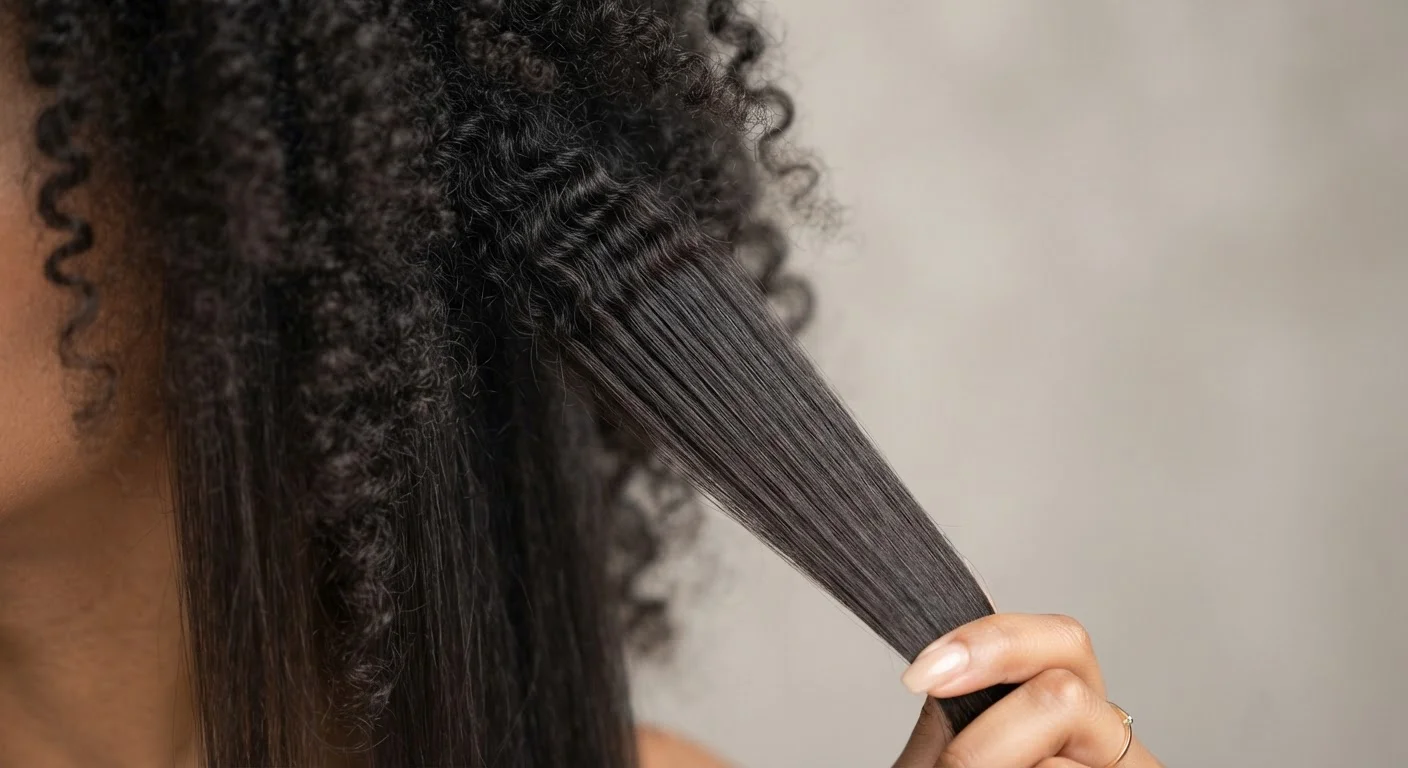
How Chemical Straightening Actually Works
Every curl, coil, or wave in your hair exists because of disulfide bonds — chemical links within the keratin protein structure of each strand. Chemical straightening treatments work by breaking those bonds, allowing the hair to be physically straightened, and then reforming them in a new, elongated configuration.
This is a permanent change to the hair that has been treated. New growth will emerge with its natural texture, but chemically processed sections do not revert to curly on their own. Understanding this irreversibility is the single most important concept before you commit to any straightening service.
The active ingredients responsible vary by formula — sodium hydroxide (commonly called lye) in traditional relaxers, guanidine compounds in no-lye options, and aldehyde or aldehyde-alternative compounds in many keratin-based treatments. Each interacts with your hair's structure differently, which is why not every treatment suits every hair type or condition.
Types of Chemical Straightening Treatments
Knowing the distinctions between treatment types helps you have a more productive conversation with a stylist.
- Lye relaxers (sodium hydroxide): Work quickly and effectively on coarser textures. They have a high pH — typically above 12 — and require careful timing to avoid scalp burns or excessive breakage. They generally leave hair softer and shinier than no-lye options.
- No-lye relaxers (calcium hydroxide or guanidine): Often marketed as gentler, but they can cause more mineral buildup in the hair shaft over time. They still carry significant chemical risk and are not a "safe" alternative — just a different chemical profile.
- Keratin treatments (Brazilian blowout and similar): These temporarily smooth and reduce frizz by coating the hair with keratin protein, sealed with heat. They are not true relaxers — results typically last two to five months. Some formulations historically contained formaldehyde or formaldehyde-releasing compounds; always ask a stylist about the specific formula being used.
- Thio-based straighteners (ammonium thioglycolate): Common in "Japanese straightening" or thermal reconditioning services. They chemically relax the bonds and then use heat to reset them straight. Results are very long-lasting, but the process is time-intensive and costly.
Ask for a Strand Test First
Before any full chemical service, ask your stylist to perform a strand test on a small, inconspicuous section of hair. This step previews how your hair will respond to the formula and timing — catching potential problems before they affect your entire head.
Real Risks You Should Weigh Before Committing
Chemical straightening involves genuine trade-offs. Being informed doesn't mean being scared — it means making a decision that's right for your hair and health.
Emerging Research on Relaxer Ingredients
Some scientific studies have begun examining potential links between certain chemicals found in some hair relaxer formulations and health outcomes. This research is ongoing and not yet definitive. If you have concerns, discuss them with your healthcare provider before proceeding with any chemical hair service. Staying informed is a reasonable step — avoiding decisions based on incomplete headlines is equally important.
- Scalp irritation and chemical burns: High-pH chemicals can cause burns if left on too long, applied to a sensitized scalp, or used on skin with existing abrasions. This is one reason stylists advise against scratching your scalp in the days before a relaxer service.
- Structural damage and breakage: Overlapping chemical applications onto already-processed hair is a leading cause of breakage. The line between new growth and relaxed hair — called the line of demarcation — is a fragile point prone to snapping.
- Scalp and systemic health considerations: Emerging research has raised questions about certain chemicals used in some relaxer formulations and their potential long-term health implications. This is an evolving area of scientific study; speak with your healthcare provider if you have specific concerns.
- Loss of natural texture: Because the change is permanent in treated hair, transitioning back to natural texture requires growing out the chemically treated sections — a process that can take a year or more.
For readers who use heat tools alongside chemical services, our guide on heat styling without damage covers the protective steps that matter most for already-processed hair.
Who Is (and Isn't) a Good Candidate
Not everyone is well-suited for chemical straightening at a given time. A licensed cosmetologist should perform a strand test and scalp assessment before any service.
12+
pH level of lye-based relaxers
For reference, baking soda sits around pH 9 — illustrating how caustic these formulas are and why timing and technique matter so much.
2–5 months
Typical duration of keratin treatment results
Unlike permanent relaxers, keratin treatments gradually wash out, meaning results vary significantly based on how often hair is washed and what shampoo is used.
Generally better candidates: Adults with healthy scalps and no active irritation, those whose hair has not been significantly color-treated or chemically processed in the past six to twelve months, and people who understand and accept the maintenance commitment involved.
Situations that warrant extra caution or waiting: Active scalp conditions (psoriasis, seborrheic dermatitis, open sores), highly porous or previously damaged hair, pregnancy (consult your OB-GYN before any chemical service), and hair that has been heavily bleached or highlighted.
Children's scalps are more sensitive than adults' — professional guidelines from cosmetology associations generally recommend against relaxers for young children, and many stylists decline to perform them on children under a certain age.
Maintenance, Upkeep, and Long-Term Hair Health
The work doesn't end when you leave the salon. Chemically straightened hair requires consistent care to stay healthy and manageable.
- Deep conditioning regularly: Chemical processing strips moisture. A weekly or biweekly deep conditioning treatment helps restore hydration and elasticity.
- Protein-moisture balance: Relaxed hair still needs protein treatments periodically, but over-doing protein on already brittle hair can backfire. Learning to read your hair's signals — or asking a stylist — helps you calibrate.
- Sulfate-free cleansing: Many stylists recommend sulfate-free shampoos for chemically treated hair, as sulfates can strip moisture more aggressively. Our overview of going sulfate-free explains what to realistically expect from the switch.
- Protecting the line of demarcation: Handle the junction between new growth and relaxed hair gently — this is the weakest point and most prone to breakage during styling and detangling.
- Regular trims: Trimming helps remove split ends before they travel up the shaft. If you're considering managing this between salon visits, our guide on trimming your own hair at home outlines when it's practical and when it isn't.
For a broader framework that fits relaxed hair into a sustainable daily routine, see building a low-maintenance hair routine from scratch.
Schedule your relaxer application at least two weeks after any color service — layering chemicals too close together is the fastest route to breakage, even on hair that looks healthy.
The cuticle is still recovering after color processing, and adding a high-pH relaxer to recently colored hair dramatically increases the risk of structural damage at the strand level.
Apply a thin layer of petroleum jelly or a scalp-protecting base around your hairline and ears before any relaxer application — this is standard professional practice that significantly reduces skin irritation.
High-pH chemicals can cause chemical burns on skin within minutes of contact; a protective barrier slows absorption and gives you a safer window during the application process.
Questions to Ask Before Your Appointment
Walking into a consultation prepared puts you in control of the outcome. Here are the key questions to raise with any stylist before a chemical service:
- What specific formula do you use, and what are its active ingredients?
- Will you perform a strand test and scalp assessment before proceeding?
- What is your process for timing and rinsing to minimize scalp exposure?
- How long has it been since my last chemical service, and is my hair ready?
- What aftercare products and routine do you recommend for my specific hair type?
- What signs should I watch for that would indicate a problem after the service?
A qualified, experienced stylist will welcome these questions. If any professional discourages you from asking or rushes through the consultation, treat that as a warning sign.
This article is for general informational purposes only and is not a substitute for advice from a licensed cosmetologist or healthcare professional. Individuals with scalp conditions, health concerns, or special circumstances — including pregnancy — should consult appropriate professionals before undergoing any chemical hair service.
The content on this site is for informational purposes only and is not a substitute for professional advice. Always consult a qualified professional for guidance specific to your situation.