

Start here
Start With Your Life, Not a Shopping List
Next
The Core Concept: A Wardrobe Built Around Versatility
Then
What Actually Goes Into a Starter Wardrobe
When you're ready
How to Shop Without Overbuying
Finally
Building Confidence Through Getting Dressed
Start With Your Life, Not a Shopping List
The most common wardrobe mistake isn't buying the wrong clothes — it's buying clothes for a life you don't actually live. Before you open a browser or walk into a store, spend a few minutes mapping out your real daily routine.
Ask yourself: Where do I go most days? What do I do on weekends? How often do I attend formal events versus casual ones? Do I work from home, commute to an office, work physically outdoors? Your answers shape everything that follows, because a wardrobe is only functional when it reflects your actual context — not an aspirational version of it.
This step also prevents over-buying. When your purchases are anchored in real need, you stop accumulating items for hypothetical occasions. If you're simultaneously trying to get your living space under control, the same principle applies: our guide on starting from scratch with home organization covers how to approach any fresh start systematically.
The Core Concept: A Wardrobe Built Around Versatility
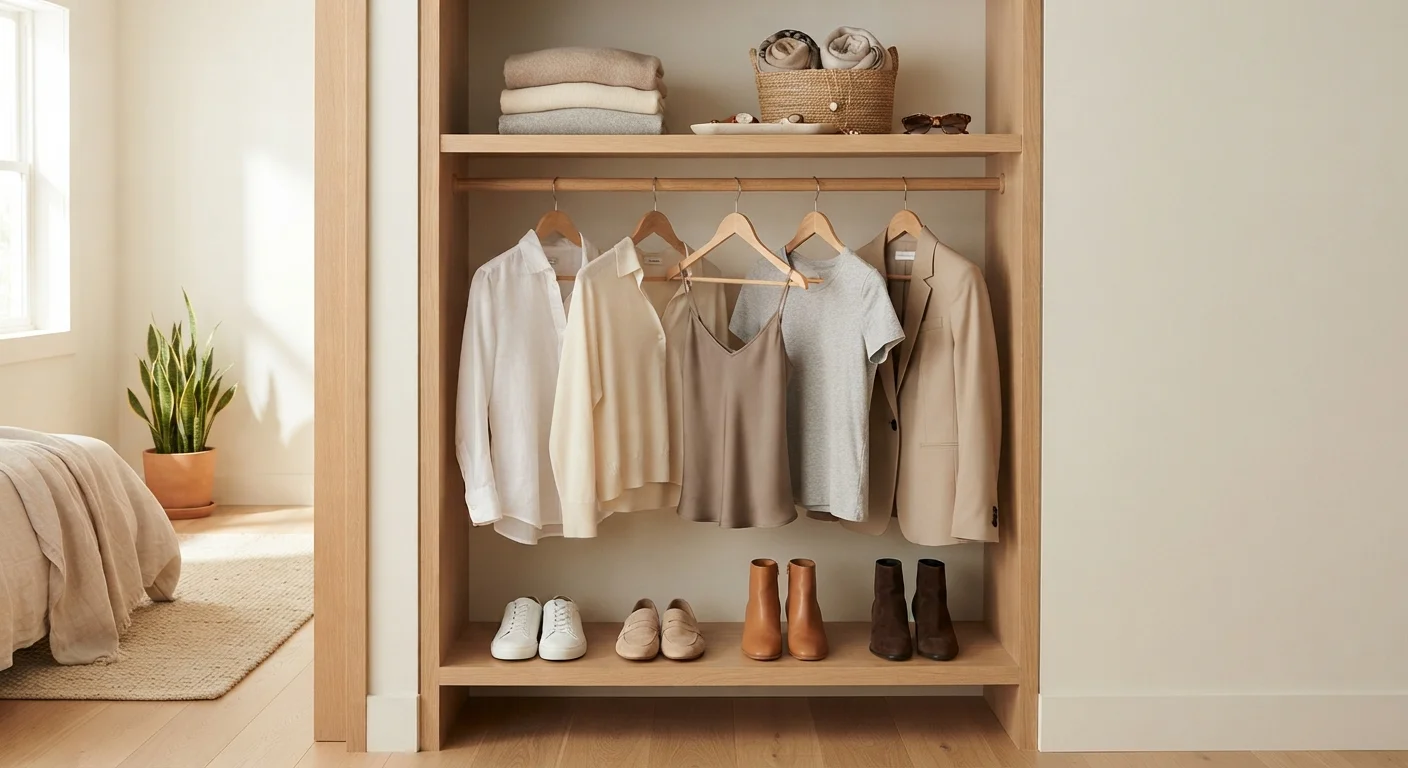
Versatility is the single most useful word in wardrobe-building. A versatile piece works across multiple contexts — it can dress up or down, pair with at least three other items, and holds up across seasons. When every piece in your closet meets this standard, getting dressed becomes easier, not harder.
Capsule wardrobe
A small, intentionally curated collection of clothing pieces chosen to mix and match easily, reducing decision fatigue while covering most everyday needs.
Versatile piece
A clothing item that works in multiple contexts and pairs naturally with several other items in your wardrobe, giving you more outfit combinations per item.
Wardrobe audit
A systematic review of everything you currently own, used to identify what you actually wear, what doesn't fit or work, and what genuine gaps exist.
Foundation pieces
Basic, often neutral clothing items — like plain tees, well-fitting jeans, or a simple jacket — that form the reliable base every outfit builds from.
Cost-per-wear
A way of thinking about clothing value by dividing the item's price by how many times you'll realistically wear it. A $60 item worn 60 times costs $1 per wear — often better value than a $15 item worn twice.
The practical goal is maximizing combinations, not maximizing pieces. Fifteen items that all work together will produce more distinct outfits than forty items that clash. Think of it like building with interlocking blocks rather than collecting random objects.
Neutral tones — cream, white, navy, grey, black, tan — form the most reliable foundation because they pair with almost anything. From there, one or two colors or patterns you genuinely love can be layered in without disrupting the system. Don't let anyone tell you neutrals are boring; they're the structure that makes everything else work.
What Actually Goes Into a Starter Wardrobe
Rather than an exhaustive list, think in categories that cover your daily needs. A functional starter wardrobe typically includes:
- Tops: A mix of crew-neck or V-neck tees, a button-down or blouse, and one or two layering pieces like a lightweight cardigan or jacket.
- Bottoms: Well-fitting jeans or trousers in a neutral tone, plus one pair of more polished pants or a skirt depending on your lifestyle.
- Shoes: A comfortable everyday shoe, one pair suitable for more formal settings, and one casual or athletic option.
- Outerwear: One weather-appropriate coat or jacket that works over most of your outfits.
- Undergarments and basics: These carry every outfit and are frequently overlooked — they deserve attention. Our piece on pieces people overlook in a functional wardrobe goes deeper here.
Fit matters more than any other single factor. A well-fitting basic will always look more intentional than an ill-fitting statement piece. Before adding anything new, try it on and assess honestly.
Fit Is the First Filter
Before evaluating color, style, or price, ask whether the item actually fits your body as it is today — not as you hope it will be. Clothes that fit well look polished regardless of how simple they are. If something needs significant tailoring to work, factor that into your decision.
How to Shop Without Overbuying
Most people walk away from a shopping trip with things they didn't plan to buy and walk past things they actually needed. Shopping with intention changes that dynamic.
Before anything else, do a quick audit of what you already own. You may already have more than you think. Taking stock of what you own before spending anything is the single most useful step a beginner can take. Similarly, shopping your own closet can reveal outfit combinations you've never tried.
When you do shop:
- Bring a short, specific list of category gaps — not a wish list of aesthetics.
- Ask yourself whether each potential purchase works with at least three things you already own.
- Prioritize fabric quality over decoration; a well-constructed plain piece outlasts a poorly made trendy one.
- Give yourself a pause period on non-essential purchases. Impulse hesitation is a skill, not indecisiveness.
Avoid the 'Complete Look' Trap
Retailers often display items styled as complete outfits to encourage buying everything at once. Resist the pull to replicate a full display — most of those supporting pieces already exist in some form in your closet. Building a wardrobe one intentional piece at a time produces more lasting results than a single large haul.
Building Confidence Through Getting Dressed
A wardrobe isn't finished the moment you acquire the pieces — it takes shape over time as you actually wear things. The goal isn't perfection; it's a system that makes daily decisions easier and leaves you feeling like yourself.
Experiment deliberately. Try combinations you wouldn't normally reach for. Notice what makes you feel capable and put-together versus what you keep skipping. That pattern is your personal style developing in real time.
The physical and mental organization of your wardrobe also matters. When clothes are visible, accessible, and stored in a way that makes sense to you, you'll use them more fully. If your broader living space feels chaotic, it affects how you interact with your wardrobe too — decluttering a room when you don't know where to start offers a transferable framework for that kind of reset.
Style is a practice, not a destination. Building a wardrobe from scratch is one of the few areas of life where slow and deliberate consistently outperforms fast and ambitious.
Frequently Asked Questions
There's no universal number, but most style educators suggest 15–20 versatile pieces can cover the majority of daily situations. The right count depends on your lifestyle, laundry frequency, and climate. Focus on coverage — meaning every item should work with several others — rather than hitting a specific total.
A capsule wardrobe is a deliberately small, curated collection of pieces chosen to mix and match easily. A regular wardrobe is simply everything you own, regardless of how well the pieces work together. The capsule approach is especially useful for beginners because it forces intentional choices over accumulation.
Trends can inform your aesthetic, but they shouldn't anchor your foundation. Trend-driven pieces tend to feel dated quickly and rarely integrate well with the rest of a wardrobe. Stick to timeless silhouettes and neutral tones for your base, then incorporate current elements sparingly if they genuinely appeal to you.
Yes — budget and quality aren't mutually exclusive when you shop slowly and selectively. Buying fewer, better-fitting pieces over time is more cost-effective than filling a closet fast with items that don't work. Thrift stores, clothing swaps, and end-of-season sales can stretch a limited budget considerably.
Start by noticing what you're drawn to visually — outfits on people you admire, images that feel like 'you.' Then consider what you feel comfortable and confident wearing day-to-day. Personal style emerges from that overlap between what you like and what actually works in your life.
Take stock of what you already own before purchasing anything. A simple wardrobe audit — sorting items by what you wear, what you avoid, and what no longer fits — gives you a clearer picture of gaps versus overcrowding. Our <a href="/beauty-style/personal-style/wardrobe-audit-taking-stock-of-what-you-own-before-buying-anything-new">wardrobe audit guide</a> walks through this step by step.
The content on this site is for informational purposes only and is not a substitute for professional advice. Always consult a qualified professional for guidance specific to your situation.