

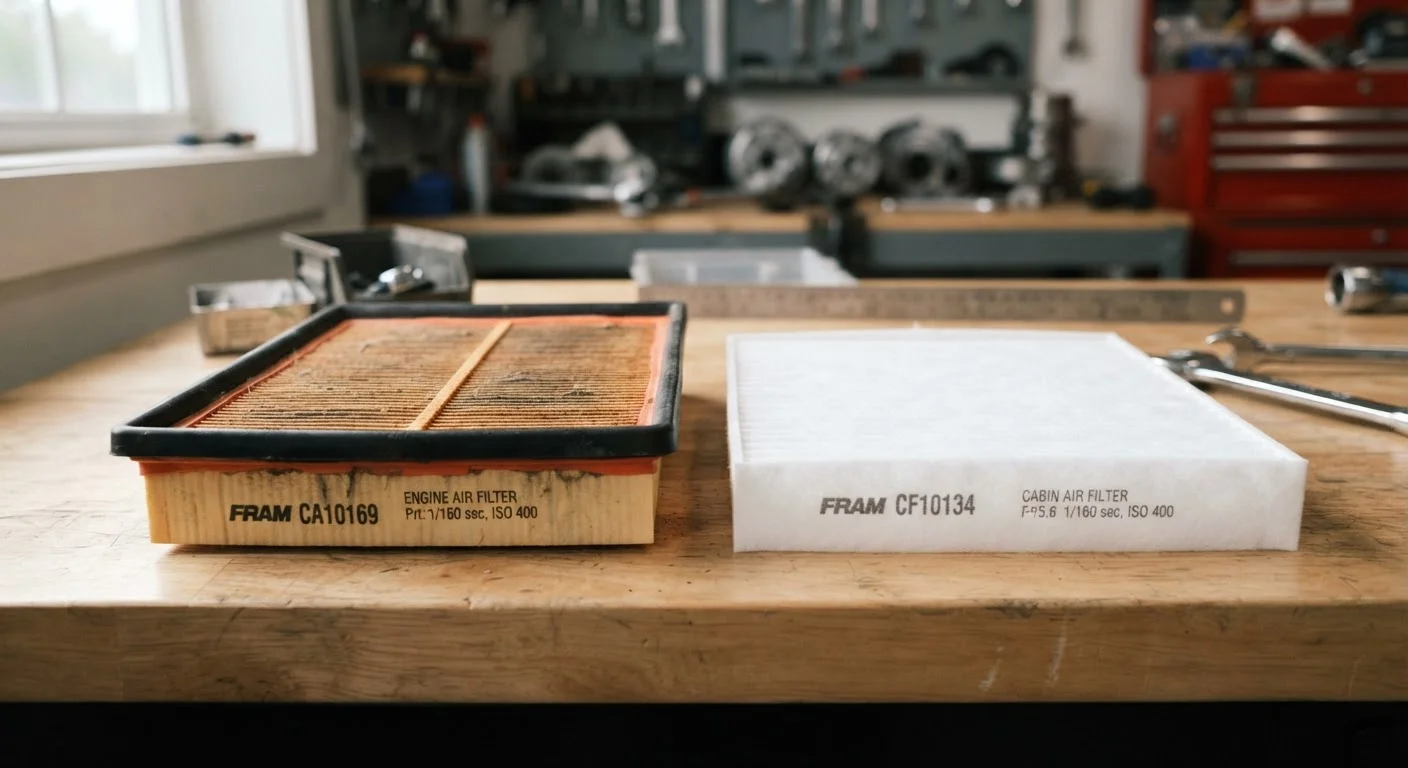
Option A
Engine Air Filter
The engine's first line of defense against dirt and debris.
Best for: Protecting your engine's internal components from airborne contaminants that enter through the intake system.
Option B
Cabin Air Filter
The passenger compartment's shield against dust, pollen, and pollutants.
Best for: Keeping the air inside your car clean for drivers and passengers, especially those with allergies or respiratory sensitivities.
Two Filters, Two Completely Different Jobs
Many drivers are surprised to learn their vehicle has not one but two separate air filters — and that confusing them is a common source of unnecessary expense and missed maintenance. These filters do not share a location, a purpose, or a replacement interval. Understanding the distinction is one of the most practical things a driver can know.
The engine air filter sits in the engine bay, typically inside a plastic housing connected to the air intake system. Its job is purely mechanical: it screens out dust, dirt, insects, and debris before outside air enters the engine's combustion chambers. Without it, abrasive particles would wear down pistons, cylinders, and other internal components over time.
The cabin air filter, by contrast, has nothing to do with the engine. It's positioned in the HVAC (heating, ventilation, and air conditioning) system — usually behind the glove box or under the dashboard — and it filters the air that flows into the passenger compartment. It catches pollen, fine dust, exhaust particles, and in some cases, odors.
| Criterion | Engine Air Filter | Cabin Air Filter |
|---|---|---|
| Primary function | Protects engine from debris | Cleans air for passengers |
| Location | Engine bay, air intake housing | HVAC system, behind glove box |
| Typical replacement interval | 15,000–30,000 miles | 12,000–15,000 miles |
| Effect when neglected | Reduced power, worse fuel economy | Poor cabin air quality, weak HVAC flow |
| DIY-friendly? | Yes, for most vehicles | Yes, for most vehicles |
| Tools typically needed | None or basic screwdriver | None in most cases |
How to Inspect Each Filter
Both filters are designed to be checked and replaced by a careful owner, though consulting your owner's manual first is always the right starting point. See our guide to DIY vs. shop repairs for a broader look at which maintenance tasks are genuinely owner-friendly.
Checking the Engine Air Filter
Open the hood and locate the air filter housing — it's usually a large plastic box with a hose running from it toward the engine. Unclip or unscrew the cover and lift the filter out. Hold it up to a light source. If it's gray or black with embedded debris and little light passes through the pleats, it's due for replacement. A lightly dusty tan or off-white filter may still have useful life left.
Checking the Cabin Air Filter
Location varies by vehicle — many are accessed by opening the glove box and either pressing in the sides to allow it to drop further, or removing a panel underneath the dashboard. Pull the filter out and examine it similarly: heavy debris, compressed fibers, or visible mold are signs it needs to go. Even if it looks moderately dirty, a filter that's been in place for more than 15,000 miles is worth replacing proactively.
Check Your Owner's Manual First
Filter locations and access procedures vary significantly between vehicle makes and models. What takes 30 seconds on one car might require removing a panel on another. Your owner's manual will show the exact location and any steps specific to your vehicle. Many manufacturers also publish free instructional content online for common maintenance tasks.
When and Why to Replace Each One
Replacement intervals vary by manufacturer and driving conditions, but general guidance gives a useful starting point. Engine air filters are typically rated for 15,000 to 30,000 miles under normal driving conditions. Cabin air filters tend to need attention sooner — around 12,000 to 15,000 miles — because they're filtering a smaller volume of air that passes directly over occupants.
15,000–30,000 mi
Typical engine air filter lifespan
General industry guidance from automotive maintenance organizations; actual interval depends on driving environment and vehicle specifications.
Up to 10%
Potential fuel efficiency loss from clogged engine filter
The U.S. Department of Energy has noted that a restricted air intake can measurably affect fuel economy on older carbureted engines; impact on modern fuel-injected engines is more modest but still present.
12,000–15,000 mi
Typical cabin air filter replacement interval
Commonly cited by vehicle manufacturers in owner's manuals; drivers in high-pollen or dusty areas may need to replace more frequently.
Driving in areas with heavy traffic, construction dust, or rural dirt roads will shorten both intervals. Conversely, a driver logging mostly highway miles in a temperate climate may stretch closer to the upper end of those ranges.
The consequences of neglect differ by filter. A choked engine air filter can reduce throttle response, lower fuel efficiency, and in severe cases, allow unfiltered air past a damaged filter element — risking real engine wear. A clogged cabin filter is less mechanically dangerous but degrades your daily driving experience and can worsen air quality for everyone in the vehicle, particularly relevant for anyone with asthma or allergies.
Replacement is straightforward enough that many drivers handle it themselves, and the filters themselves are widely available at auto parts stores. If you're comfortable with HVAC filter changes at home — similar in concept to what's described in home maintenance contexts — the cabin filter swap will feel very familiar.
The content on this site is for informational purposes only and is not a substitute for professional advice. Always consult a qualified professional for guidance specific to your situation.