

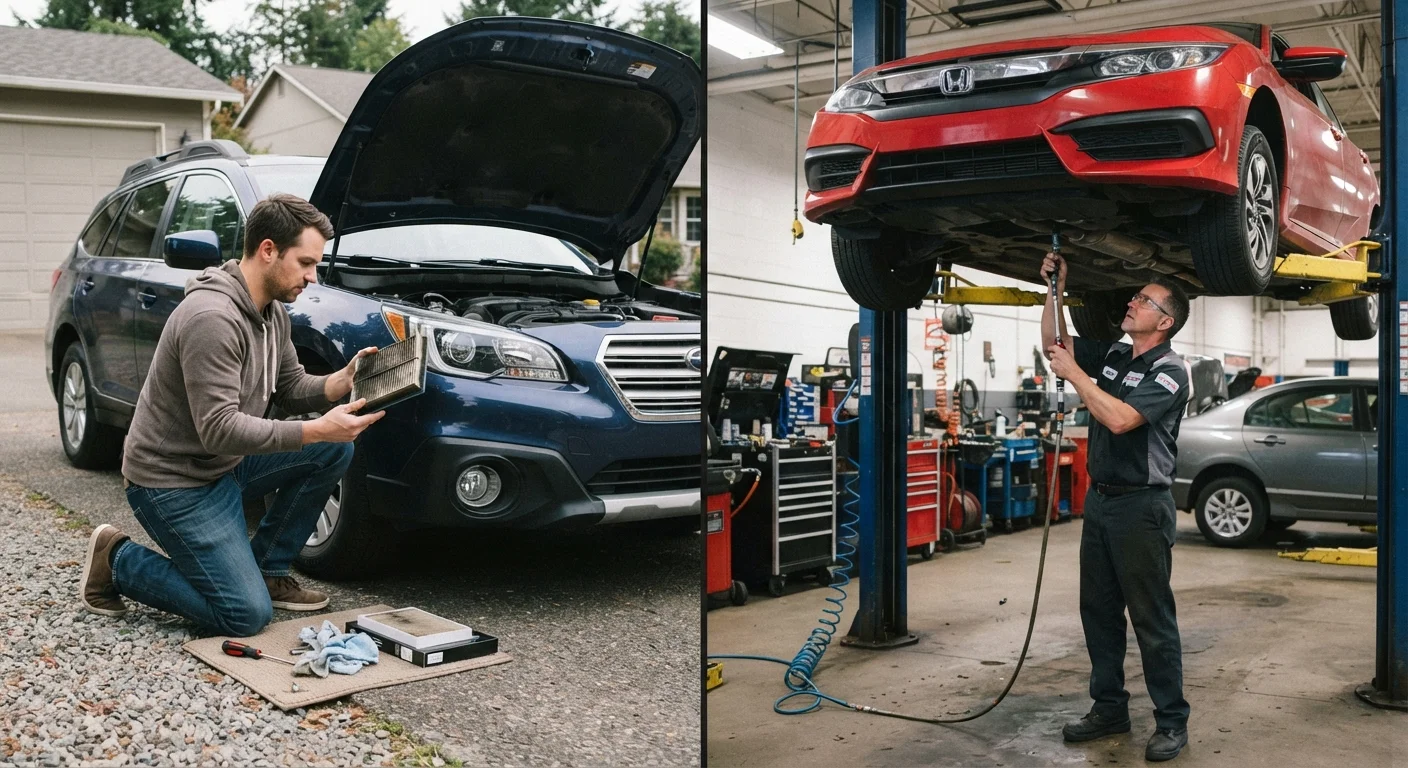
Our Verdict
DIY maintenance makes sense for straightforward, low-risk tasks where mistakes are easy to catch and correct. For anything involving safety systems, specialized tools, or diagnostic complexity, a qualified shop is the right call. The key is honest self-assessment — knowing your limits protects both your car and your safety.
| Best for | Recommended |
|---|---|
| Drivers comfortable with basic tools and routine upkeep | DIY maintenance |
| Safety-critical repairs or complex diagnostics | Professional shop |
| Those wanting to reduce routine costs without taking on serious risk | Hybrid approach (DIY basics, shop for the rest) |
| First-time car owners building confidence gradually | Professional shop with DIY learning alongside |
Why the DIY vs. Shop Decision Actually Matters
Every car owner eventually faces the same question: do I handle this myself, or pay a shop to do it? Get it right and you can save real money while staying on top of your vehicle. Get it wrong and a $20 mistake can turn into a $500 repair bill — or worse, a safety hazard on the road.
The decision isn't just about cost. It's about skill level, available tools, the consequences of an error, and whether the job requires specialized equipment or professional certification. For a practical primer on building good habits from the start, see our First-Time Car Owner's Guide.
| DIY at Home | Professional Shop | |
|---|---|---|
| Typical cost | Parts cost only | Parts + labor charges |
| Tools required | Basic hand tools | Specialized diagnostic equipment |
| Skill level needed | Low to moderate | Trained and certified |
| Safety risk if done wrong | Low (for appropriate tasks) | Mitigated by professional accountability |
| Suitable tasks | Filters, fluids, wipers, tires | Brakes, suspension, engine, transmission |
| Time investment | Varies; no scheduling needed | Appointment required; wait time involved |
| Warranty considerations | May affect warranty if done incorrectly | Preserves warranty when required |
Tasks That Are Reasonable to Do Yourself
Several maintenance jobs are genuinely within reach for a careful, patient driver — no formal training required. These tasks share a few things in common: they involve easy-to-access components, require minimal tools, and carry low consequences if something goes slightly wrong.
- Air and cabin filter replacement: Both filters are typically accessible without lifting the vehicle. Swapping them takes 10–20 minutes and requires nothing more than a screwdriver in most cases. Our guide to air filters and cabin filters explains exactly what to look for.
- Windshield wiper blades: Most wiper arms use a simple clip mechanism. Manufacturer instructions are usually printed on the packaging.
- Checking and topping off fluids: Coolant, windshield washer fluid, and power steering fluid reservoirs are labeled under the hood. For a complete walkthrough, see our fluid checks guide.
- Battery terminal cleaning: Corrosion on terminals can often be safely cleaned with a battery brush and a baking soda solution — with the battery disconnected first.
- Tire pressure checks and inflation: A quality gauge and a compressor (many gas stations have them) are all you need.
Start Small and Build Confidence
If you're new to DIY maintenance, begin with the simplest tasks — checking tire pressure, replacing wiper blades, or swapping a cabin air filter. Each successful job builds familiarity with your vehicle and confidence in your abilities. Always consult your owner's manual before starting any task; it contains model-specific guidance that generic tutorials may miss.
Repairs That Belong in a Professional Shop
Some jobs look approachable on a video tutorial but carry real consequences when performed incorrectly. These are tasks where a single misstep can compromise vehicle safety, void a warranty, or cause damage that dwarfs the original repair cost.
- Brake system work: Pad replacement might seem simple, but brake calipers, rotors, and hydraulic lines require precise torque specs and proper bleeding procedures. Errors here are directly life-threatening.
- Suspension and steering components: Worn tie rods, ball joints, or struts affect vehicle control. These require alignment equipment after installation that no driveway setup can replicate.
- Transmission service or repair: Whether automatic or manual, transmission work involves complex hydraulic systems and precise calibration beyond the scope of most DIY efforts.
- Check engine light diagnosis: A scan tool can read a fault code, but correctly interpreting what's causing the code — and what to do about it — often requires professional diagnostic experience and equipment.
- Timing belt or chain replacement: Engine timing is exact. A mis-timed engine can sustain severe internal damage almost immediately.
Ignoring warning signs in these areas tends to compound costs significantly. Our article on habits that lead to expensive repairs covers how small oversights escalate.
Don't Let a Video Tutorial Overestimate Your Readiness
Online tutorials make many repairs look straightforward, but they rarely show the complications that arise — seized bolts, corroded components, or tools that don't quite fit your specific model year. If a repair involves your braking system, steering, or any emission-related component, verify with a qualified mechanic before attempting it yourself. The cost of a professional inspection is almost always less than fixing a DIY repair gone wrong.
Building a Sensible Hybrid Approach
The most practical strategy for most drivers isn't all-or-nothing. Handle the simple, low-risk maintenance yourself — filters, fluids, wipers, tire pressure — and let qualified mechanics handle anything involving safety systems, complex diagnostics, or precision calibration.
Before taking on any new DIY task, ask yourself three questions: Do I have the right tools? Do I understand what I'm doing well enough to catch if something goes wrong? What's the worst-case outcome of a mistake? If the answer to the last question involves your safety or someone else's, call a shop.
Consistency matters as much as the individual tasks. A steady routine of simple at-home checks — paired with scheduled professional service — keeps problems small and predictable. Our guide to building a maintenance routine is a good next step for turning good intentions into lasting habits.
The content on this site is for informational purposes only and is not a substitute for professional advice. Always consult a qualified professional for guidance specific to your situation.