

Our Verdict
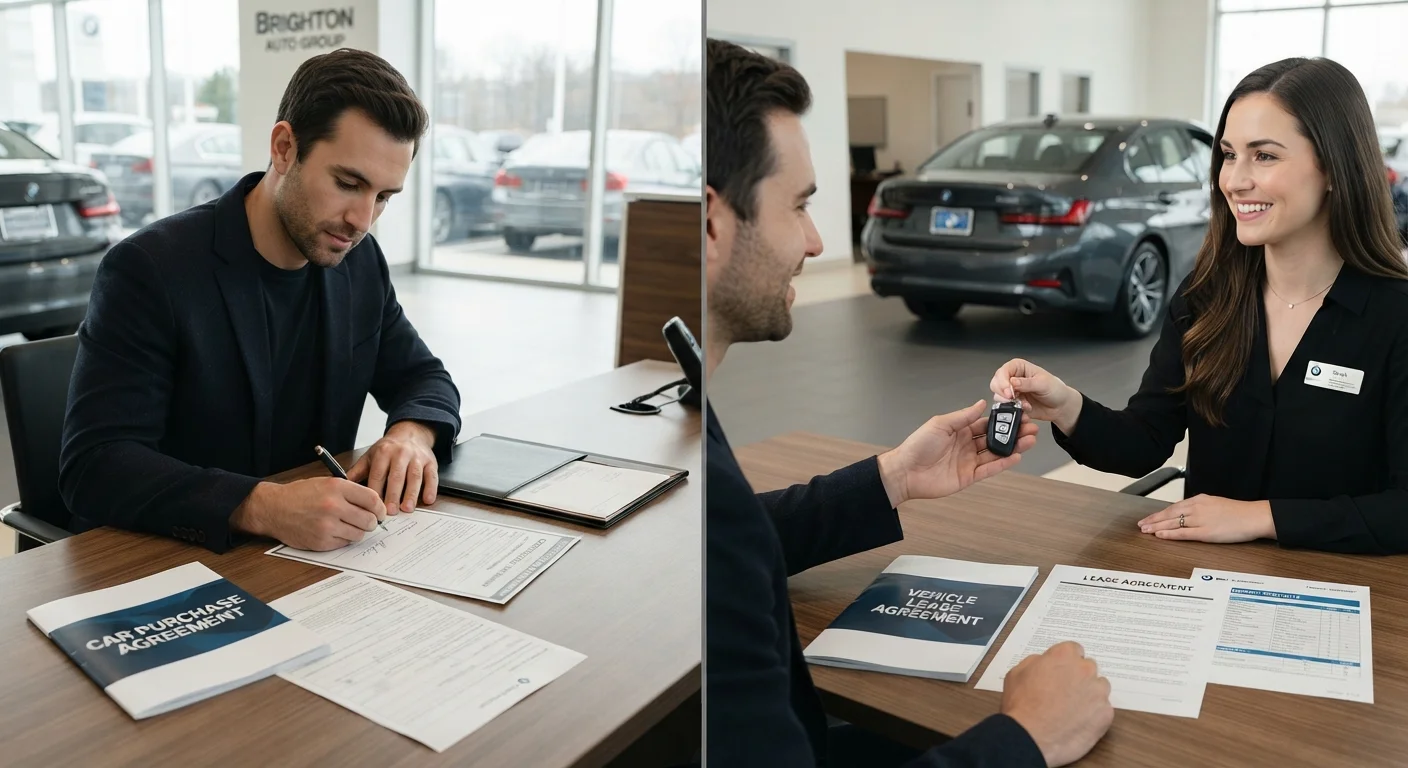
Leasing works well for drivers who want predictable costs, lower monthly payments, and a new vehicle every few years — provided they stay within mileage limits. Buying makes more financial sense for drivers who log high miles, plan to keep a vehicle for many years, or want to eventually eliminate a monthly car payment altogether. Neither path is inherently superior; the right choice depends on how you drive, how you budget, and how you value flexibility versus long-term savings.
Leasing suits low-mileage drivers who prioritize lower payments and newer vehicles; buying is better for those who drive heavily, want ownership equity, or plan to keep their car long-term.
How Leasing and Buying Actually Work
When you buy a car, you either pay the full purchase price upfront or finance it through a loan. Each payment builds equity in the vehicle, and once the loan is paid off, you own it outright — free of any monthly obligation.
When you lease, you're essentially paying for the right to use the car for a set period, typically two to four years. Lease payments cover the vehicle's depreciation during that time, plus interest and fees — not the full value of the car. At the end of the lease, you return the vehicle (or sometimes have the option to buy it at a pre-set price).
Understanding this core difference explains nearly every financial tradeoff that follows. One path builds an asset; the other keeps you in a cycle of payments in exchange for always driving something newer.
The Case for Leasing
Lower monthly payments than a comparable auto loan
Because lease payments only cover depreciation over the contract term rather than the vehicle's full value, they typically run lower than loan payments for the same car.
Drive a newer vehicle on a predictable cycle
Leasing lets you upgrade to a new model every two to four years without the hassle of selling or trading in — appealing if you value having current safety technology and features.
Repairs often covered under warranty for full term
Lease terms are usually designed to coincide with manufacturer warranty coverage, reducing out-of-pocket repair costs during the lease period.
Lower upfront costs in many cases
Lease deals sometimes require less money down than purchasing, which can reduce the initial financial barrier to getting into a vehicle.
Leasing appeals most to drivers who want to minimize what they spend each month and avoid the hassle of selling or trading in a vehicle. Because lease payments only cover a portion of the car's value, they're typically lower than loan payments on the same vehicle — sometimes significantly so.
There's also a practical appeal for those who prefer driving a car that's always under warranty. Most lease terms align closely with manufacturer warranty periods, which means many mechanical repair costs are covered throughout the lease. For a fuller picture of what ongoing ownership costs look like, see the true cost of owning a car.
The Case for Buying
No ownership equity built over time
Every lease payment goes toward using the vehicle, not owning it. At contract end, you have no asset — just the option to start another round of payments.
Mileage caps create real financial risk
Exceeding your contracted mileage allowance triggers per-mile overage fees at lease end, which can add up to hundreds or thousands of dollars unexpectedly.
Ongoing payment with no end in sight
Unlike a loan that eventually pays off, leasing keeps you in a perpetual payment cycle — there is no point where the monthly obligation disappears.
Less flexibility to modify or sell the vehicle
As the lessee, you don't own the car, so modifications are generally prohibited and you can't simply sell it if your circumstances change mid-lease without early termination fees.
Buying demands more financially at the outset — larger down payments, higher monthly loan payments, and full responsibility for repairs once the warranty expires. But it comes with something leasing never offers: ownership.
Once a loan is paid off, that monthly payment disappears. For drivers who hold on to vehicles for seven, ten, or more years, the total cost per year often drops well below what repeat leasing would cost over the same period. You also have no mileage restrictions, no penalty for normal wear, and the freedom to modify or sell the car whenever you choose. First-time buyers especially should understand what ownership actually entails — car ownership basics for first-timers is a practical starting point.
~49%
Average value lost in first three years of ownership
Industry estimates suggest new vehicles can depreciate roughly 40–50% of their value within the first three years, which is the primary cost absorbed by buyers — and covered by lessees indirectly through lease payments.
~8 years
Average age of vehicles on U.S. roads
According to data from S&P Global Mobility, the average age of light vehicles in operation in the United States has been rising, suggesting many buyers do hold on to their vehicles well beyond typical lease terms.
Costs That Catch People Off Guard
Both paths carry hidden or overlooked costs that can affect your real-world budget.
With leasing, the fees can add up fast. Excess mileage charges — often 15 to 25 cents per mile over the contract limit — can generate a significant bill at lease end. Wear-and-tear fees apply if the car shows damage beyond what the leasing company considers normal. Disposition fees (charged when you return the car without leasing or buying another from the same company) are also common.
With buying, you absorb the full cost of depreciation — a new vehicle can lose a substantial portion of its value in the first few years. Maintenance costs grow as the car ages, and major repairs are entirely your responsibility once the warranty expires. Annual costs many car owners underestimate — from registration fees to tire replacement — apply to both paths but compound over time with ownership.
Lease-End Purchase Option: Worth Evaluating
Most lease contracts include an option to purchase the vehicle at the end of the term for a pre-set residual value. In some market conditions, this price can be favorable compared to the car's actual market value — making the purchase option worth calculating before simply returning the keys. However, this depends heavily on the specific vehicle, residual price written into your contract, and current used-car market conditions. Review your contract terms carefully and compare against current market pricing before deciding.
Which Path Fits Your Situation?
Rather than a universal recommendation, consider these practical questions:
- How many miles do you drive annually? Most leases cap at 10,000–15,000 miles per year. Frequent or long-distance drivers often find leasing becomes costly at contract end.
- How long do you plan to keep the vehicle? Leasing makes most sense on a two-to-four-year horizon. If you typically drive vehicles for six or more years, buying almost always produces better long-term value.
- How important is monthly cash flow? If a lower monthly payment meaningfully improves your financial flexibility, leasing's payment structure may matter. Thinking through what's a necessity versus a preference is worth doing — separating needs from wants in your budget can help frame the decision.
- Do you want to build equity? If yes, only buying delivers that. A leased car returns to the dealer with nothing to show for your payments beyond the use of the vehicle.
This article provides general financial information for educational purposes and does not constitute personalized financial or legal advice. Consult a qualified financial professional regarding your specific circumstances.
The content on this site is for informational purposes only and is not a substitute for professional advice. Always consult a qualified professional for guidance specific to your situation.