

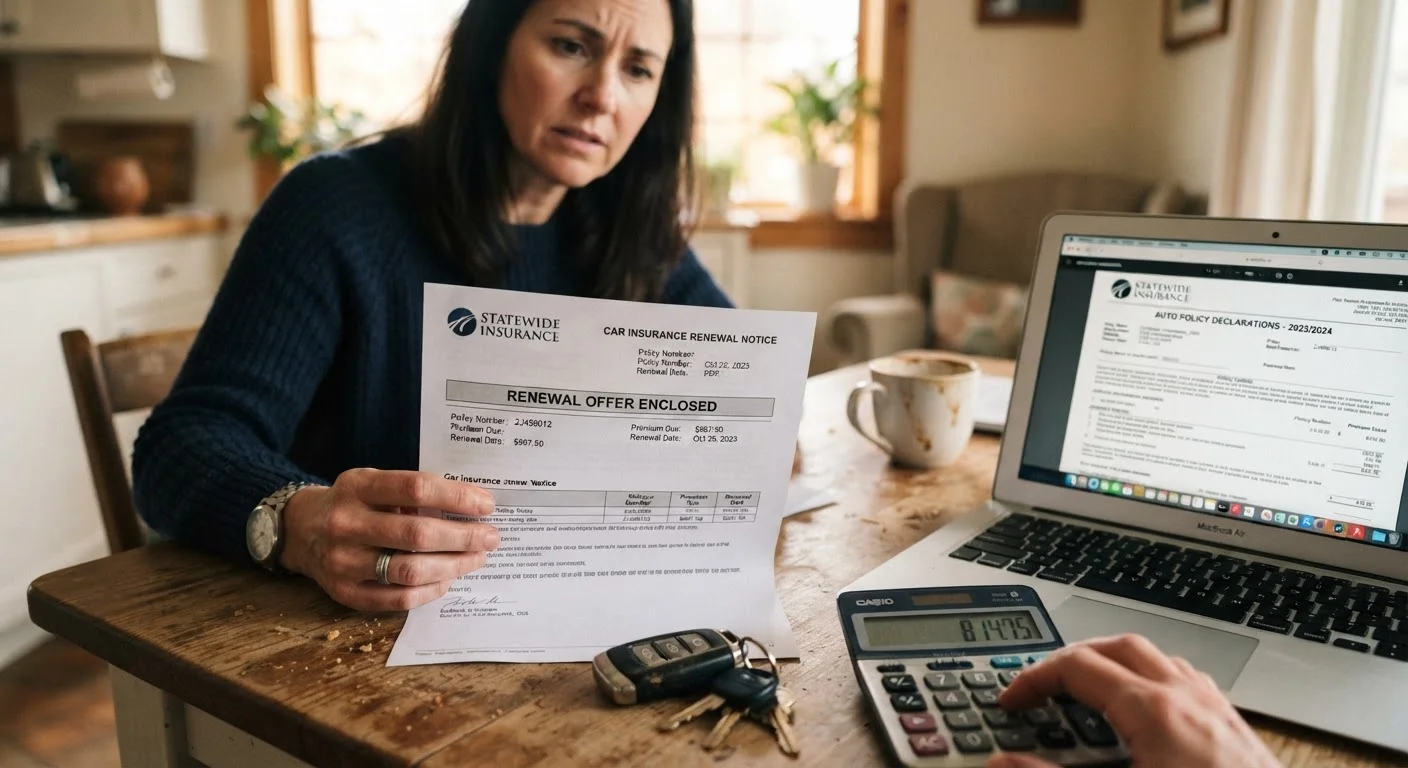
The Renewal Surprise Most Drivers Don't Expect
You've been a careful driver all year — no tickets, no fender-benders, no claims. Then your renewal notice arrives and the number is higher than before. It feels unfair, but it's completely legal, and it happens to millions of American drivers every renewal cycle.
The reason is straightforward: your driving record is only one input in a much larger calculation. Insurers price risk using dozens of variables, many of which have nothing to do with how you personally handle a vehicle. Understanding what those variables are puts you in a better position to anticipate changes and respond to them. See our breakdown of what you're actually paying for for context on how premiums are structured in the first place.
~$2,500
Average annual U.S. auto insurance premium
According to data from the National Association of Insurance Commissioners, average expenditures on auto insurance have risen substantially over recent years, with many states exceeding this figure.
40+
States permitting credit-based insurance scoring
The majority of U.S. states allow insurers to use a credit-based insurance score as a rating factor, meaning credit health can directly influence premiums in most of the country.
6–12 mo.
Typical policy renewal cycle
Most personal auto policies renew every six or twelve months, giving insurers regular intervals to apply updated pricing models and external data.
External Forces That Move Your Rate
A significant portion of any premium change has nothing to do with you specifically. Insurers track losses across entire regions and vehicle categories, and when those losses increase, rates across a pool of policyholders adjust to compensate.
- Repair cost inflation: The cost of parts, labor, and specialized technology in modern vehicles has risen steadily. When repair costs increase across the industry, carriers pass a portion of that increase on through higher premiums — even to drivers who've never made a claim.
- Medical cost trends: Liability coverage pays for injuries to others in accidents you cause. As healthcare costs rise, the potential payout on those claims increases, which insurers factor into pricing.
- Local claims activity: If vehicle theft, weather-related claims, or collision frequency increases in your zip code, everyone in that area tends to see rate adjustments at renewal.
- Catastrophic weather events: Hailstorms, floods, and wildfires generate large volumes of comprehensive claims. Insurers recalibrate rates in affected regions afterward.
These factors explain why two neighbors with identical driving records can see different premium increases depending on which carrier they use and how each company models regional risk. The auto insurance myths that cost drivers money article explores other widely misunderstood rating factors worth reviewing.
Personal Factors That Trigger a Recalculation
Beyond market forces, changes in your own circumstances are reviewed at each renewal — and some of them may have shifted without you realizing it.
Check Your Policy Details Before Renewing
Before accepting a renewal, take five minutes to confirm the listed address, drivers, and vehicle information are all current. An outdated garaging address or a driver who no longer lives in your household can affect your rate in ways that may not benefit you. Accurate information is the baseline for a fair premium calculation.
- Credit-based insurance score: In most states, insurers use a version of your credit data — distinct from your FICO score — as a predictor of claim likelihood. A drop in your credit profile can raise your premium even if your driving is spotless. (California, Hawaii, Massachusetts, Michigan, and a handful of other states restrict this practice.)
- Address change: Moving to a zip code with higher vehicle theft rates, more uninsured drivers, or heavier traffic typically raises your premium. This is one of the most immediate triggers for a rate change.
- Drivers on your policy: Adding a teen or a new household member with a less established driving record increases the insurer's risk exposure, often significantly.
- Vehicle changes: If you've replaced or added a vehicle, the new car's theft rate, safety ratings, and repair costs all feed into your new rate.
- Lapsed or reduced coverage elsewhere: If you previously carried umbrella or multi-policy discounts and those policies changed, you may lose associated savings.
Insurance is just one piece of the broader cost of ownership. For a full picture, see the true cost of owning a car and annual costs drivers underestimate.
What You Can Actually Do About It
You can't control inflation or local theft statistics, but you're not powerless when your renewal arrives with an unwelcome number.
- Review what you're being charged for: Confirm the coverage levels, deductibles, and listed drivers are current and accurate. Outdated information — like a vehicle being listed as garaged somewhere you no longer live — can cost you unnecessarily.
- Compare quotes at every renewal: Rates vary meaningfully across carriers for identical coverage. What was competitive eighteen months ago may not be today. Make sure you're comparing the same limits and deductibles when you shop.
- Ask about available adjustments: Increasing your deductible, enrolling in a usage-based or telematics program, or bundling policies are all worth discussing with your insurer — though whether any of these make sense depends on your individual situation.
- Monitor your credit: Where state law permits it, maintaining a healthy credit profile can help keep your insurance score in a favorable range.
Understanding that your premium reflects a dynamic risk calculation — not just your personal history — is the first step toward managing it more confidently.
This article is for general informational purposes only and does not constitute financial or insurance advice. For guidance specific to your policy or coverage needs, consult a licensed insurance professional.
Frequently Asked Questions
Several factors unrelated to your driving can raise your premium, including inflation in repair and medical costs, a drop in your credit-based insurance score, rising claims in your zip code, or the insurer's own statewide rate filing. None of these require you to have filed a claim.
In most U.S. states, insurers use a credit-based insurance score — a separate calculation from your standard credit score — to help set premiums. A decline in your credit profile can push your rate up even if your driving record is clean. A few states, including California and Michigan, restrict or prohibit this practice.
Yes. Your zip code is one of the most significant rating factors. Moving to an area with higher vehicle theft, more accidents, or denser traffic typically raises your premium. Moving to a lower-risk area can reduce it.
Most personal auto policies renew every six or twelve months, and that's when insurers apply updated information. However, mid-term changes — like adding a driver or changing your vehicle — can trigger an immediate recalculation.
Comparing quotes at each renewal is a sensible habit. Rates vary significantly between carriers for the same coverage level, and your current insurer may not always offer the most competitive rate for your updated risk profile. Just ensure you're comparing equivalent coverage when reviewing quotes.
Not necessarily. While the cost to replace an older vehicle may be lower — potentially reducing comprehensive and collision premiums — liability and medical coverage costs are driven by other factors and often trend upward over time regardless of vehicle age.
The content on this site is for informational purposes only and is not a substitute for professional advice. Always consult a qualified professional for guidance specific to your situation.