

Start here
Why the Foundation Matters More Than the License
Next
The Pre-Drive Checklist Every New Driver Should Know
Build skills
Structured Practice: How to Build Real Skills
Have the talk
Key Conversations to Have Before Solo Driving
Keep growing
What Comes Next: Growing Into a Confident Driver
Why the Foundation Matters More Than the License
A driver's license is a legal credential, not a safety certification. The test confirms a minimum standard — it says nothing about how a teen will respond to a distracted driver merging into their lane, a rain-slicked curve, or the pressure of friends in the back seat telling them to hurry up.
According to the CDC, motor vehicle crashes are a leading cause of death among teenagers in the United States. That statistic isn't meant to frighten anyone — it's a reminder that early driving habits carry real weight. The months before and just after getting a license are the window when the patterns that will define a driver for decades are being set.
Getting that foundation right is the entire point of this guide.
Graduated Driver Licensing (GDL)
A staged licensing system used by all U.S. states that restricts new drivers' privileges — such as nighttime driving and passenger limits — and lifts them gradually as the driver gains experience.
Blind spot
An area around the vehicle that the driver cannot see through mirrors alone. Proper mirror adjustment and shoulder checks reduce — but don't eliminate — blind spots.
Following distance
The space maintained between your vehicle and the one ahead. A larger following distance gives more time to react to sudden stops or hazards.
Defensive driving
A driving approach focused on anticipating hazards and the mistakes of other road users, rather than simply reacting to them after they occur.
Cognitive load
The mental effort required to process information and make decisions. New drivers have high cognitive load because basic vehicle control still requires conscious attention, leaving less capacity for hazard awareness.
The Pre-Drive Checklist Every New Driver Should Know
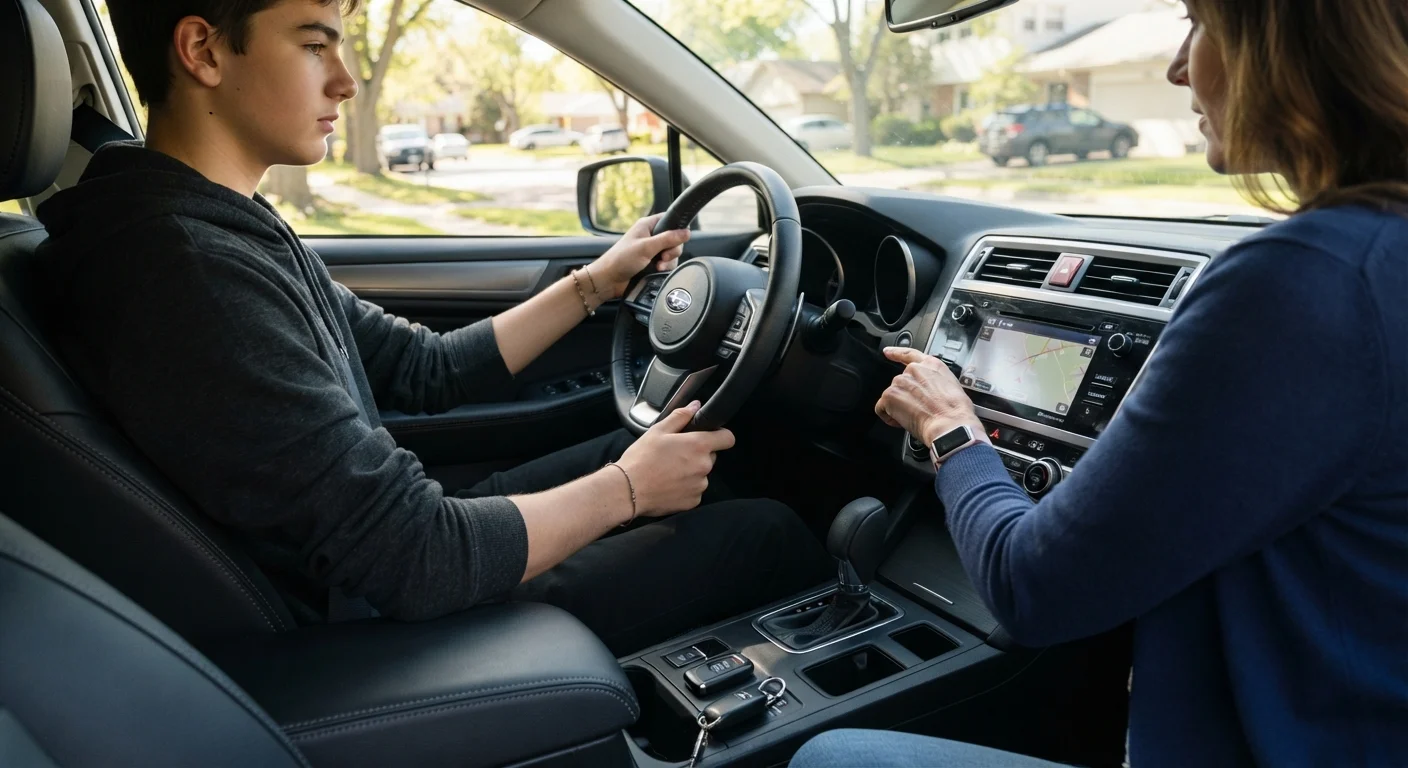
Before a new driver starts the engine, there's a brief but meaningful routine worth making automatic. It takes less than two minutes and addresses a surprising share of avoidable problems.
- Adjust mirrors and seat position — every time, even if you're the only one who drives the car. Correct positioning eliminates blind spots and ensures full pedal reach.
- Check fuel level and warning lights — teens often haven't yet built the habit of monitoring gauges. A quick glance at startup prevents running out of fuel or ignoring a check-engine light.
- Silence the phone or place it out of reach — not on the seat, not in a cupholder. Out of sight meaningfully reduces the urge to glance at it.
- Buckle up before shifting into drive — treating seatbelts as non-negotiable from day one avoids the habit of intending to buckle "after just pulling out of the driveway."
- Check surroundings before moving — walk around the car if visibility is limited, and use the rearview camera as a supplement, not a replacement, for looking.
For more on keeping the vehicle itself in good shape — tire pressure, fluid checks, and warning lights — see our first-time car owner's maintenance guide.
Make the Routine Non-Negotiable From Day One
Habits form fastest when they're practiced consistently from the very beginning — before any exceptions feel acceptable. Running through a pre-drive checklist every single time, even for a two-minute trip down the street, cements the behavior before shortcuts seem tempting. Model the routine yourself when driving with your teen.
Structured Practice: How to Build Real Skills
Random practice doesn't produce well-rounded drivers — structured, progressively challenging practice does. The goal is graduated exposure: start in controlled, low-stakes environments and introduce complexity only as core skills become reliable.
A Practical Progression
- Empty parking lots — basic controls, smooth braking, turning, and parking without traffic pressure.
- Quiet residential streets — intersections, stop signs, lane positioning, and low-speed hazard awareness.
- Light suburban roads — multi-lane driving, traffic signals, pedestrians, and speed management.
- Busier arterials and highways — merging, following distance, and maintaining consistent speed in traffic.
- Challenging conditions — night, rain, unfamiliar areas — introduced only after daytime competence is solid.
Night and wet-road driving deserve particular attention before a teen drives solo in those conditions. Our guides on night driving habits and driving in rain cover the specific adjustments these conditions require.
Key Conversations to Have Before Solo Driving
Research consistently shows that parental expectations and family rules around driving are among the strongest predictors of teen driving behavior. A conversation — or a written agreement — sets clear expectations and opens the door for honest dialogue when things go wrong.
Topics Worth Covering Directly
- Phone use: No exceptions, including voice calls. Hands-free isn't distraction-free for new drivers whose cognitive load is already high.
- Passengers: Many GDL laws limit teen passengers. Reinforce the reason — each additional peer in the car statistically increases crash risk.
- Curfews and routes: Know where your teen is going and what time they're expected back. This isn't surveillance — it's accountability.
- What to do in an emergency: Walk through what happens if there's a breakdown, a minor fender-bender, or a situation that feels unsafe. Knowing the answer in advance prevents panic in the moment.
- Impairment — including fatigue: Drowsy driving impairs judgment similarly to alcohol. Teens should feel empowered to call for a ride rather than drive tired.
Written Agreements Can Help
Some families find it useful to formalize driving expectations in a simple written agreement — sometimes called a parent-teen driving contract. It isn't a legal document; it's a shared reference point that makes conversations about violations less personal and more about agreed rules. Many state DMVs and road safety organizations offer free templates as a starting point.
What Comes Next: Growing Into a Confident Driver
Getting the basics right is the start of a longer journey. Truly confident driving is built through experience across a wide range of conditions — not just comfort in familiar territory.
Consider encouraging your teen to learn the principles of defensive driving early. It's a mindset shift — from reacting to hazards to anticipating them — and it's one of the most durable safety tools any driver can develop.
Beyond safety habits, first-time drivers benefit from understanding basic car ownership responsibilities. Our guide on car ownership for first-timers covers insurance, registration, and the paperwork side of driving that often surprises new owners.
The goal isn't a perfectly cautious driver who hesitates at every turn. It's a driver who understands risk, reads the road honestly, and makes good decisions — consistently, even when no one is watching.
Frequently Asked Questions
Most state Graduated Driver Licensing (GDL) programs require 40–50 supervised practice hours, but research generally supports more. Quality matters as much as quantity — varied conditions, times of day, and road types build more well-rounded skills than repetitive practice in a single setting.
Distraction — especially from phones — and carrying multiple teen passengers are consistently identified as high-risk factors for new drivers. The first six to twelve months after getting a license are statistically the most dangerous period for young drivers.
Most GDL laws restrict unsupervised night driving for a set period after licensing. Beyond legal requirements, teens should demonstrate consistent daytime competence before night driving is introduced, ideally first with a supervising adult.
Formal driver education provides structured instruction from trained professionals and often includes classroom safety content that complements behind-the-wheel practice. Many states require it, and it may also affect insurance costs — check your state's specific requirements.
Start in low-traffic, familiar environments and gradually increase complexity as skills improve. Keep early sessions calm and focused on observation rather than speed. Acknowledging progress explicitly and avoiding harsh criticism during practice helps reduce anxiety over time.
Automatic emergency braking, rearview cameras, and lane-departure warnings are features worth prioritizing, as they provide an extra layer of assistance while skills are still developing. Avoid vehicles with very powerful engines that can tempt or overwhelm inexperienced drivers.
The content on this site is for informational purposes only and is not a substitute for professional advice. Always consult a qualified professional for guidance specific to your situation.