

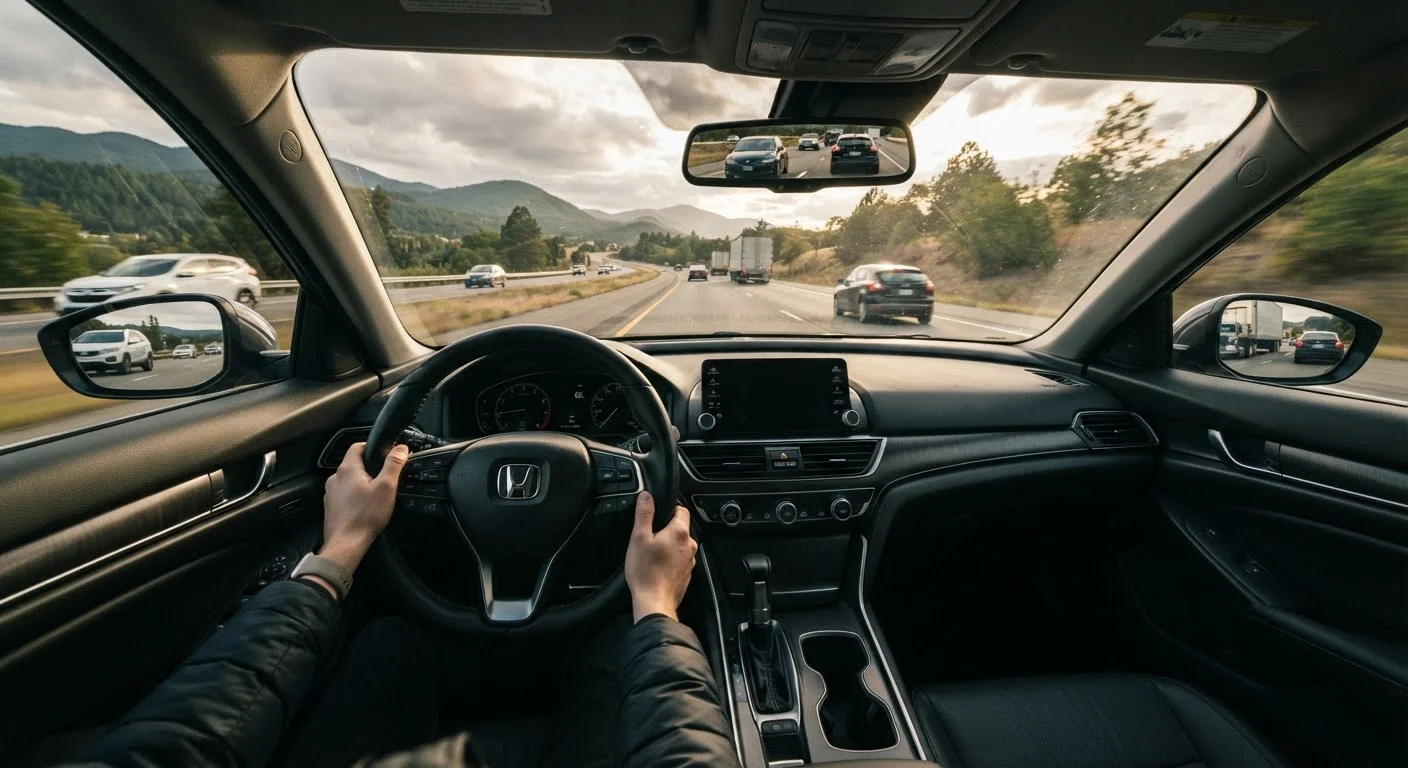
The Gaps Your Mirrors Can't Fill
Mirror technology has improved considerably over the decades, but no mirror setup completely eliminates blind spots. Physics simply won't allow it. Every car, truck, and SUV on American roads has zones where other vehicles, cyclists, or pedestrians can disappear from view entirely — even when mirrors are set correctly.
Most drivers learn about blind spots once, during their initial licensing process, then rarely revisit the concept. That's a problem, because blind spot-related crashes are a consistent contributor to lane-change and intersection collisions across the country. Understanding exactly where your blind spots are — and how your specific vehicle shapes them — is foundational to safer driving on highways, surface streets, and parking lots alike.
For more on building solid driving safety habits, the night driving habits guide covers how reduced visibility compounds these challenges after dark.
The rear quarter blind spot (beside and behind each rear pillar)
This is the classic blind spot every driver hears about — the zone flanking the rear of your car on both sides that neither your side mirrors nor your rearview mirror covers cleanly. On a standard sedan, this area typically extends from about the back door rearward to a point level with the rear bumper.
The size of this zone depends heavily on the shape of your vehicle's C-pillar (the structural column between the rear side window and the back glass). Thicker pillars — common on SUVs and crossovers — create a larger dead zone. A motorcyclist or compact car can sit entirely within this zone while you're preparing to change lanes, completely invisible until you physically turn your head.
What to do: Before any lane change, signal first, then briefly turn your head to glance over your shoulder toward the affected zone. This takes about one second and should become automatic every single time.
A motorcycle can disappear completely into this zone while you're preparing to merge.
The front corner blind spot (near the hood's edges on each side)
Many drivers forget that blind spots exist at the front of the vehicle, not just the sides and rear. When navigating tight parking lots, pulling out of driveways, or easing into intersections, pedestrians and cyclists can be hidden by the hood or front pillars (A-pillars) until they're dangerously close.
Tall hoods on trucks and large SUVs make this especially significant. A small child, a cyclist riding alongside parked cars, or a pedestrian stepping off a curb can all be obscured by the front end of the vehicle before you've cleared enough of the intersection to see them in a mirror.
What to do: Slow to a true crawl when pulling forward in low-visibility situations. In parking lots, edge forward incrementally so your sight lines open gradually before you commit to crossing a travel lane.
A child or cyclist can be completely hidden by a truck hood at close range.
The wide-angle mirror gap (between side mirrors and rearview)
Mirrors adjusted incorrectly often create a significant overlap — both mirrors show the rear of your own car — while leaving a gap between the side mirror's coverage and the rearview mirror's field of view. That gap, often a narrow wedge on each side of the vehicle, is a genuine blind zone.
The Society of Automotive Engineers has documented a mirror adjustment method that reduces overlap and narrows this gap considerably: position each side mirror outward until you can just barely see the rear corner of your own car. This takes getting used to, but it expands your rear coverage significantly without requiring additional technology.
What to do: Check your mirror adjustment periodically, especially after passengers adjust them or you've switched between vehicles. A mirror that's even slightly off can silently expand your blind zones.
Incorrect mirror overlap creates a gap that leaves a real blind zone on both sides.
The truck and SUV extended rear blind zone
Larger vehicles carry proportionally larger blind spots behind them. On a full-size pickup truck or large SUV, the rear blind zone — the area directly behind the vehicle that the rearview mirror doesn't capture — can extend 20 feet or more behind the bumper. For some larger trucks and vans, it can exceed 50 feet.
This is the zone associated with backover incidents in driveways and parking lots, which disproportionately involve children. Rear-view cameras, now federally required on new vehicles sold in the U.S., help significantly but don't replace the habit of walking around the vehicle to check surroundings before reversing in areas where children or pedestrians may be present.
What to do: Before reversing in driveways or unfamiliar lots, physically walk around your vehicle if pedestrians — especially children — could be nearby. Use your camera as confirmation, not as your sole check.
The rear blind zone on a full-size truck can extend beyond 50 feet behind the bumper.
The intersection pillar blind spot (A-pillar blocking cross traffic)
When you approach a four-way intersection and look left and right, your A-pillars — the columns on each side of the windshield — can block your view of a portion of the crossing road. A pedestrian, cyclist, or slow-moving vehicle in that narrow angular zone may be hidden at the precise moment you're deciding whether it's safe to proceed.
This is compounded in poor lighting or adverse weather. The guide to driving in rain notes how wet conditions reduce contrast and make partially obscured hazards even harder to detect.
What to do: At intersections, lean your head slightly left or right to look around the A-pillar before committing. It's a small movement with a meaningful payoff in cross-traffic visibility.
Leaning slightly to one side at an intersection moves your A-pillar out of the line of sight.
The lane-adjacent motorcycle blind spot
Motorcycles present a unique challenge: they're narrow enough to occupy the same physical space where other blind spots concentrate. A motorcycle sitting in your rear quarter blind spot is harder to detect than a car because it displaces less visual space in your mirror. At highway speeds, a motorcycle can also close distances faster than you might anticipate.
This is one reason lane changes demand a full head-check rather than mirror-only confirmation. Side mirrors that seem clear can miss a motorcycle entirely, particularly if the rider is in the outer portion of the adjacent lane — right where your mirror coverage naturally thins.
What to do: Treat every head-check as mandatory before merging, not optional. If you're unsure, wait. Signals give other drivers time to react, but they don't make a blind spot disappear.
Motorcycles are narrow enough to disappear into rear quarter blind spots that would show a car.
Closing the Gap: Habits That Actually Help
No single fix eliminates blind spots entirely, but combining good mirror setup with deliberate head checks and predictable signaling gets drivers very close. The goal is to make blind spot checks automatic — a reflex built through repetition rather than a conscious decision made under pressure.
Set Your Mirrors Before You Drive
Adjust your mirrors every time you sit down in the driver's seat — even if you're the only person who drives the vehicle. Seat position affects mirror angle, and a small shift in how you're sitting changes what each mirror covers. The extra ten seconds pays off every time you change lanes.
Keep in mind that technology like blind spot monitoring systems is a supplement, not a substitute. Sensors can miss fast-moving motorcycles, narrow cyclists, or objects at certain angles. Treat any warning light as a prompt to look, not as a final clearance. Drivers who rely exclusively on sensors without developing physical checking habits are trading one vulnerability for another.
Confident lane changes, smooth merges, and safe turns all trace back to the same discipline: knowing where your blind spots are and building the habit of checking them every time. That's true whether you're on a quiet suburban street or a busy interstate. The same vigilance that protects you also protects motorcyclists, cyclists, and pedestrians who are most vulnerable when a driver doesn't look. For a deeper look at how proximity and speed interact in traffic, see our guide to tailgating dangers.
The content on this site is for informational purposes only and is not a substitute for professional advice. Always consult a qualified professional for guidance specific to your situation.