

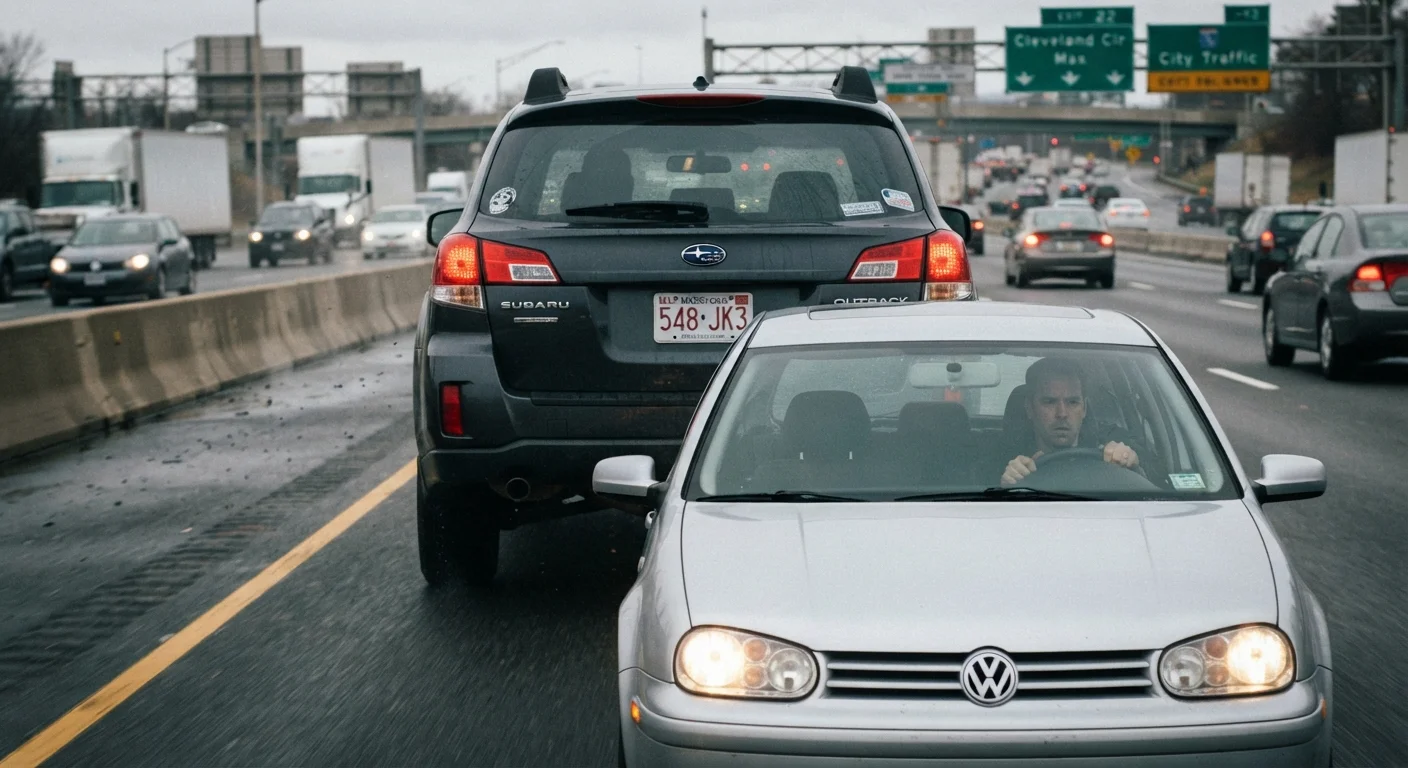
The Physics Problem Most Drivers Ignore
Most drivers know they shouldn't tailgate, yet rear-end collisions remain among the most frequent crash types on American roads. The gap between knowing and doing comes down to a basic failure to appreciate the physics involved.
At 60 mph, a car is covering 88 feet every second. The average driver takes about 1.5 seconds to perceive a hazard and move their foot to the brake — that's more than 130 feet of travel before braking even starts. Add the braking distance itself, and a total stopping distance of 240 feet or more is realistic in ordinary conditions. That's roughly 18 car lengths. When you're following the car ahead by just two or three car lengths, you've already lost the math battle.
For a deeper look at how speed compounds this problem, see the science behind stopping distance at highway speeds.
~29%
Of all U.S. crashes are rear-end collisions
According to the National Highway Traffic Safety Administration (NHTSA), rear-end crashes are consistently one of the most common crash types on American roads.
88 ft/sec
Distance traveled per second at 60 mph
At highway speeds, even a brief distraction or delayed reaction covers the length of several car lengths before braking begins.
1.5 sec
Average driver perception-reaction time
Traffic safety research generally cites 1.5 seconds as a baseline reaction time, though fatigue, distraction, and age can extend this significantly.
Why the Three-Second Rule Exists — and When It Isn't Enough
The three-second rule gives drivers a practical, speed-independent way to gauge following distance. The method: watch for the car ahead to pass a fixed reference point — a sign, a shadow, a bridge — then count. If you reach the same point before three seconds have elapsed, you're too close.
Three seconds is a minimum in dry, clear conditions with a well-maintained vehicle traveling at moderate speed. Rain, fog, poor tire tread, heavy payloads, and fatigue all extend the distance you need. Safe following distances shift significantly with conditions — what works on a clear day at 45 mph isn't enough in a rainstorm on the freeway.
Truck drivers are trained to follow at even greater intervals precisely because their braking requirements are so much higher. Passenger drivers hauling trailers, carrying full SUVs, or driving on unfamiliar roads should apply the same logic.
Practice the Three-Second Count on Your Next Drive
Pick a stationary roadside marker — a sign, overpass, or shadow — and start counting when the car ahead passes it. If you reach the same point before 'one-thousand-one, one-thousand-two, one-thousand-three,' close the gap slowly by easing off the accelerator. Repeat the count until three full seconds consistently pass. This single habit, practiced regularly, recalibrates your sense of safe distance.
The Hidden Danger: Complacency and Habit
Tailgating is rarely aggressive in intent — more often, it's a habit built up through years of driving in dense traffic where everyone follows closely. When a behavior becomes normalized, the brain stops flagging it as risky. This is the same complacency that makes other driving dangers easy to overlook.
Research in traffic psychology consistently shows that drivers overestimate their reaction speed and underestimate vehicle closing rates. In other words, we think we'd have time to react when, in reality, we often wouldn't. Pair that miscalibration with fatigue, which slows reaction time considerably, and the margin for error shrinks even further.
Building awareness of following distance is a cornerstone of defensive driving — anticipating hazards before they happen. The goal isn't to drive slowly or timidly; it's to stay in a position where you always have options.
What Safe Following Actually Looks Like
Maintaining proper following distance doesn't require complex calculations in real time. A few practical habits make a consistent difference:
- Use the three-second rule as a floor, not a target. In normal highway driving, four seconds is a more comfortable buffer that accounts for distraction and slower-than-expected reaction times.
- Increase your gap proactively in bad conditions. Rain, gravel roads, nighttime driving, and heavy traffic all warrant more space. Night driving especially demands wider margins due to reduced visibility and depth perception.
- Watch what's happening two or three cars ahead, not just the vehicle directly in front of you. Anticipating slow-downs earlier gives you a longer reaction window.
- If someone is tailgating you, don't brake-check them. Ease off your accelerator gradually, increase your own gap ahead, and create a situation where a smooth slowdown is possible if needed.
None of this is about being an overly cautious driver. It's about keeping space that gives you choices — and choices are what prevent collisions.
Frequently Asked Questions
The standard guideline is the three-second rule: pick a fixed point ahead, and make sure at least three seconds pass between when the car in front passes it and when you do. In adverse conditions — rain, fog, heavy loads — extend that to four or more seconds.
Yes, in all 50 states, following too closely is a traffic violation. Laws vary by state in terms of how "safe distance" is defined and what penalties apply, but a driver who rear-ends another vehicle is almost always found at fault.
Humans are poor judges of distance and speed at highway velocities. What feels like a comfortable gap often isn't. Driving in dense traffic also normalizes close following, making shorter gaps feel acceptable even when they aren't.
Stopping distance increases exponentially, not linearly, with speed. A car traveling at 60 mph needs roughly four times the stopping distance of one going 30 mph. This is why highway tailgating is especially dangerous.
Stay calm and avoid brake-checking. Gradually reduce your speed slightly to increase the gap in front of you, which gives you more reaction space. If safe and legal, move to another lane and let the tailgater pass.
Significantly. Larger and heavier vehicles — trucks, SUVs, vehicles with a trailer — require considerably more stopping distance than a compact car. Commercial trucks can need two or more times the stopping distance of a passenger vehicle.
The content on this site is for informational purposes only and is not a substitute for professional advice. Always consult a qualified professional for guidance specific to your situation.