

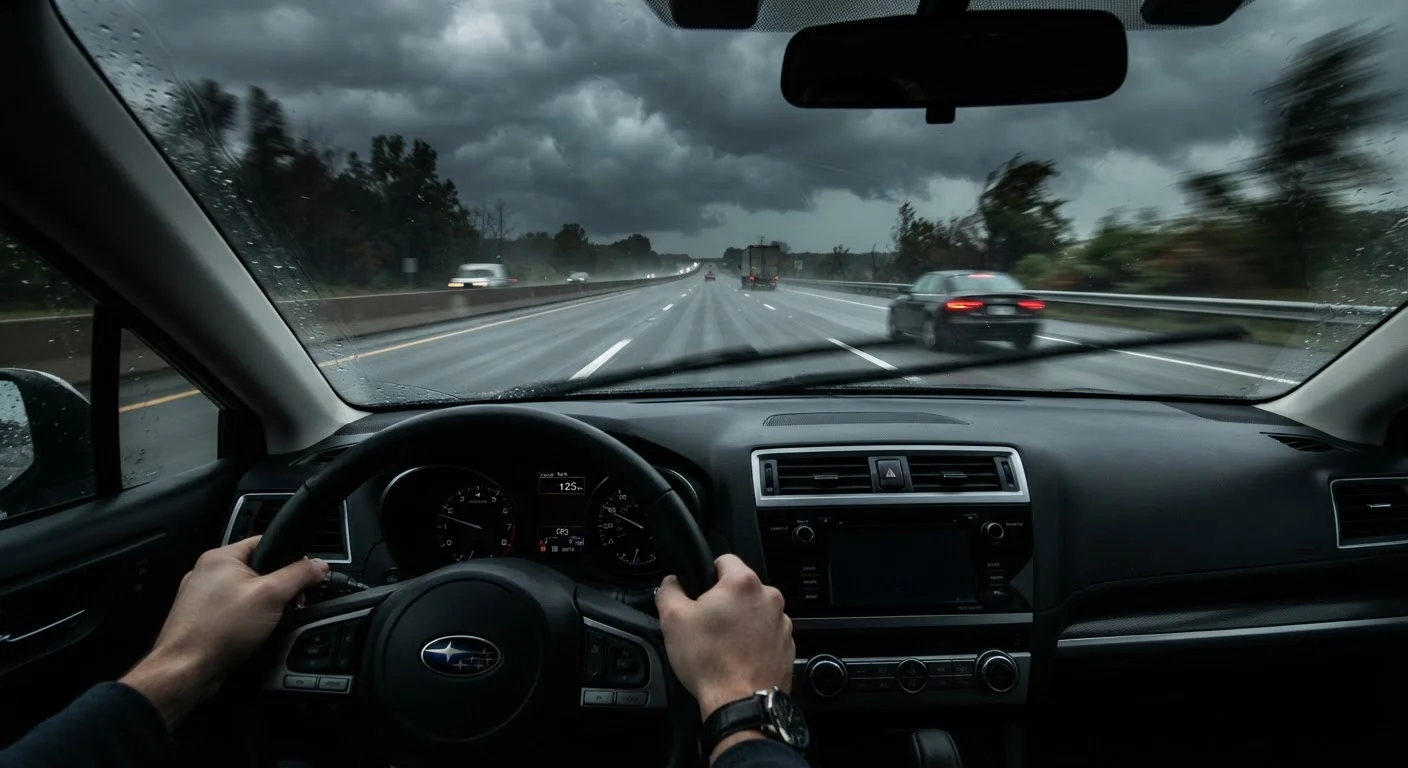
Total Stopping Distance: Two Phases, One Number
Most drivers think of braking as a single event, but stopping a vehicle at highway speed involves two distinct phases: reaction distance and braking distance. Together, they form your total stopping distance — the space your car actually needs from the moment a hazard appears to the moment your wheels stop.
Reaction distance is how far your car travels while your brain processes a threat and your foot moves to the brake pedal. At a typical alert reaction time of 1.5 seconds — a commonly cited figure in traffic engineering research — a vehicle traveling 70 mph covers roughly 154 feet before braking even begins.
Braking distance is the additional distance needed once the brakes are fully applied. Physics makes this number unforgiving: braking distance increases with the square of speed, not linearly. Double your speed and your braking distance roughly quadruples. At 70 mph on dry pavement, a typical passenger car requires approximately 300 feet to stop once the brakes engage. Combined with reaction distance, total stopping distance can exceed 450 feet — roughly 1.5 football fields.
Understanding both phases is the foundation of defensive driving on American roads.
How Weather and Road Conditions Multiply the Numbers
Dry pavement offers the best-case scenario. The moment surface conditions change, braking distances stretch — sometimes dramatically.
~450 ft
Total stopping distance at 70 mph on dry roads
Based on a typical 1.5-second reaction time plus braking distance on dry asphalt for a standard passenger vehicle.
4×
Braking distance increase when speed doubles
Because braking distance scales with the square of speed, doubling your speed roughly quadruples the distance needed to stop.
50%+
Extra stopping distance on wet pavement
Wet roads significantly reduce tire friction; the actual increase depends on speed, tire condition, and road surface.
- Wet roads reduce tire-to-pavement friction significantly. Stopping distances on wet asphalt can increase by 50% or more compared to dry conditions, depending on tire tread depth and speed.
- Snow and ice represent the worst-case end of the spectrum. On packed snow, stopping distances can be 3–4 times longer than on dry pavement. On glare ice, braking distance can extend to 10 times or beyond the dry-road figure.
- Gravel and loose surfaces can behave unpredictably; anti-lock brakes (ABS) may modulate differently, and drivers should not assume dry-pavement instincts apply.
Tire condition matters enormously. Worn tread reduces the tire's ability to channel water away from the contact patch, increasing the risk of hydroplaning — a condition where the tire rides on a thin film of water rather than gripping the road surface. For a deeper look at how rain changes your safety margin, see where American drivers go wrong in the rain.
Following Distance: Translating Physics Into Habit
Knowing the numbers is useful. Building habits around them is what keeps drivers safe. The widely taught three-second rule — picking a fixed point and ensuring three seconds pass between the car ahead and your own — provides a reasonable baseline at moderate speeds, but it needs adjustment at highway speeds or in poor conditions.
At 70 mph, three seconds translates to roughly 308 feet of following distance. That leaves very little buffer once you factor in your own reaction time on top of normal variation. Many traffic safety professionals suggest a four-to-five-second gap at highway speeds and even more in wet or low-visibility conditions.
Tailgating is one of the leading contributors to rear-end collisions, and the physics explains why: a driver following one car length behind at 65 mph has almost no stopping distance margin at all. For a full breakdown of how to adjust spacing by speed and condition, see safe following distances in different driving conditions.
Reaction distance
The distance a vehicle travels from the moment a driver perceives a hazard to the moment the brakes are fully applied. It is directly tied to the driver's reaction time and current speed.
Braking distance
The distance a vehicle travels after the brakes are fully engaged until the vehicle comes to a complete stop. It increases with the square of speed, meaning small speed increases cause large braking-distance increases.
Total stopping distance
The sum of reaction distance and braking distance. This is the real-world space a vehicle needs to come to a complete halt from the moment a hazard appears.
Hydroplaning
A condition where a vehicle's tires ride on a thin film of water rather than maintaining contact with the road surface, causing a significant loss of steering and braking control.
ABS (Anti-lock Braking System)
A safety system that prevents wheels from locking up during hard braking, helping the driver maintain steering control. ABS reduces stopping distance on most surfaces but does not eliminate the physics of speed.
Vehicle type also matters. Larger vehicles — trucks, SUVs, and especially loaded trailers — carry more momentum and typically require significantly longer stopping distances than compact passenger cars, even with equivalent braking systems.
The content on this site is for informational purposes only and is not a substitute for professional advice. Always consult a qualified professional for guidance specific to your situation.