

The Three-Second Rule — and Why It's Just a Baseline
Most American drivers learned the three-second rule during driver's ed: pick a fixed point on the road, watch the car ahead pass it, and count to three. If you reach that point before finishing the count, you're too close. Under ideal conditions — dry pavement, daylight, normal speeds — three seconds gives a reasonable buffer for perception, reaction, and braking.
But ideal conditions are the exception. Speed, weather, vehicle size, and driver alertness all affect how quickly a situation can become unrecoverable. Treating three seconds as the universal answer puts drivers closer to the edge than they realize.
The core principle behind any following-distance guideline is stopping distance: the total space your vehicle needs from the moment a hazard appears to when the car comes to rest. That number is the sum of reaction distance (time before your foot hits the brake) and braking distance (time for the car to stop). Both grow faster than most people expect as speed increases.
How Conditions Should Change Your Gap
Stopping distance
The total distance a vehicle travels from when a hazard is perceived to when the car fully stops. It includes both reaction distance and braking distance.
Reaction distance
The distance covered between perceiving a hazard and physically pressing the brake pedal. At highway speeds, this can be over 100 feet before braking even begins.
Braking distance
The distance the vehicle travels after the brakes are applied until it comes to a complete stop. This is heavily influenced by speed, pavement condition, and tire quality.
Hydroplaning
A condition where a tire rides on a film of water rather than gripping the road surface, causing a dramatic loss of steering and braking control. Most likely at highway speeds on wet roads.
Following distance buffer
The time-based gap a driver deliberately maintains between their vehicle and the one ahead. Measured in seconds using the three-second (or adjusted) counting method.
The table below summarizes how specific conditions affect how much time buffer you should build in. These ranges reflect widely accepted guidance from road safety research and defensive driving curricula.
| Condition | Recommended Buffer | Why It Matters |
|---|---|---|
| Dry pavement, good visibility | 3 seconds | Baseline — adequate reaction time at normal speeds |
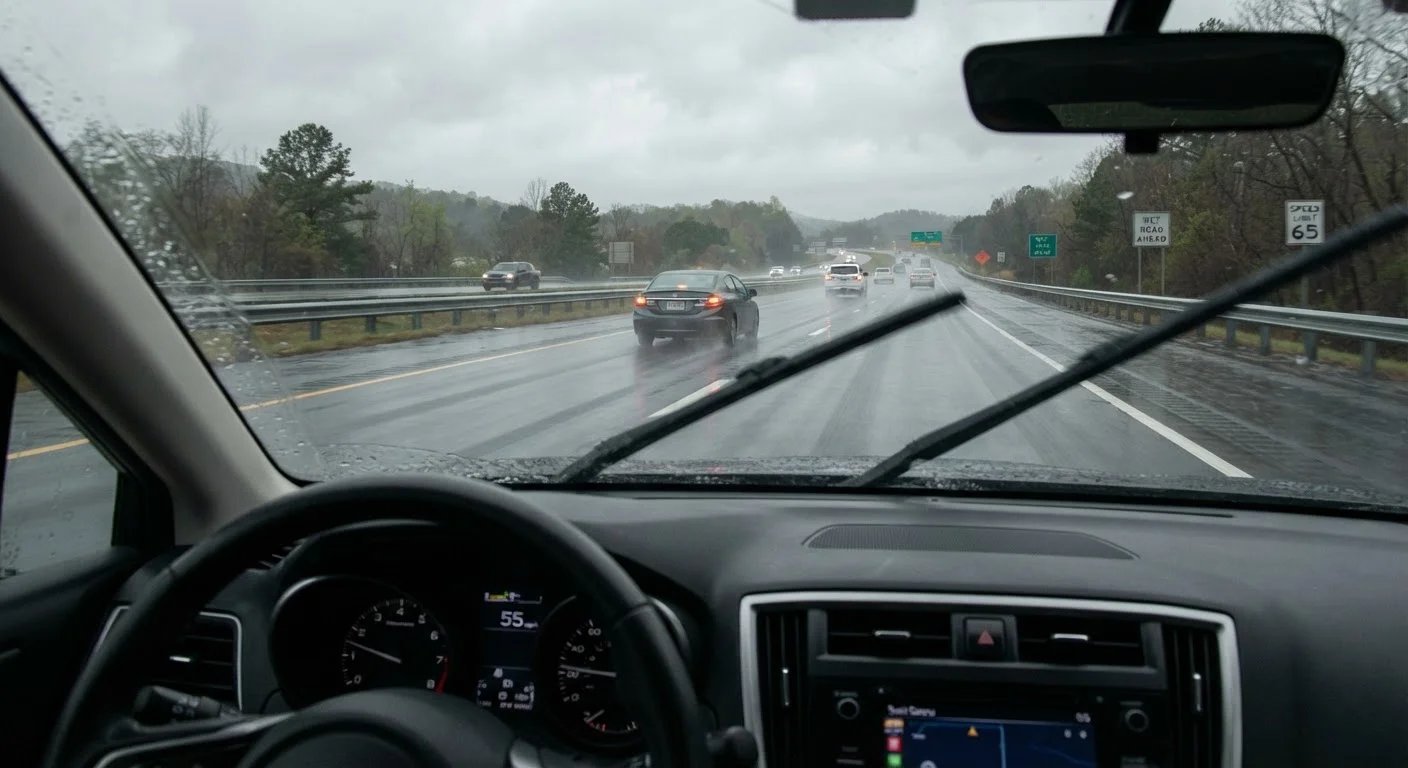
| Rain / wet roads | 4–6 seconds | Wet pavement roughly doubles stopping distance; hydroplaning risk |
| Snow or ice | 8–10 seconds | Ice can multiply stopping distance by 10× versus dry road |
| Fog or heavy smoke | 4–6 seconds minimum | Reduced sight lines mean hazards appear with far less warning |
| Night driving | 3–4 seconds | Headlights limit sight distance; fatigue slows reaction time |
| Towing a trailer | 5–6+ seconds | Heavier loads increase braking distance significantly |
| Highway speeds (65–75 mph) | 4+ seconds | Each second of travel covers ~100 feet; gaps shrink fast |
For rain-specific technique, see what drivers get wrong in wet conditions. For night driving adjustments, these habits can sharpen your after-dark awareness.
Counting Seconds Accurately While Driving
To measure your gap, watch the vehicle ahead pass a fixed roadside marker — a sign, shadow line, or overpass. Say "one-one-thousand, two-one-thousand, three-one-thousand" at a natural pace. If you reach the marker before finishing, ease off the accelerator. This takes a few tries to feel natural, but it becomes instinctive with practice.
Vehicle Type and Load: The Factor Drivers Overlook
Passenger cars and SUVs share the same road with pickup trucks hauling payloads, motorhomes, and semi-trailers — each with dramatically different stopping characteristics. A fully loaded large SUV with worn tires will stop considerably longer than an empty compact car on the same pavement.
If you're driving a heavier or larger vehicle, or towing anything at all, expand your gap before you feel like you need to. The physics of weight and momentum mean you cannot brake as aggressively without risking jackknife (for towed loads) or extended stopping distance.
The same logic applies to tire condition and type. Worn tread substantially reduces wet-weather grip. All-season tires on ice perform far differently than winter tires — which is why following-distance recommendations for snow and ice are so conservative. No amount of attention compensates for inadequate grip.
For a broader look at how road hazards shift across the calendar, the guide on safe driving in all four seasons covers what to watch for month by month.
~29%
Of all U.S. crashes that are rear-end collisions
According to NHTSA data, rear-end crashes are among the most common crash types on American roads.
10×
Stopping distance multiplier on black ice vs. dry road
Road safety research consistently shows ice can extend stopping distances dramatically compared to dry pavement.
88 feet
Distance traveled per second at 60 mph
A basic speed-to-distance conversion that illustrates how quickly gaps close at highway speeds.
The content on this site is for informational purposes only and is not a substitute for professional advice. Always consult a qualified professional for guidance specific to your situation.