

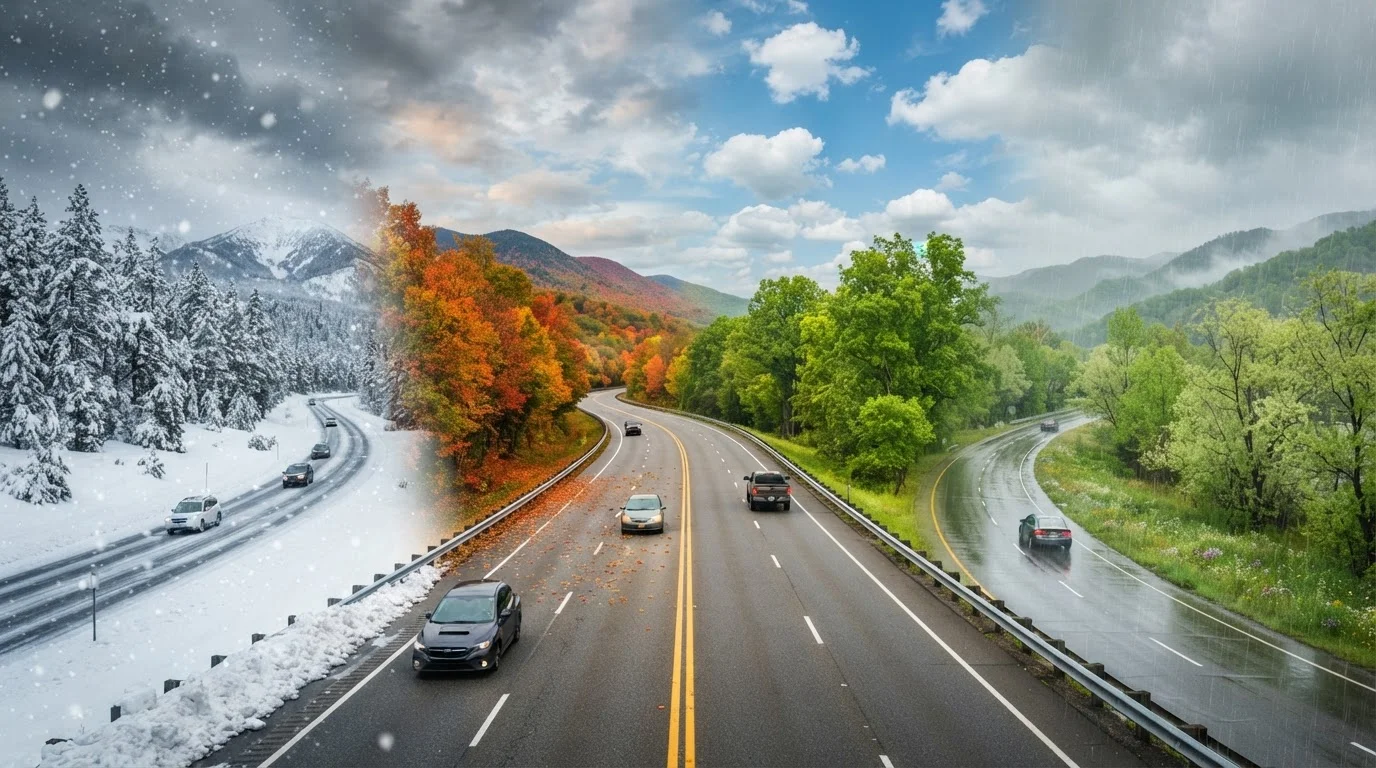
Why Seasonal Road Hazards Deserve Serious Attention
American roads don't behave the same way in January as they do in July. Temperature, precipitation, light levels, and traffic density all shift with the calendar — and so do the risks every driver faces. Yet most drivers apply the same habits year-round, which is a problem when conditions underfoot and overhead change dramatically.
According to the Federal Highway Administration, weather-related road conditions contribute to hundreds of thousands of crashes annually in the United States. Each season has a distinct hazard profile, and recognizing those differences is the foundation of confident, safety-first driving. This guide breaks down what actually changes on American roads in each season — and what you can do about it.
For a complementary look at how climate affects road trip planning across different U.S. regions, see how weather shapes road conditions across major American routes.
21%
U.S. crashes linked to weather conditions
The Federal Highway Administration estimates weather is a contributing factor in about 21% of all vehicle crashes in the United States annually.
3×
Longer stopping distance on ice vs. dry pavement
Stopping distances on ice can be three times greater than on dry asphalt at the same speed, according to road safety research.
1–2 feet
Water depth that can sweep away a vehicle
The National Weather Service notes that as little as two feet of moving water can carry away most passenger vehicles during flash flooding events.
Oct–Dec
Peak deer-vehicle collision season
State wildlife agencies consistently report that deer-vehicle collisions peak during the fall rutting season, with October and November being the highest-risk months.
Winter: Ice, Snow, and Reduced Visibility
Winter is the season most drivers think of first when it comes to road danger — and with good reason. Ice, especially black ice (a nearly transparent glaze that blends into the pavement), forms rapidly on bridges, overpasses, and shaded roadways where the surface cools faster than surrounding areas. Black ice offers virtually no warning and very little grip.
Snow compounds the problem by reducing visibility and covering lane markings. Even a light dusting can mask road edges and painted lines, making lane keeping much harder. Add to that the shorter daylight hours, and winter driving demands a higher baseline of caution than any other season.
Before driving on a cold morning, check whether bridges and overpasses look slightly darker or shinier than the surrounding road — that sheen is often black ice. Treat those surfaces as if they're frozen even when air temperatures hover just above freezing.
Bridge decks lose heat from both above and below, making them freeze before road surfaces that have ground warmth beneath them — a physics reality that catches many drivers off guard.
If you begin to hydroplane, resist the urge to brake hard. Ease off the accelerator gently and keep the steering wheel straight until you feel traction return, then steer smoothly in your intended direction.
Hard braking or sharp steering input while hydroplaning can spin the vehicle; gradual deceleration allows tires to re-engage the road surface as water clears.
Key winter adjustments:
- Increase your following distance to at least 8–10 seconds on snow or ice — stopping distances can triple compared to dry pavement.
- Accelerate and brake gradually; sudden inputs break traction on slick surfaces.
- Clear all snow and ice from your vehicle before driving, including the roof — sliding debris is a hazard to other drivers.
- Check that your headlights, defrosters, and windshield wipers are functioning correctly before heading out.
Pair your winter driving adjustments with proper seasonal vehicle upkeep — the seasonal car maintenance checklist covers what to inspect before each season begins.
Spring: Rain, Flooding, and Unpredictable Surfaces
Spring brings relief from snow but introduces its own set of challenges. Increased rainfall, snowmelt in northern states, and fluctuating temperatures create conditions where road surfaces can deteriorate rapidly. Potholes — formed when freeze-thaw cycles crack pavement — peak in spring, and hitting one at highway speed can damage tires, rims, and suspension components.
Hydroplaning is a serious spring risk. When water on the road surface builds up faster than tires can disperse it, your vehicle can ride on a thin film of water and lose steering control entirely. This typically occurs at speeds above 35 mph on wet roads.
Never Drive Into Flooded Roadways
Floodwater depth is extremely difficult to judge from inside a vehicle, and road surfaces beneath the water may be washed out entirely. Just 12 inches of water can float many cars, and moving water doubles the danger. If you encounter a flooded road, turn around — do not attempt to cross.
Key spring adjustments:
- Slow down in rain, particularly on roads you haven't driven recently where surface conditions may be unknown.
- Never drive through flooded roadways. Just six inches of fast-moving water can knock a person down; two feet can carry away most passenger vehicles.
- Check tire tread depth — worn tires hydroplane at much lower speeds than tires with adequate tread.
- Be alert for loose gravel washed onto roadways from shoulders and embankments.
Summer: Heat, Sun Glare, and Heavy Traffic
Summer feels like easy driving weather — clear skies, dry roads, long days. But it brings its own under-appreciated hazards. Road surface temperatures can climb well above air temperature, accelerating tire wear and increasing the risk of a blowout, particularly on underinflated tires.
Sun glare at dawn and dusk is one of the most overlooked summer hazards. Low sun angles during the hour after sunrise and before sunset can temporarily blind drivers, making it difficult to see traffic signals, pedestrians, and stopped vehicles. This is especially dangerous at intersections and on east-west roads.
Summer also brings significantly heavier traffic — road trips, construction detours, and tourist destinations all increase congestion. More vehicles mean more lane changes, more sudden braking, and a higher probability of encountering distracted or fatigued drivers. Understanding how your risk profile shifts in high-density traffic is covered in detail in our look at highway versus city driving risk.
Key summer adjustments:
- Keep sunglasses accessible in your vehicle at all times and use your sun visor.
- Check tire pressure monthly — heat causes air to expand, and overinflated tires reduce contact patch and grip.
- Allow extra following distance in heavy traffic and anticipate stops earlier than usual.
- Stay hydrated on long drives — dehydration contributes to reduced alertness and reaction time.
Fall: Wet Leaves, Deer, and Fading Daylight
Fall is perhaps the most deceptive season for drivers. The weather often feels mild and the scenery is appealing, but October and November carry hazards that catch many drivers off guard.
Wet leaves on pavement are a significant and underestimated traction hazard. A layer of decomposing leaves can be nearly as slippery as ice, particularly on curves and at intersections where braking force is highest. Because leaves look harmless, many drivers don't reduce their speed accordingly.
Deer activity peaks during the fall rutting season, roughly October through December. Deer are most active at dawn and dusk and are more likely to dart into traffic without warning. The risk is especially pronounced on rural roads and near wooded areas.
Daylight saving time ends in fall, which means more driving occurs in darkness. Reduced visibility affects reaction time and the ability to spot road hazards, pedestrians, and cyclists.
Key fall adjustments:
- Treat leaf-covered roads — especially wet ones — with the same caution as icy pavement.
- Slow down on rural roads at dawn and dusk, and scan tree lines for movement.
- If a deer runs in front of you, brake firmly and hold your lane rather than swerving, which can cause loss of control.
- Ensure your headlights are clean and properly aimed as darkness arrives earlier each evening.
Adapting Your Driving Habits All Year Long
Seasonal awareness isn't just about reacting to bad conditions — it's about anticipating them before you pull out of the driveway. A few consistent habits make a meaningful difference across all four seasons.
Following distance is the single most adjustable safety variable available to any driver. Doubling your following distance on wet, icy, or leaf-covered roads costs almost nothing in travel time but provides the margin needed to stop safely when conditions change.
Speed is the second lever. Posted speed limits reflect dry pavement conditions; in rain, snow, or ice, appropriate speed is lower than the posted limit and must be calibrated to what you can actually see and stop within.
Vehicle readiness underpins all of it. Tires, brakes, lights, and wipers that perform well in July may not be adequate come November. The car maintenance hub covers the essential upkeep routines that keep your vehicle safe across changing conditions. For a structured approach, the seasonal maintenance checklist is a practical place to start each season.
Confident driving in all conditions is built on consistent habits, not luck. Understanding what each season demands — and adjusting accordingly — is what separates prepared drivers from reactive ones.
The content on this site is for informational purposes only and is not a substitute for professional advice. Always consult a qualified professional for guidance specific to your situation.