

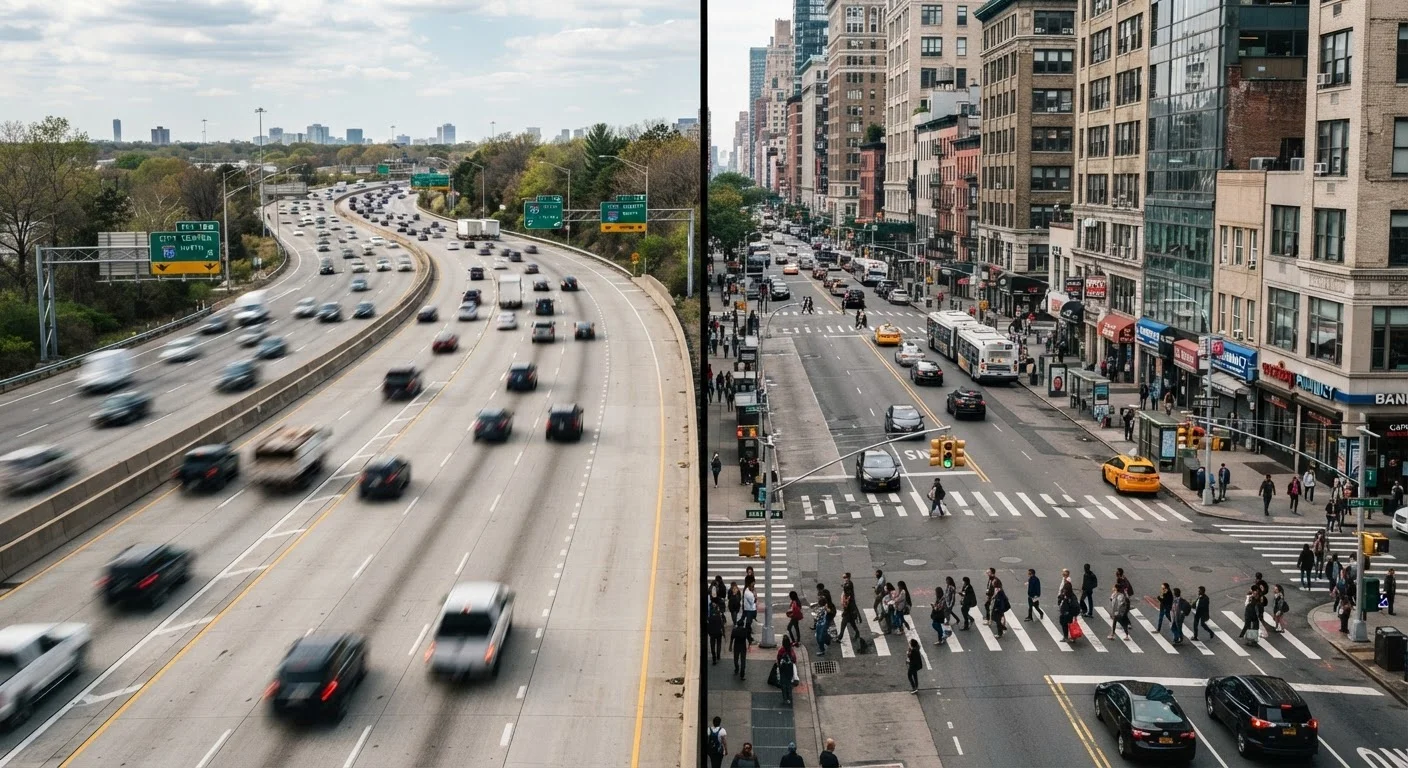
Option A
Highway Driving
High-speed, lower-interruption travel with unique crash severity risks.
Best for: Covering long distances between cities and towns where sustained, consistent speed is the norm.
Option B
City Driving
Lower-speed, high-complexity navigation through dense, unpredictable environments.
Best for: Short, stop-and-go trips in urban and suburban areas with frequent turns, pedestrians, and intersections.
The Core Difference: Speed vs. Complexity
Highway and city driving aren't just different speeds — they're fundamentally different cognitive tasks. On a highway, traffic flows in one direction at high speed with limited interruptions. In a city, you're constantly processing traffic signals, cyclists, pedestrians, double-parked vehicles, and unpredictable lane changes happening simultaneously.
That distinction shapes your risk profile in ways most drivers don't consciously recognize. According to the National Highway Traffic Safety Administration (NHTSA), urban roads account for a disproportionate share of total crash volume — but rural and highway crashes produce a higher rate of fatalities per crash. In short: cities keep you busier, highways hit harder when things go wrong.
Understanding this split is the foundation of defensive driving on American roads — adjusting your behavior not just to the speed limit, but to the actual risk environment you're in.
| Criterion | Highway Driving | City Driving |
|---|---|---|
| Typical speed range | 55–80 mph | 15–45 mph |
| Crash frequency | Lower per mile | Higher per mile |
| Crash severity | Higher fatality rate | Lower fatality rate per crash |
| Primary hazard type | Fatigue, distraction, speed | Intersections, pedestrians, density |
| Decision frequency | Low — sustained attention | High — constant inputs |
| Key skill required | Following distance, lane discipline | Active scanning, anticipation |
| Reaction time window | Very short at high speed | Slightly longer at low speed |
Highway Hazards: What Actually Goes Wrong
The most dangerous highway hazards aren't always the ones that feel dangerous. Crash data consistently shows that distraction, fatigue, and following too closely are the leading contributors to high-speed crashes — not aggressive driving or blowouts, though those matter too.
At 70 mph, a vehicle travels roughly 103 feet per second. A two-second distraction — glancing at a phone, adjusting the radio — means covering more than 200 feet blind. That's why following distance matters so much: you need space to react, not just to brake.
Highway driving also introduces lane-change risk during merges and exits. On-ramp merges are a particular stress point; see our guide to merging onto a freeway without causing a near-miss for specifics on reading traffic speed and using acceleration lanes correctly.
Driver fatigue compounds quickly on long stretches where visual monotony sets in. Night driving on highways raises that risk further, as reduced visibility adds another layer to speed-related hazard.
~56%
Share of US traffic fatalities on rural roads
NHTSA data consistently shows rural and highway roads account for a disproportionate share of fatal crashes relative to their traffic volume.
103 ft/sec
Distance traveled at 70 mph
At highway speed, a vehicle covers over 100 feet every second, making even a brief distraction a significant blind interval.
~40%
Of all US crashes occur at intersections
Federal Highway Administration research identifies intersections as the single highest-risk location type in the urban road network.
City Driving Hazards: Volume and Unpredictability
In urban environments, the hazard isn't speed — it's the sheer density of decision points. The average city driver encounters dozens of intersections, crosswalks, bus stops, and lane merges per mile. Each one is an opportunity for a collision if attention lapses even briefly.
Intersections alone account for a large portion of urban crashes. Left turns carry particular risk: they require crossing oncoming traffic, often without a protected signal phase. Pedestrians and cyclists add further unpredictability, especially at unmarked crosswalks and in neighborhoods where people cross mid-block routinely.
Low speed doesn't mean low consequence. Pedestrian fatalities can and do occur at speeds under 25 mph. City driving demands constant, active scanning — checking not just the car ahead, but the sidewalk, the cross street, and the parked car door that might swing open.
Construction zones amplify city driving risk by compressing lanes, rerouting pedestrians, and changing traffic patterns sometimes without adequate warning.
Speed Limits Don't Tell the Whole Story
A posted 25 mph speed limit in a city doesn't eliminate serious risk — it simply shifts the dominant hazard from impact force to decision complexity. Pedestrian injuries can still occur at low speeds, particularly when drivers fail to scan crosswalks or check blind spots before turning. Always treat a lower speed limit as a prompt to increase awareness, not just reduce the number on your speedometer.
Adapting Your Habits to Each Environment
The best drivers don't apply the same mental mode to every road — they shift their approach as the environment changes. Transitioning from a highway to city streets means dialing up your scanning frequency and reducing your following distance from the highway standard of three to four seconds down to two, while slowing your speed to match the denser environment.
Going the other direction — from city to highway — means resisting the temptation to stay in the left lane unnecessarily, keeping your eyes well ahead rather than fixated on the bumper in front of you, and managing alertness over time. On long highway trips, road conditions shift with the season, adding weather-related variables to the fatigue equation.
The common thread in both environments is anticipation — looking ahead, identifying what could go wrong, and giving yourself the time and space to respond. That habit, more than any vehicle feature or speed limit, is what separates safer drivers from reactive ones.
The content on this site is for informational purposes only and is not a substitute for professional advice. Always consult a qualified professional for guidance specific to your situation.