

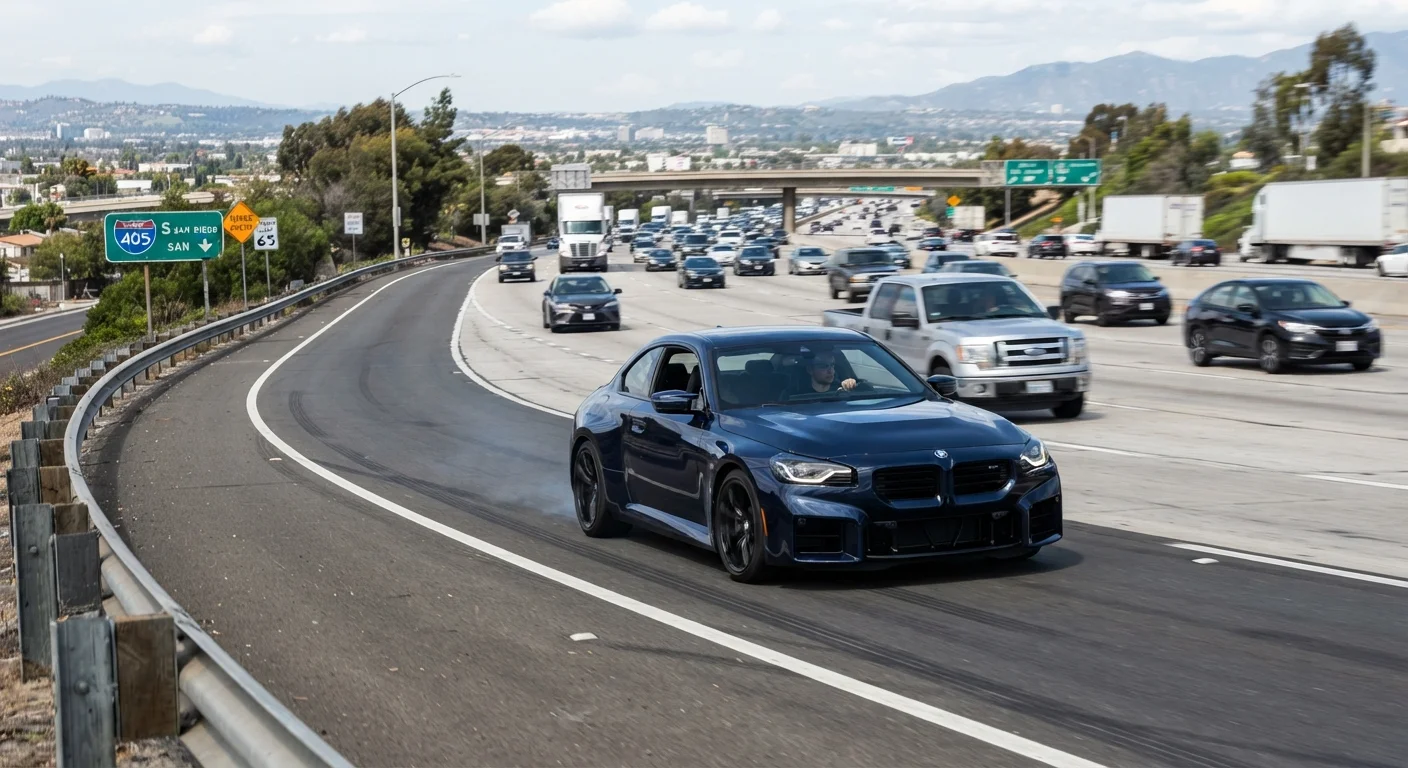
Why Freeway Merges Go Wrong
Merging onto a freeway ranks among the most anxiety-inducing moments for everyday drivers — and for good reason. It requires you to simultaneously accelerate, steer, monitor mirrors, check blind spots, and make a quick judgment call about a gap in traffic moving at 65 mph or faster. When any one of those tasks gets fumbled, a near-miss — or worse — can follow.
Most merge-related problems trace back to a handful of repeatable mistakes: entering the on-ramp too slowly, waiting until the last foot of the acceleration lane to check traffic, or stopping when traffic is heavy. Understanding those failure points is the first step toward fixing them. For a broader look at how highway driving demands a different mindset than city streets, see our article on highway versus city driving risk.
Use the Full Acceleration Lane
Many drivers instinctively slow down or hesitate at the ramp, treating the acceleration lane like a holding area. It is actually designed to get you to freeway speed before you merge. Use every foot of it. Arriving at the merge point near freeway speed makes gap selection significantly easier and reduces the speed differential that causes rear-end incidents.
What You Need Before You Reach the Ramp
A confident merge begins well before the on-ramp itself. Make sure your vehicle is ready — acceleration response, mirrors properly set, and no distractions in hand. If you are heading out on a longer drive, our pre-departure checklist covers what to inspect before you leave.
What you will need
Properly adjusted mirrors
Eliminate as much blind-spot area as possible before you even approach the ramp.
Turn signal
Communicates your merge intention to freeway drivers so they can adjust their spacing.
Clear sight lines
Keeping your windshield, windows, and mirrors clean ensures you can accurately judge gap size and vehicle speed.
Step-by-Step: Merging Safely and Smoothly
Follow these steps in sequence every time you approach a freeway on-ramp. With practice, they become instinctive.
Scan freeway traffic as soon as you enter the ramp
The moment you turn onto the on-ramp, glance toward freeway traffic through your driver-side mirror and over your left shoulder when safe. Identify the speed of vehicles in the right lane and look for a gap that will be available by the time you reach the merge point. Early awareness gives you the longest possible window to adjust your speed.
Accelerate steadily through the ramp curve
Use the full length of the on-ramp to build speed. Begin accelerating as soon as the road straightens enough to do so safely. Your goal is to reach or closely approach freeway traffic speed before you reach the end of the acceleration lane — not after. Hesitant acceleration forces you to merge at a speed differential that makes gaps disappear fast.
Signal your merge intention early
Activate your left turn signal while you are still in the acceleration lane — ideally three to five seconds before you need to complete the merge. This alerts freeway drivers to your presence and gives cooperative drivers time to shift left or ease off the gas to open a gap for you.
Check mirrors and blind spot, then commit to a gap
Do a final left-side mirror check followed by a quick shoulder glance to confirm your blind spot is clear. Pick a specific gap — not a vague sense of open space — and accelerate smoothly into it. Match the speed of surrounding traffic as you enter the lane. Merging either much slower or much faster than traffic creates risk for everyone nearby.
Cancel your signal and stabilize in the lane
Once you are fully in the right lane, cancel your turn signal and establish a safe following distance from the vehicle ahead. Check your mirrors briefly to confirm the merge is complete and traffic behind you has adjusted normally. Avoid sudden braking or weaving immediately after merging — give yourself and surrounding drivers a moment to settle.
Handling Heavy Traffic and Short Ramps
Not every merge is textbook-clean. When freeway traffic is congested or the on-ramp is unusually short, adjust your approach rather than abandoning the fundamentals.
In heavy traffic, you may need to slow slightly at the top of the ramp to time a gap rather than match full freeway speed. Look for cooperative drivers who ease off the throttle to create space — a common courtesy move. If you must stop, do so calmly and wait for a clear gap before accelerating fully. Stopping is a last resort, not a default strategy.
Tailgating on the on-ramp — crowding the car ahead while waiting for a gap — is both dangerous and counterproductive. It removes your sight line to freeway traffic and eliminates your reaction time. Our piece on why tailgating is more dangerous than most realize explains the physics behind stopping distance that make this especially risky at speed.
Short ramps require earlier, more aggressive acceleration. Begin checking traffic the moment you turn onto the ramp — not halfway down it. Construction zones can also compress merge distances without warning; navigating construction zones safely walks through how to handle those added complications.
Never Stop Unless Absolutely Necessary
Stopping at the end of an on-ramp when traffic is moving freely is one of the most dangerous things a driver can do. It forces the vehicles behind you on the ramp to brake suddenly and makes it nearly impossible to accelerate to freeway speed in the remaining distance. Stop only if traffic is at a complete standstill and there is genuinely no safe gap.
The content on this site is for informational purposes only and is not a substitute for professional advice. Always consult a qualified professional for guidance specific to your situation.