

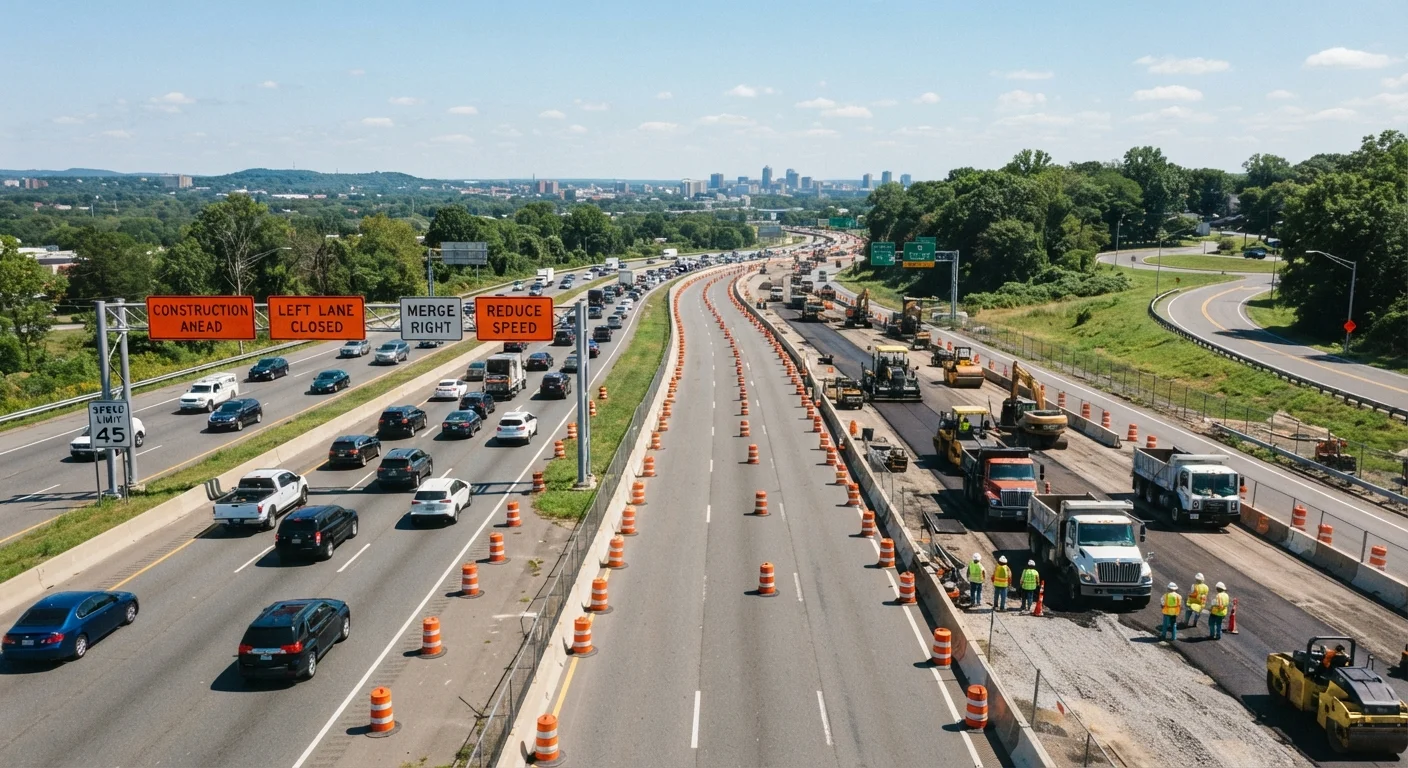
Why Construction Zones Catch Drivers Off Guard
American roads host tens of thousands of active work zones at any given time, and the Federal Highway Administration consistently identifies them as high-risk environments — not just for workers, but for drivers. The challenge isn't that construction zones are inherently confusing; it's that they compress multiple demands into a short stretch of road simultaneously: reduced lane widths, altered traffic patterns, unfamiliar signage sequences, and the presence of workers and equipment just beyond the cones.
Many drivers encounter a work zone and react instinctively — braking hard, changing lanes abruptly, or fixating on the construction activity itself rather than the traffic around them. That reactive mode is exactly what the step-by-step habits below are designed to replace. If you already practice confident scanning in other complex environments — like the shifting risk profiles between highway and city driving — applying that same discipline to work zones will feel natural.
Doubled Fines Are Real and Enforced
Every U.S. state has laws that increase fines — often double — for speeding and other violations committed inside designated work zones. In many states, violations can also result in license points. Law enforcement frequently stations officers specifically within active work zones, so standard speed is not a safe assumption.
Beyond safety, there's a compliance angle worth understanding. Every state imposes enhanced penalties for violations committed inside posted work zones. The financial and legal stakes make deliberate, law-abiding behavior the only sensible approach.
Check Traffic Apps Before You Leave
Navigation apps often flag active work zones with estimated delays before you even hit the road. Knowing a zone is ahead gives you the chance to plan an alternate route, adjust your departure time, or simply prepare mentally — reducing the surprise factor that leads to poor in-zone decisions.
What to Do: Step-by-Step Through a Work Zone
The steps below apply to any work zone you'll encounter — highway construction, urban road resurfacing, or bridge repair. Follow them in sequence and you'll move through confidently rather than reactively.
What you will need
Navigation or Traffic App
Provides advance notice of active work zones, lane closures, and estimated delays along your route.
Cruise Control (OFF)
Disabling cruise control keeps your foot closer to the brake and your attention sharper inside variable-speed zones.
Read the advance warning signs early
Construction zones typically begin with a series of orange diamond-shaped signs placed well before the actual work area — sometimes a mile or more ahead on highways. These signs tell you what's coming: lane drops, reduced speeds, flaggers, or shoulder closures. Treat every orange sign as a prompt to scan further ahead, ease off the gas gradually, and start identifying which lane you'll need to be in.
Merge early and smoothly
When a lane ends ahead, merge as soon as you see the first signs indicating the closure — not at the final merge point. Early merging keeps traffic flowing and reduces the dangerous stop-and-go accordion effect. Signal your intent, check your mirrors and blind spot, match the speed of traffic in the target lane, and move over deliberately. Avoid forcing your way in or stopping mid-lane. For a refresher on reading traffic speed and merging technique, see our guide to merging without causing a near-miss.
Drop your speed and turn off cruise control
Once inside the reduced-speed zone, set your speed to match the posted construction zone limit and disable cruise control immediately. Work zones have unpredictable pace changes: traffic can slow suddenly when a flagger stops vehicles, when equipment crosses the road, or when a lane narrows unexpectedly. With your foot actively over the brake pedal, your reaction time to these events drops significantly compared to riding on cruise.
Increase your following distance
The standard three-second following distance is a minimum under normal highway conditions. Inside a work zone, extend that to at least four to five seconds. Reduced lane widths, debris on the road surface, and erratic behavior from other drivers all demand extra buffer. Count seconds from when the car ahead passes a fixed object — a cone, a sign post — until your front bumper reaches the same point.
Eliminate distractions entirely
Work zones compress lanes, introduce unexpected obstacles, and place workers feet from moving vehicles. This is not the moment for navigation adjustments, phone glances, or dashboard fiddling. If you need to make a change to your route or music, do it before you enter the zone or pull off safely once you're clear of it. Distracted driving is a leading cause of work-zone fatalities for both drivers and road workers.
Obey flaggers and temporary signals above all else
When a flagger is present, follow their directions precisely and promptly — even if a traffic light, sign, or your GPS says otherwise. Make eye contact with the flagger if possible to confirm they see you, then respond to their signal without hesitation. Temporary traffic signals (often portable or mounted on trailers) operate on fixed cycles and may not account for your individual speed, so approach them as you would any red light: prepared to stop.
Maintain calm through the transition back to normal traffic
The end-of-work-zone sign doesn't mean floor it. Traffic ahead may still be moving slowly through residual congestion, and posted speeds return gradually. Accelerate smoothly back to highway speeds only when the road ahead is clear and lanes have fully reopened. Sudden acceleration at the zone exit is a common cause of rear-end collisions with drivers ahead who are still cautious.
Never Ignore a Flagger's Instructions
Flaggers have legal authority to direct traffic, and their instructions override traffic lights or standard road markings. Passing a flagger who is displaying a stop paddle is treated the same as running a red light — and is far more dangerous to the workers around you.
For low-visibility conditions — common in work zones near dawn, dusk, or in poor weather — the habits covered in our night driving guide apply directly: slow down, extend your sightline discipline, and reduce reliance on habit in favor of active observation.
If you're traveling long distances and expect to pass through multiple zones, planning ahead using the US Road Trips hub can help you anticipate stretches of the route that are more likely to have active construction.
The content on this site is for informational purposes only and is not a substitute for professional advice. Always consult a qualified professional for guidance specific to your situation.