

Our Verdict
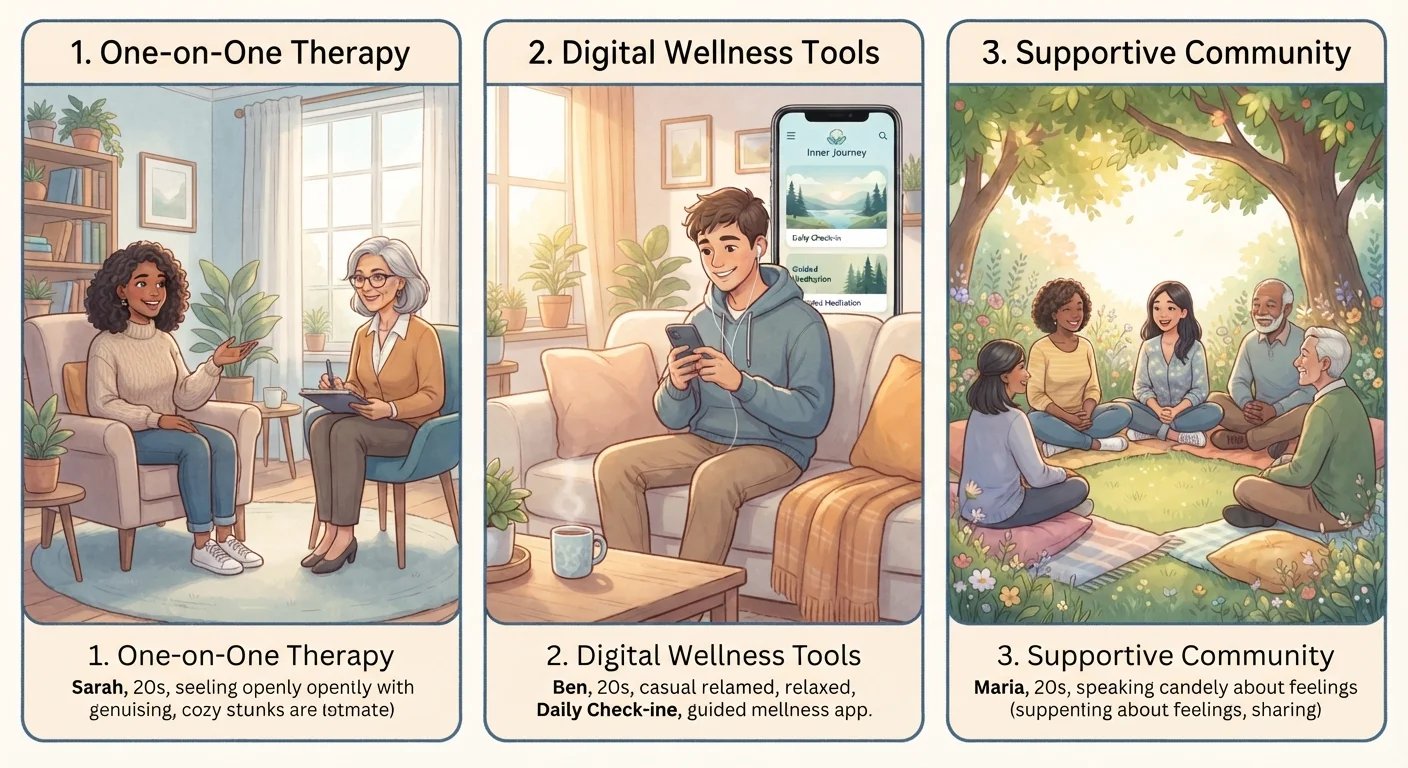
Each option serves a genuinely different purpose. Professional therapy remains the most clinically robust choice for diagnosed mental health conditions, significant distress, or complex personal histories. Self-help apps offer convenient, low-cost skill practice for everyday stress and mood management. Peer support adds a layer of human connection and shared understanding that neither therapy nor technology fully replaces. For many people, the smartest approach is a thoughtful combination of all three.
| Best for | Recommended |
|---|---|
| Those managing a diagnosed mental health condition or significant ongoing distress | Professional Therapy |
| Those seeking affordable, on-demand tools for daily stress or mood management | Self-Help Apps |
| Those who benefit most from shared human experience and community belonging | Peer Support |
| Those wanting a layered, well-rounded mental wellness routine | A combination of all three |
Why This Comparison Matters
Mental wellness support has never been more varied — or more confusing to navigate. Scrolling through an app store, you'll find hundreds of meditation and mood tools. Search online and you'll encounter peer forums, group chats, and community hotlines. Meanwhile, professional therapists and counselors remain the backbone of clinical mental health care. Knowing which option is right for a given situation — and understanding what each one genuinely cannot do — cuts through a lot of noise.
This is general health information intended to help you think through your options, not a substitute for advice from a qualified healthcare professional. If you're experiencing significant distress, persistent symptoms, or a mental health crisis, please reach out to a licensed provider or call a crisis line.
For broader context on everyday mental wellness, see the full picture on mental well-being.
Professional Therapy: Depth and Clinical Expertise
Working with a licensed therapist, psychologist, or counselor means receiving care that is individualized, structured, and grounded in evidence-based practice. Modalities such as cognitive behavioral therapy (CBT), dialectical behavior therapy (DBT), and acceptance and commitment therapy (ACT) have a substantial research record behind them. A trained clinician can assess your situation, track change over time, and adjust the approach if something isn't working.
Therapy is typically the most appropriate path when symptoms are persistent, significantly impairing daily life, or connected to past trauma. It's also the only option on this list that involves a professional bound by ethical and licensing standards.
The practical barriers are real: cost, insurance coverage, waitlists, and geographic availability all affect access. Telehealth has expanded reach considerably, but gaps remain — particularly for rural communities and lower-income households.
Ask About Sliding-Scale Fees
Many therapists offer sliding-scale pricing based on income, and community mental health centers often provide services at reduced cost. If cost is a barrier, it's worth asking directly — more providers offer flexible rates than most people realize. Training clinics at universities can also be an affordable option.
Self-Help Apps: Accessibility and Skill Practice
Mental wellness apps typically offer guided meditations, breathing exercises, mood logs, sleep tools, and structured programs loosely based on CBT or mindfulness principles. Their main advantages are availability (any time, any place) and low or no cost at entry level.
Research on app effectiveness is growing but still developing. Some studies suggest structured app-based programs can reduce mild-to-moderate anxiety and depression symptoms in the short term, particularly when combined with other support. However, app-based tools generally lack personalization, cannot diagnose, and don't involve a human clinician tracking your progress.
Apps are most useful as a daily practice supplement — a way to build skills between therapy sessions, maintain habits during low-stress periods, or simply create a moment of intentional calm. They are generally not designed to manage clinical-level conditions on their own. For a closer look at one popular app feature, the pros and cons of mood-tracking apps walks through the genuine benefits and drawbacks.
| Professional Therapy | Self-Help Apps | Peer Support | |
|---|---|---|---|
| Personalization | High — tailored to the individual | Low — mostly preset programs | Moderate — shared experience-based |
| Clinical oversight | Yes — licensed professional | No | No (unless facilitated by a professional) |
| Cost | Higher; varies by insurance/access | Free to low-cost entry | Often free or low-cost |
| Availability | Limited by schedule and location | 24/7, smartphone required | Varies by group and format |
| Human connection | One-on-one with a professional | None | Group-based, peer-to-peer |
| Best suited for | Clinical conditions, complex needs | Mild stress, skill practice | Isolation, shared experience, community |
Peer Support: Connection and Shared Experience
Peer support encompasses a wide range of formats: in-person support groups, online communities, structured peer-specialist programs, and informal mutual aid networks. What distinguishes peer support from the other two options is its foundation in shared lived experience rather than clinical expertise or technology.
Research consistently connects social support to better mental health outcomes, including reduced feelings of isolation and improved coping. Peer groups can reduce stigma by normalizing struggle and fostering a sense of belonging that neither an app nor a therapist can fully replicate.
The limitations are equally worth naming. Peer spaces vary enormously in quality and moderation. Without clear boundaries or trained facilitators, some online communities can inadvertently reinforce unhelpful patterns. As noted in common mental wellness myths, unstructured venting doesn't always help and can occasionally make things worse.
Well-run peer support — whether through a nonprofit, healthcare system, or established community organization — tends to offer significantly more benefit than informal, unmoderated spaces.
Building a Layered Approach
These three options aren't mutually exclusive, and for many people the most effective approach involves elements of each. Someone might work with a therapist weekly, practice a breathing exercise via an app between sessions, and attend a monthly peer group for connection. The combination addresses different dimensions: clinical skill-building, daily habit formation, and human belonging.
Small daily habits for emotional regulation can complement whichever structured support you choose, reinforcing gains made in therapy or peer settings. Similarly, journaling practices supported by research can serve as a low-cost self-reflection tool alongside any of the three options above.
The practical starting point is honest self-assessment: How severe are your current symptoms? What can you realistically access and afford? What has or hasn't worked before? A primary care physician or a mental health professional can help you think through the right level of support for your specific situation.
This article is for general informational purposes only and does not constitute medical or mental health advice. Always consult a qualified healthcare professional regarding your individual circumstances.
The content on this site is for informational purposes only and is not a substitute for professional advice. Always consult a qualified professional for guidance specific to your situation.