

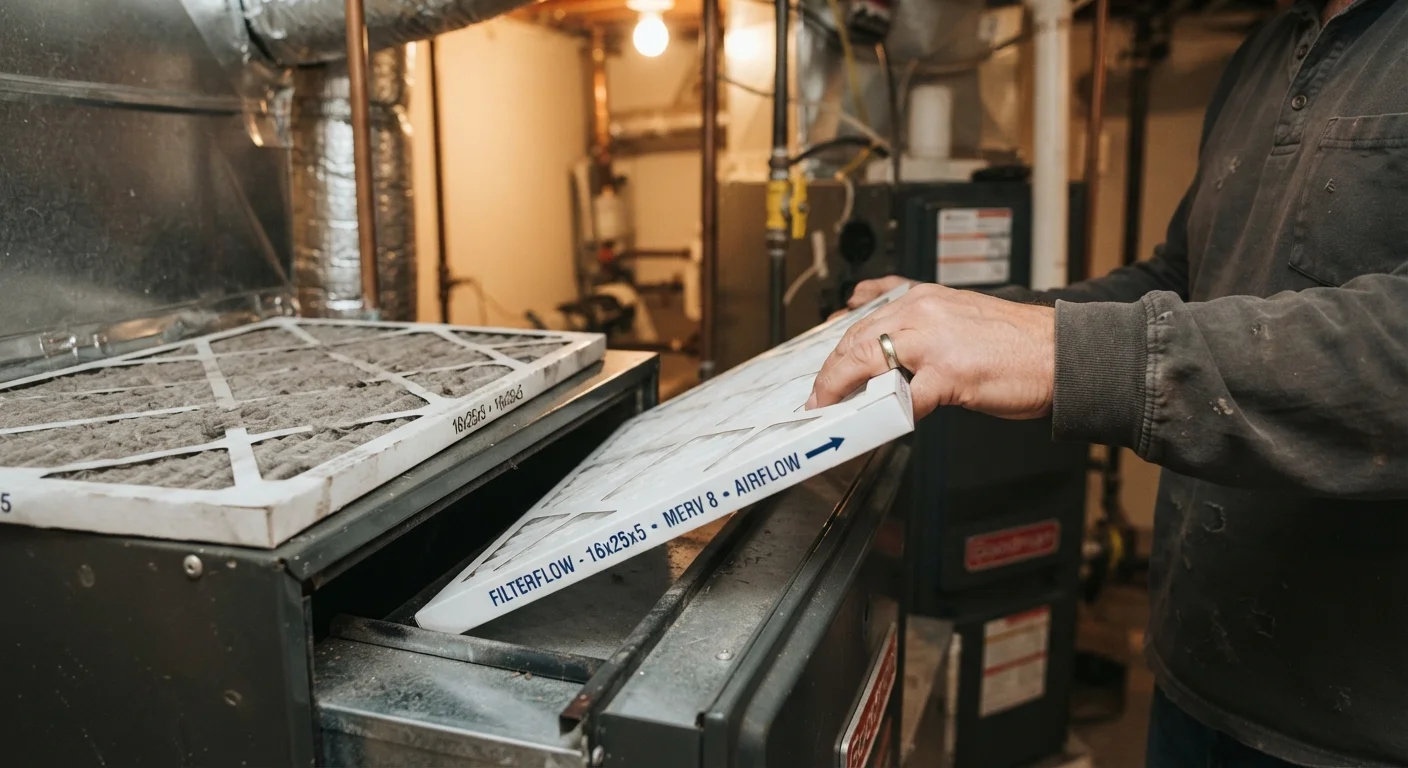
What MERV Ratings Actually Mean
Every furnace filter carries a MERV rating — Minimum Efficiency Reporting Value — a standardized scale from 1 to 16 that describes how effectively the filter captures particles. Higher numbers catch smaller particles. A MERV 1–4 filter stops large debris like lint and dust bunnies. A MERV 8 traps mold spores, pet dander, and most dust. A MERV 11–13 captures fine particles including some bacteria and smoke.
The instinct to grab the highest-rated filter available is understandable, but it often backfires. Residential HVAC systems are engineered for a specific range of airflow resistance. Filters rated MERV 13 and above are dense enough to restrict airflow in systems not designed for them — forcing the blower motor to work harder, raising energy consumption, and accelerating wear. For most American homes, a MERV 8 to MERV 11 filter strikes the right balance between filtration and airflow. Households with allergy sufferers or asthma may benefit from pushing toward MERV 11, but should confirm compatibility with their system's specifications or an HVAC technician first.
HEPA Filters and Residential HVAC Systems
True HEPA filters — rated at MERV 17 and above — are not designed for standard forced-air residential systems. They are so dense that most home HVAC blowers cannot overcome the resistance. If hospital-grade filtration is a priority, consult an HVAC professional about whether a whole-home air purifier or supplemental filtration unit is appropriate for your system rather than substituting a HEPA filter into a standard slot.
How Often to Replace Your Filter — and What Changes That Interval
The standard guidance of every 90 days is a reasonable starting point for a single-occupant home with no pets and no significant dust sources. Real households rarely fit that baseline. Here's how common variables shorten the interval:
- One or more pets: Drop to every 60 days. Pet hair and dander clog filters faster than almost anything else.
- Multiple occupants or young children: Plan for every 60 days.
- Allergy or asthma in the household: Some households benefit from monthly changes, especially during high-pollen seasons.
- Vacation or infrequently used home: A filter in a rarely occupied space can last six months or more.
- Recent renovation: Construction dust is extremely fine and fills filters rapidly — check and likely replace within 30 days of any drywall, sanding, or demolition work.
The most reliable check is visual inspection. Pull the filter monthly and hold it to light. A filter that looks uniformly gray and blocks your view through it is overdue for replacement. Weaving this task into your seasonal home maintenance calendar makes it easy to stay consistent year-round.
The Airflow Trade-Off and Why It Matters
A clogged filter and an overly restrictive filter cause the same core problem: insufficient airflow across the heat exchanger. In a gas furnace, restricted airflow traps heat, causing the unit to overheat and cycle off on its high-limit safety switch. Repeated cycling strains the heat exchanger — a component that, when cracked, requires either expensive repair or full system replacement.
Filter thickness is a related variable many homeowners overlook. A 1-inch filter in a slot designed for a 4-inch media filter will allow air to bypass the filter entirely around its edges, defeating the purpose. Conversely, forcing a thick filter into an undersized slot damages the filter frame and creates gaps. Check your system's manual or the existing filter's dimensions before purchasing a replacement.
Filter changes also tie directly into other safety systems. A furnace working harder due to airflow restriction produces more heat stress throughout the system — worth keeping in mind alongside other maintenance priorities like those covered in our guide on smoke and CO detector maintenance. These systems work together; neglecting one increases the stakes for the others.
For a broader look at how filter maintenance fits into your full HVAC upkeep picture, see Home Maintenance From the Ground Up.
Match your filter's MERV rating to your system's design specifications, not the highest available option.
Filters that are too restrictive reduce airflow, overwork the blower motor, and can cause the furnace to overheat and cycle off repeatedly. Compatibility between the filter and the system is more important than maximum filtration.
Set a recurring reminder to visually inspect your filter every 30 days, regardless of your planned replacement interval.
Household conditions change — a renovation, a new pet, or an unusually dusty season can clog a filter weeks ahead of schedule. Regular visual checks catch this before damage occurs.
Always replace with a filter that matches the exact dimensions of your system's slot.
Undersized filters allow air bypass around the edges, sending unfiltered air through the system. Oversized filters won't seat properly and create gaps or frame damage.
Shorten your replacement interval to 60 days or less if you have pets or allergy sufferers in the household.
Pet dander and hair are among the fastest filter-clogging materials in a typical home. Allergy sufferers benefit from fresher filtration surfaces that haven't accumulated months of allergens.
Replace your filter immediately after any indoor renovation involving dust, drywall, or demolition.
Construction dust is extremely fine and accumulates far faster than everyday household particles. Leaving the existing filter in place during or after a project can clog it within days.
Putting It Into Practice
Furnace filter maintenance is one of the lowest-cost, highest-impact tasks in home upkeep. A filter that costs a few dollars, changed on the right schedule, helps your HVAC system run efficiently, protects indoor air quality, and reduces the likelihood of an expensive service call. The wrong filter — too restrictive, too thin, or left in too long — quietly costs more than the savings it seems to offer.
If you are ever uncertain whether your system's current setup is appropriate, an HVAC technician can assess your blower capacity and recommend the right filter specifications for your equipment. This is also one of the most frequently misunderstood home maintenance tasks — so if you've been guessing until now, you're far from alone.
5–15%
Energy savings from regular filter changes
The U.S. Department of Energy has noted that replacing a clogged HVAC filter can reduce system energy consumption by roughly 5 to 15 percent.
60 days
Recommended interval for pet-owning households
HVAC industry guidance generally shortens the standard 90-day interval to 60 days or less for homes with one or more shedding pets.
The content on this site is for informational purposes only and is not a substitute for professional advice. Always consult a qualified professional for guidance specific to your situation.