

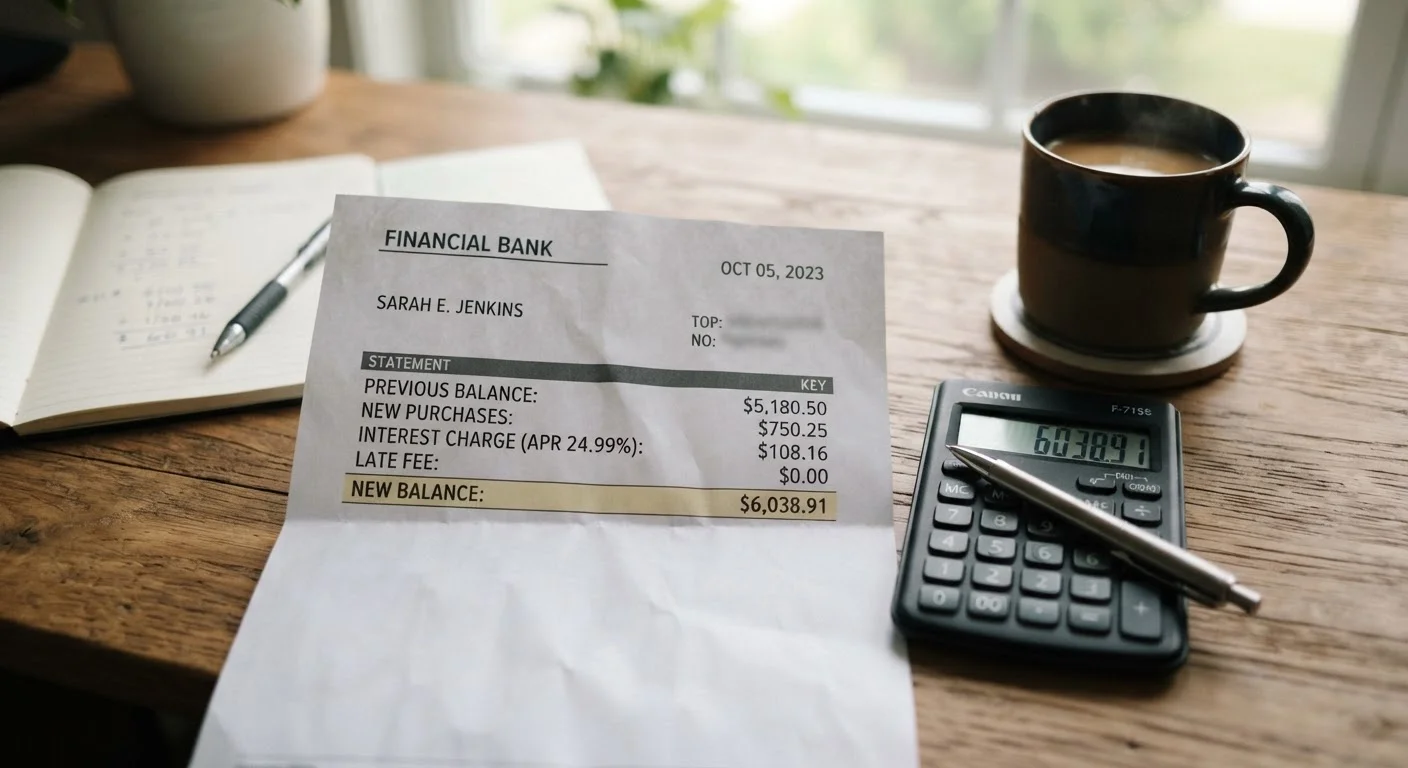
From APR to Daily Charge: How the Math Actually Works
Your credit card's APR is a yearly rate, but interest doesn't wait until the end of the year to show up. Card issuers convert that annual rate into a daily periodic rate by dividing it by 365. Each day you carry a balance, that rate is multiplied by what you owe, and the result is added back to your balance.
Here's what that looks like in practice. If your card carries a 22% APR, your daily rate is roughly 0.0603%. On a $500 balance, that's about 30 cents per day — which sounds trivial. But because yesterday's interest becomes part of today's balance, the charges compound. Over a full month, that $500 generates roughly $9 in interest. Over a year without any payments, the balance grows to about $610.
The compounding effect is why many people feel like they're making payments but their balance barely moves. They are paying interest on interest, not just on the original amount they spent.
20%+
Average U.S. credit card APR
Federal Reserve data has shown average credit card interest rates consistently exceeding 20% in recent years, among the highest levels in decades.
$1,000+
Extra interest on minimum-only payments
On a typical $1,500 balance at ~21% APR, paying only the minimum can result in over $1,000 in total interest charges before the balance is cleared.
1/365
Daily fraction of APR charged
Most U.S. credit card issuers calculate interest daily, meaning your balance grows every single day you don't pay it in full.
The Grace Period: Your Best Defense Against Interest
Most credit cards offer a grace period — typically 21 to 25 days between the end of your billing cycle and your payment due date. If you pay your full statement balance before that due date, issuers are generally required by law (under the CARD Act of 2009) not to charge interest on new purchases.
This means the credit card, used correctly, is an interest-free short-term loan. The problem starts when you carry even a portion of the balance forward. Once you don't pay in full, interest often begins accruing from the original purchase dates — not just on the remaining amount. Some cards also lose the grace period entirely until you pay the balance in full again.
Two important exceptions: cash advances and balance transfers typically start accruing interest the moment the transaction posts, with no grace period at all — and often at a higher rate.
Set Up Autopay for the Full Statement Balance
Automating your full statement balance payment — not just the minimum — ensures you never accidentally carry a balance or lose your grace period due to a forgotten due date. Most card issuers allow you to schedule this directly through their app or website. Even if cash flow is tight some months, knowing this option exists keeps it in your toolkit.
Why Minimum Payments Keep You in Debt Longer
Card issuers set minimum payments low — often 1% to 2% of your balance, or a small flat dollar amount. This is not designed with your financial wellbeing in mind. At minimum payment levels, the bulk of your payment covers interest, leaving very little to reduce the principal.
Consider a $1,500 balance at 21% APR. Paying only the minimum (estimated at around $30–$37 per month as the balance shrinks) could take more than 10 years to pay off and cost over $1,000 in interest charges alone — more than half the original balance. Doubling that payment to $75 per month could cut the timeline to under two years and save hundreds of dollars.
If you're trying to balance debt payoff with other financial goals, understanding exactly what your interest charges cost each month gives you a concrete number to work with. See our guide to managing saving and debt repayment together for frameworks that address both at once.
What to Do If Interest Is Eating Your Budget
Once you understand the mechanics, a few strategies become clear. First, prioritize paying more than the minimum — even $20 or $30 extra per month reduces principal faster and limits compounding. Second, if you carry balances on multiple cards, a structured payoff method can help. Our comparison of the debt avalanche and debt snowball methods walks through which approach may suit your habits and situation.
For larger balances, debt consolidation is worth understanding — it can sometimes lower the interest rate you're paying, though it comes with its own trade-offs and risks to weigh carefully.
It's also worth reflecting on the habits that make balances grow in the first place. Some spending patterns feel low-stakes but accumulate quietly — our piece on financial behaviors that quietly hold people back covers several worth examining honestly.
This article is for general informational and educational purposes only and does not constitute personalized financial or legal advice. For guidance specific to your situation, consult a qualified financial professional.
Frequently Asked Questions
Your card issuer divides your APR by 365 to get a daily periodic rate, then multiplies it by your average daily balance and the number of days in the billing cycle. The result is added to what you owe. For example, a 22% APR means a daily rate of roughly 0.060%, which on a $1,000 balance adds about $18 in interest per month.
Minimum payments are typically 1–2% of your balance or a small flat dollar amount. Paying only the minimum means most of your payment goes toward interest, barely reducing the principal. A $2,000 balance at 22% APR could take over a decade to pay off with minimum payments only, costing hundreds in extra interest.
Yes — for purchases, if you pay your full statement balance by the due date each month, issuers generally do not charge interest. This grace period typically applies to new purchases only, not to cash advances or balance transfers, which often begin accruing interest immediately.
Lower is always better, but the most important thing is avoiding carrying a balance at all. Federal Reserve data shows average credit card interest rates regularly above 20%. If you do carry a balance, a lower APR reduces daily charges — but it does not eliminate them.
You can call your card issuer and request a lower rate, especially if you have a strong payment history. There's no guarantee, but issuers sometimes accommodate the request. Consumer advocates at the CFPB note this is an underused option worth trying before seeking other solutions.
Generally, high-interest debt costs more than low-risk savings earn, making aggressive debt payoff financially sound. However, most financial educators recommend keeping a small emergency fund — even $500 to $1,000 — so that unexpected costs don't push you back onto the card. A qualified financial adviser can help you weigh your specific situation.
The content on this site is for informational purposes only and is not a substitute for professional advice. Always consult a qualified professional for guidance specific to your situation.