

The Budget Gaps Most Travelers Never See Coming
Savvy travelers obsess over flight fares and hotel rates — and rightfully so. But some of the biggest hits to a travel budget come from a handful of quiet, easy-to-overlook decisions made before and during a trip. These aren't rookie mistakes; even experienced travelers fall into these traps regularly.
The good news? Every one of them is avoidable once you know what to look for. Whether you're heading overseas or mapping out a domestic road trip, these are the overlooked money leaks worth plugging before you go.
Using a card with foreign transaction fees abroad
Most standard U.S. credit and debit cards charge a foreign transaction fee — typically 1% to 3% — on every purchase made outside the country. That might sound minor, but on a two-week international trip with $3,000 in card spending, you could quietly lose $60–$90 before you even notice. Many travelers don't realize this fee exists until they review their statement at home.
Cards designed for travel — often from credit unions or travel-focused issuers — frequently waive this fee entirely. Checking your card's fee structure before departure costs nothing. For more on how currency exchange works in practice, see what to know before converting currency abroad.
A 3% foreign transaction fee on $3,000 in spending quietly costs $90 before you notice.
Exchanging currency at airport kiosks
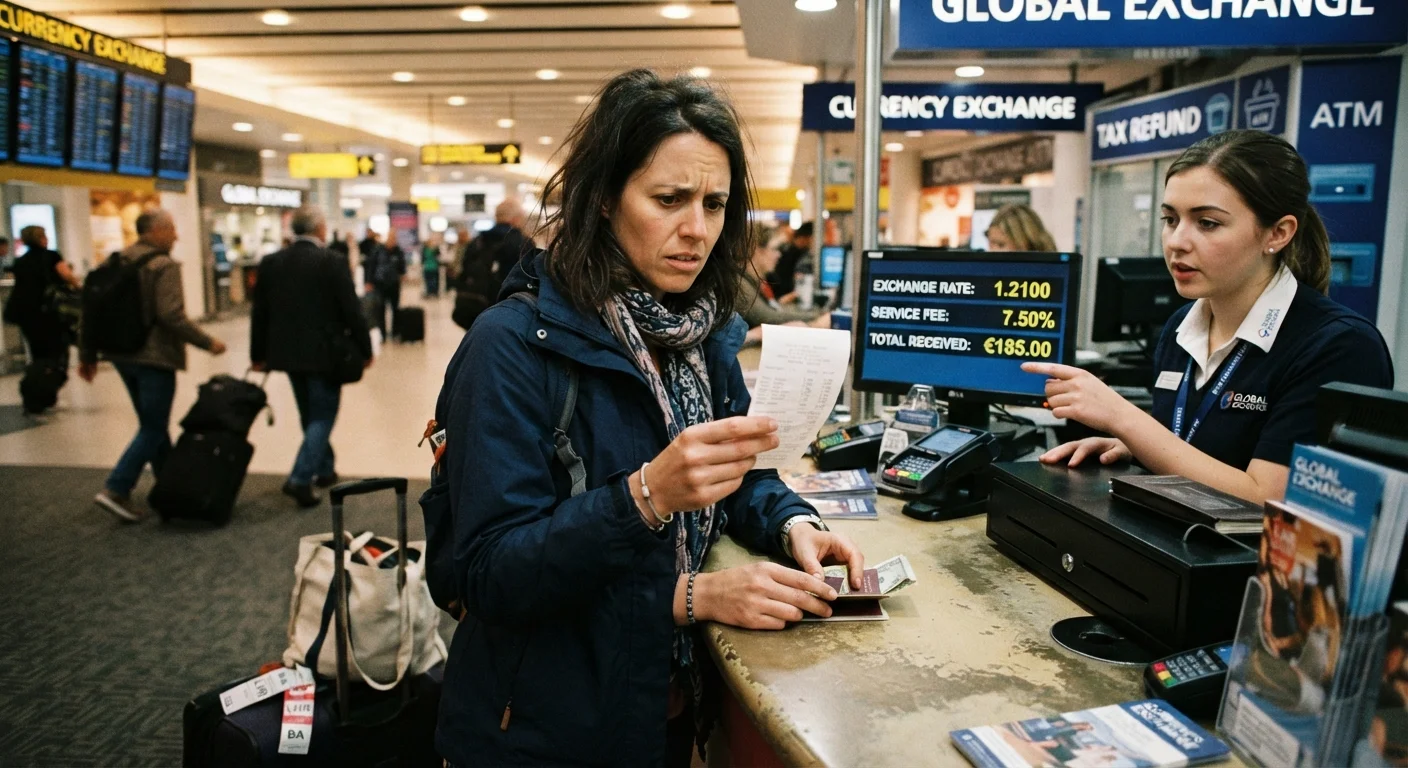
Airport currency exchange counters are convenient — and consistently among the most expensive places to convert money. The spread between the rate they offer and the mid-market rate (the real exchange rate) can be substantial, sometimes 8–12% worse than what you'd get from a local ATM or bank. That gap is essentially an invisible fee on every dollar you convert.
A better approach for most travelers is withdrawing local currency from an ATM upon arrival, using a bank with favorable international withdrawal terms. Even with an ATM fee, the net rate is usually far better than an airport kiosk. First-time international travelers are especially likely to fall into this trap out of convenience.
Airport exchange kiosks can offer rates 8–12% worse than a local ATM upon arrival.
Renting a car at peak times and airport locations
Car rentals at airports carry built-in surcharges — airport concession fees, facility charges, and local taxes that often add 20–30% to the base rate. Picking up a rental from an off-airport location a short rideshare ride away can meaningfully cut that total. Similarly, weekend and holiday pickups tend to command premium pricing, especially at popular tourist destinations.
For international trips, the calculus around renting versus using local transit is worth thinking through carefully. Ground transportation options abroad vary widely by destination, and a rental isn't always the cost-effective choice it might seem at home.
Airport rental surcharges alone can add 20–30% to a car rental's base rate.
Skipping travel insurance on non-refundable bookings
Travel insurance feels like an optional extra right up until a flight gets cancelled, a medical issue arises abroad, or a hurricane forces a reroute. For trips built around non-refundable flights, hotels, and tours — especially international ones — the financial exposure from skipping coverage can far exceed the cost of a policy. Trip cancellation and interruption coverage, medical evacuation, and lost baggage protection are all common policy components worth understanding.
Coverage costs and terms vary significantly, so comparing options before purchasing is important. This is general information — readers should review individual policy terms and consult an insurer for guidance specific to their situation.
Skipping insurance on a non-refundable trip can turn one disruption into a four-figure loss.
Ignoring fare calendar flexibility
Flying on a Tuesday or Wednesday rather than a Friday or Sunday frequently costs less — sometimes significantly so — on the same route. Many booking platforms include a flexible date view that shows price variation across a range of days. Shifting departure or return by even one day can occasionally save $100–$200 per person on domestic routes and more on international ones.
Airfare pricing follows patterns that aren't random. Understanding the logic behind flight prices helps travelers make more informed decisions rather than booking on instinct. Also worth reviewing: the real cost of a cheap flight, since a low base fare doesn't always mean a low total cost.
Shifting your departure by one day can sometimes save $100–$200 per person on the same route.
Underestimating budget airline add-on fees
Ultra-low-cost carriers advertise fares that can look dramatically cheaper than mainline competitors. But checked bag fees, carry-on charges, seat selection fees, and in-flight purchases can add $80–$150 or more per round trip to that base price. When totaled up, the "cheap" ticket sometimes costs as much as — or more than — a full-service fare that included those amenities. Comparing total trip cost, not just the base fare, is essential before assuming a budget carrier is actually the budget option.
Budget airline add-ons can quietly erase every dollar saved on a discounted base fare.
Making Your Travel Dollars Work Harder
None of these oversights require complicated workarounds to fix. Most come down to a bit of advance research and a few deliberate decisions during the planning phase. For a deeper look at the financial prep that often gets skipped, the pre-trip financial checklist for budget travelers covers the full picture — from currency to insurance to ATM strategy.
If you're weighing reward points against straightforward savings, it's also worth reading up on how travel rewards compare to cash savings before assuming one approach is always better. And for anyone planning a first international trip, understanding the decisions that complicate international travel can help you avoid the planning gaps that catch most people off guard.
Do a quick cost audit before booking
Before finalizing any trip, total up the add-on costs: card fees, baggage, insurance, airport transfers, and rental surcharges. Many travelers find that shifting just one or two of these decisions saves more than hours of hunting for a cheaper hotel. A full budget travel planning framework can help you approach this systematically.
The trips that stretch your budget furthest usually aren't the ones with the lowest sticker price — they're the ones where the traveler anticipated the hidden costs before they hit.
The content on this site is for informational purposes only and is not a substitute for professional advice. Always consult a qualified professional for guidance specific to your situation.