

Why Overpacking Happens — and Why It Costs You
Overpacking is almost a rite of passage for first-time international travelers. The logic feels sound: what if you need that extra outfit? What if the weather changes? But hauling a heavy checked bag through train stations, cobblestone streets, and cramped hostels has real costs — financially and physically. Many airlines charge checked-bag fees that add up quickly each way, and navigating busy airports is measurably harder when you're lugging more than you can comfortably carry.
The good news is that packing light is a learnable skill, not a talent reserved for minimalists. Whether you're heading out for a week or a month, these practices will help you travel smarter. If you're also sorting out the logistics side of your trip, see our first international trip planning guide for everything from passport checks to travel insurance.
Core Practices for Packing Light Without Sacrificing Comfort
These proven strategies cover every stage of the packing process, from planning your wardrobe to deciding what documents to carry.
Build your wardrobe around a single neutral color palette.
When every item coordinates with every other, a small number of pieces produces a surprisingly large number of outfits. This eliminates the need to pack 'just in case' clothing that ends up worn once or never.
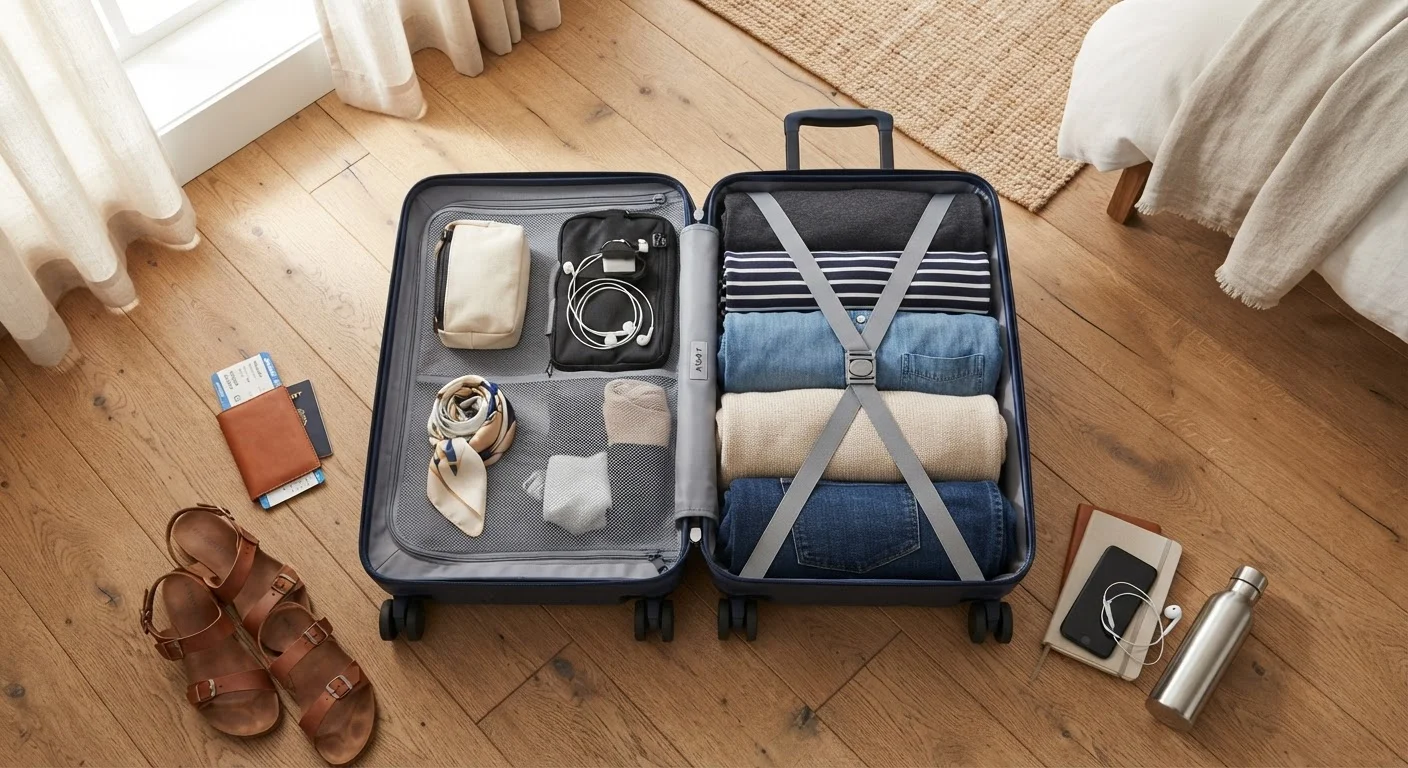
Roll your clothes instead of folding them flat.
Rolling compresses garments more efficiently and makes it easier to see everything at a glance without unpacking. It also reduces wrinkles in many fabrics.
Use packing cubes to compartmentalize and compress your bag.
Packing cubes create structure inside a soft bag, preventing shifting and making repacking fast at every stop. Compression cubes can reduce clothing volume noticeably.
Limit toiletries to a small pouch of true essentials, and plan to buy the rest locally.
Full-sized toiletry bottles are heavy and often violate carry-on liquid rules. Most everyday products — shampoo, sunscreen, toothpaste — are widely available at destinations worldwide.
Check your airline's exact baggage dimensions and weight limits before packing.
Rules vary significantly between carriers, especially budget international airlines. A bag that fits one carrier's overhead bin may be gate-checked on another — sometimes at steep fees.
Create a master packing list and stick to it.
Without a list, packing becomes emotional rather than strategic — leading to duplicates, forgotten essentials, and last-minute panic additions. A vetted list removes the guesswork.
Quick Actions You Can Take Right Now
You don't have to overhaul your entire packing style overnight. Start with these small, high-impact moves before your next departure.
Thinking about skipping checked bags entirely? Our carry-on only travel guide gives a realistic look at what that actually requires for trips of any length.
The Mindset Shift That Makes It All Click
Packing light isn't about deprivation — it's about trusting that most things you forget can be found, borrowed, or done without. Pharmacies, convenience stores, and supermarkets exist at virtually every destination. Forgotten shampoo or a spare phone charger isn't an emergency; it's a five-minute errand.
“The traveler who moves lightly through the world experiences more of it. Every extra kilogram in your bag is attention taken away from where you actually are.”
— Rolf Potts, Travel author and advocate of minimalist travel
First-time travelers are often surprised by how well-supplied their destinations turn out to be. Our piece on things that surprise Americans traveling internationally covers exactly these kinds of expectations versus reality moments. The traveler who packs light moves freely, adapts quickly, and usually enjoys the trip more — and that's the whole point.
For a broader look at the financial prep that ties into packing decisions — like whether to buy toiletries abroad or budget for a laundry service — check out our pre-trip financial checklist.
The content on this site is for informational purposes only and is not a substitute for professional advice. Always consult a qualified professional for guidance specific to your situation.