

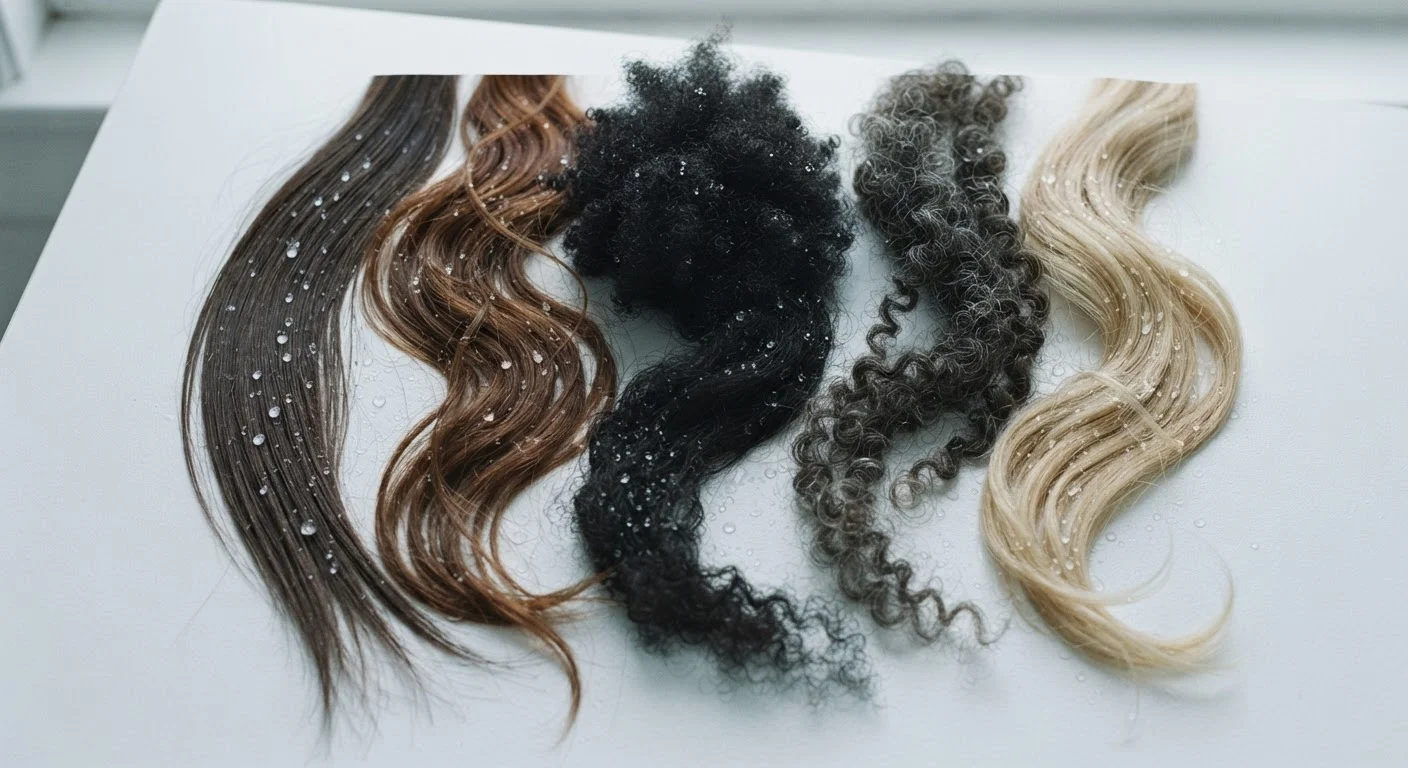
Why Curl Type Alone Doesn't Tell the Whole Story
Most people learn to describe their hair by its curl pattern — straight, wavy, curly, coily. While that's a useful starting point, it says almost nothing about how your hair behaves with moisture, how much stress it can tolerate before breaking, or how products will distribute through it. That's where porosity, elasticity, and density come in.
Think of curl pattern as the shape of your hair and these three properties as its physics. Two people can both have type 3C curls and have almost opposite moisture needs based on their porosity. Hair typing systems give you a starting vocabulary, but understanding these properties lets you actually customize your routine. It's the difference between following generic advice and reading what your own hair is telling you.
~100,000
Average number of hair follicles on a human scalp
This widely cited estimate from trichology literature illustrates why density varies substantially from person to person — active follicle counts differ based on genetics and health.
6 inches
Average hair growth per year
The American Academy of Dermatology notes that scalp hair grows approximately half an inch per month on average, meaning structural damage at the root takes months to become visible at the ends.
30%
Stretch a healthy wet strand can achieve
Hair scientists generally note that a healthy hair strand can stretch up to roughly 30% of its length when wet before returning to shape, serving as a practical elasticity benchmark.
Porosity: How Your Hair Handles Moisture
Porosity describes how readily your hair cuticle — the outermost layer of each strand — opens to allow moisture in, and how well it holds that moisture once absorbed. There are three general ranges:
- Low porosity: The cuticle lies flat and tightly overlapped, making it harder for water and products to penetrate. Hair may feel dry even after conditioning because moisture is sitting on top rather than being absorbed. Heat (like a warm towel wrap or steaming) helps open the cuticle temporarily to improve absorption.
- Medium (normal) porosity: The cuticle allows moisture in and out at a balanced rate. This is the most adaptable range and generally requires the least effort to maintain.
- High porosity: The cuticle has more gaps or is raised — often from chemical processing, heat damage, or genetics — which means hair absorbs water fast but also loses it fast. It may feel dry quickly after washing and can be prone to frizz in humidity.
High porosity hair often overlaps with breakage concerns. Our article on why hair keeps breaking explores that connection in depth.
Test Before You Buy
Knowing your porosity level before choosing conditioners or treatments can save you from wasting money on products your hair can't absorb. Do a simple strand float test on clean hair — without any product on it — to get the most accurate read. Revisit the test any time your hair undergoes a significant change, like a chemical service or noticeable texture shift.
Elasticity: The Stress Test Your Hair Takes Every Day
Elasticity measures the structural integrity of each strand — specifically, how well it stretches under tension and returns to its original length without snapping. To test it, take a single wet strand and gently pull it between two fingers. Healthy elasticity means it stretches noticeably before returning to shape. Low elasticity means it snaps quickly with minimal stretch.
Elasticity depends on the condition of the cortex — the inner structure of the strand — and specifically its protein bonds. When those bonds are damaged by repeated chemical services, excessive heat, or physical stress like tight hairstyles, elasticity drops. This is why breakage often has multiple causes: it's rarely just about dryness.
Hair with poor elasticity usually benefits from protein-supporting treatments, which help rebuild the internal structure of the strand. However, too much protein can make hair stiff and brittle — balance with adequate moisture matters.
Density: How Much Hair You Actually Have
Density is simply a measure of how many follicles — and therefore how many strands — are active on your scalp. It's usually described as low, medium, or high, and it affects how your hair looks in bulk, how long styling takes, and how products should be applied.
It's easy to confuse density with strand thickness (sometimes called strand width or diameter). These are separate measurements. You can have high density with very fine strands, which creates apparent fullness but may feel delicate. Or low density with thicker strands, which can look sparse even though each strand itself is robust.
Density is also not a fixed trait. Hair density naturally changes with age, hormonal shifts, and health factors. How hair care needs evolve across decades covers this in context — including what to look for and when changes warrant a conversation with a healthcare provider.
From a practical standpoint, high-density hair needs thorough product distribution to avoid buildup at the roots, while low-density hair benefits from lightweight formulations that don't weigh down individual strands.
Using All Three Together
The real value of understanding these properties comes from combining them. Consider two scenarios:
- High porosity + low elasticity + high density: This combination often appears in hair that has been chemically processed heavily. It needs moisture-sealing products, reduced heat exposure, and careful handling to prevent further structural loss — not just more conditioner.
- Low porosity + normal elasticity + fine strands: This hair resists product absorption and gets weighed down easily. Lightweight, water-based formulations applied with heat activation will outperform heavy creams every time.
Just as skin type is more nuanced than it first appears, hair properties rarely fit a single tidy category. Most people sit somewhere in the middle of each spectrum, and those ranges can shift over time. Reassessing your hair periodically — especially after a major life change, chemical service, or noticeable texture shift — keeps your routine aligned with what your hair actually needs right now.
Frequently Asked Questions
Drop a clean, shed strand into a glass of room-temperature water and wait two to four minutes. If it sinks quickly, porosity is likely high. If it floats near the top, porosity is likely low. If it hovers somewhere in the middle, you likely have medium or normal porosity. Note that product buildup can skew results, so use a strand that's been gently cleansed.
Low elasticity means a wet strand breaks quickly when gently stretched rather than snapping back into shape. This often points to a lack of protein integrity in the hair shaft. It can result from chemical processing, heat damage, or nutritional gaps, and it's frequently linked to breakage.
Yes. Density refers to how many follicles are active on your scalp, while strand width (also called strand thickness or diameter) is a separate measurement. You can have a large number of fine strands — high density, low strand thickness — which creates a full appearance but requires gentle, lightweight products.
Yes. Porosity can shift due to heat styling, chemical services like coloring or relaxing, environmental exposure, and even aging. Hair that was low porosity in your twenties may become higher porosity after years of processing. Periodic reassessment helps keep your routine accurate.
Density is a physical count of strands per square inch of scalp. Volume is a visual and tactile quality influenced by density, strand thickness, curl pattern, and styling. You can have high density hair that appears flat if each strand is very fine and straight.
They do. High porosity hair often benefits from heavier, occlusive conditioners that help seal the cuticle. Low porosity hair typically responds better to lighter, water-based formulations that don't sit on the strand's surface. For more on choosing the right product, see our guide on <a href="/beauty-style/hair-styling/conditioner-deep-conditioner-and-hair-mask-what-each-one-actually-does">conditioner types and when to use each</a>.
The content on this site is for informational purposes only and is not a substitute for professional advice. Always consult a qualified professional for guidance specific to your situation.