

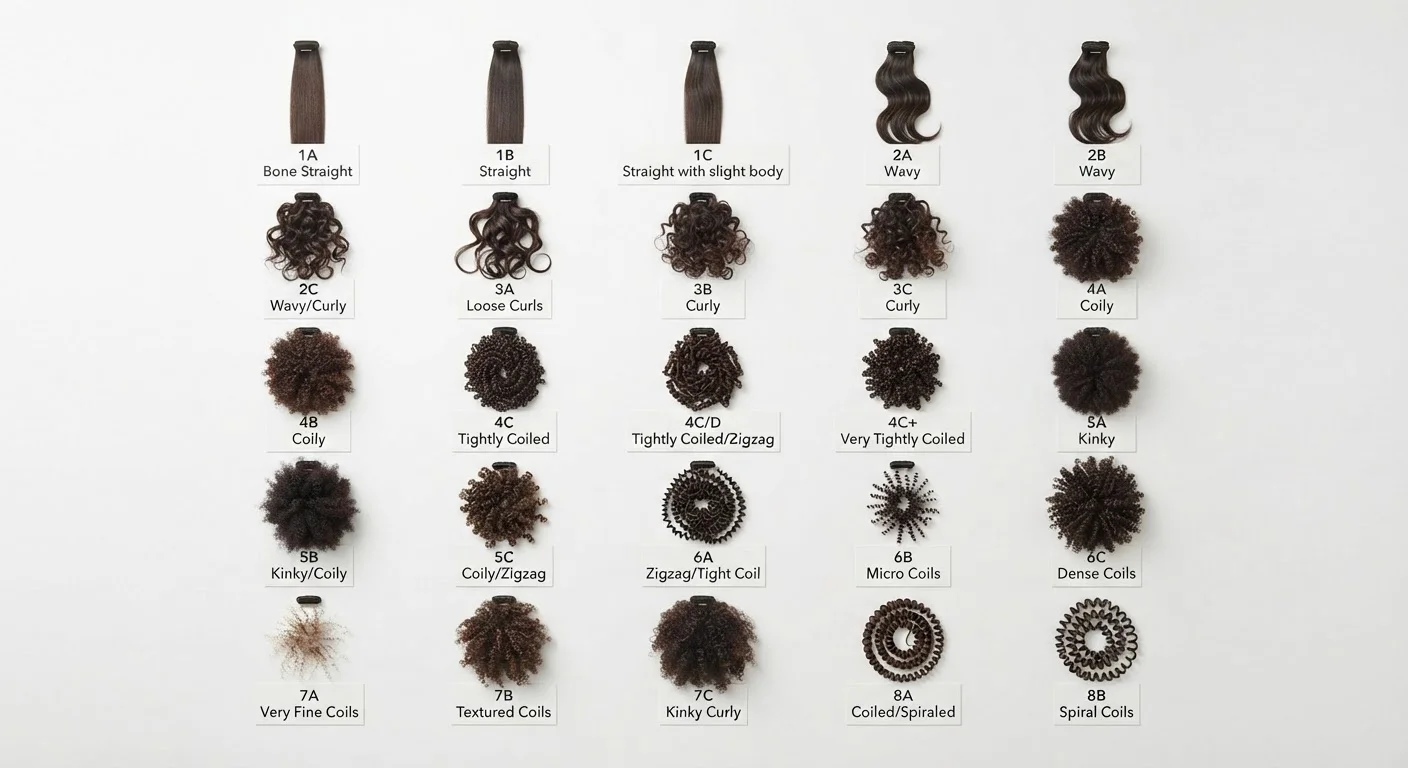
What Hair Typing Systems Actually Do
Hair typing systems give a shared vocabulary to describe texture, curl pattern, and structure. They're not a scientific ranking — no type is healthier or more desirable than another — but they're genuinely useful shorthand when figuring out which care habits and styling approaches tend to work for a given texture.
The most widely referenced framework in the U.S. divides hair into four main categories (Types 1 through 4), each split into three subcategories (a, b, c) based on the tightness or pattern of the curl, wave, or coil. Understanding where your hair generally falls can help you build a low-maintenance routine from scratch that actually suits your texture rather than working against it.
One important caveat: most people have more than one hair type on their head. The back may be tighter than the crown; the hairline often differs from the length. Use your dominant texture as a starting reference, not a rigid label.
| Number of main hair types | 4 (Types 1–4) |
| Subcategories per type | 3 (a, b, c) |
| Most commonly used system in U.S. | The 1–4 numeric/letter classification |
| Hair type with highest shrinkage | Type 4c (coily) |
| Can hair type change? | Yes — hormones, age, and health can alter texture |
| Is hair typing medically standardized? | No — it is a community and industry convention, not clinical classification |
The Four Main Types, Broken Down
Type 1 — Straight: Hair lies flat from root to tip with no natural curl or wave. Sebum (the scalp's natural oil) travels down the strand easily, which often means this type gets oily faster and may need more frequent washing. The subcategories reflect shine and thickness rather than curl tightness.
Type 2 — Wavy: Hair forms a loose S-shape. Type 2a waves are subtle and tend to straighten easily with heat; 2b waves are more defined with some frizz; 2c waves begin to resemble loose curls and are more resistant to straightening. Wavy hair sits between straight and curly in terms of moisture needs — it can get weighed down by heavy products.
Type 3 — Curly: Strands form a defined spiral or ringlet. Type 3a curls are loose and springy; 3b curls are tighter with more volume; 3c curls are dense, corkscrew-shaped coils. Curly hair is more prone to dryness because oil has a harder time traveling the length of the strand. Porosity and density often matter as much as curl type here.
Type 4 — Coily: Hair grows in tight coils or zig-zag patterns. Type 4a has a defined S-coil pattern; 4b forms a Z-shaped zig-zag with less defined curl; 4c has the tightest coils, with minimal definition and the highest shrinkage — strands may appear much shorter than their actual length. Type 4 hair is typically the most fragile and moisture-hungry, and is especially vulnerable to breakage from rough handling.
Hair type
A classification of hair based on its natural curl or wave pattern, ranging from straight (Type 1) to tightly coiled (Type 4). It's used as a shorthand for texture and care needs.
Porosity
The hair strand's ability to absorb and retain moisture, determined by the condition of the outer cuticle layer. High porosity absorbs quickly but loses moisture fast; low porosity resists absorption.
Shrinkage
The appearance of shorter length when coily or curly hair is in its natural state compared to when stretched. Type 4 hair can shrink up to 70–75% of its actual length.
Sebum
The natural oil produced by the scalp's sebaceous glands. It travels down the hair shaft to condition the strand; tighter curl patterns make this journey more difficult, contributing to dryness.
Protective styling
Hairstyles that tuck away or shield the ends of the hair to reduce manipulation and environmental exposure. Common in Type 3 and Type 4 hair care to minimize breakage.
Coil pattern
The shape a strand of hair naturally forms — ranging from a loose S-wave to a tight Z-shaped zig-zag. Coil pattern is the primary basis of the 1–4 typing system.
How to Use Your Hair Type Practically
Hair typing is a starting point, not a prescription. The same Type 3b curl can behave completely differently depending on porosity, density, and the climate you live in. That's why understanding porosity and elasticity alongside your curl type gives a far more complete picture.
A few practical principles tied to typing:
- Straighter types (1–2a) often benefit from lighter-weight products and more frequent cleansing.
- Wavy to loose curly types (2b–3a) generally do well with moisturizing but lightweight formulations; heavy creams can flatten the pattern.
- Tighter curly and coily types (3b–4c) often need richer moisture, gentler detangling, and protective styling to minimize breakage.
Hair typing is also helpful when browsing styling ideas. Quick hairstyles that work on unwashed hair vary significantly by texture — what works for a Type 1 will look entirely different on a Type 4c. And if you're ever considering a chemical treatment, know that your hair type affects how treatments interact with the strand — see what to know before chemically straightening or relaxing hair for a thorough overview of the trade-offs involved.
Hair texture also shifts over time due to hormonal changes, aging, and health factors — something worth keeping in mind as your needs evolve. Hair care across every decade covers how these changes typically unfold and why what worked in your twenties may need revisiting later.
The content on this site is for informational purposes only and is not a substitute for professional advice. Always consult a qualified professional for guidance specific to your situation.