

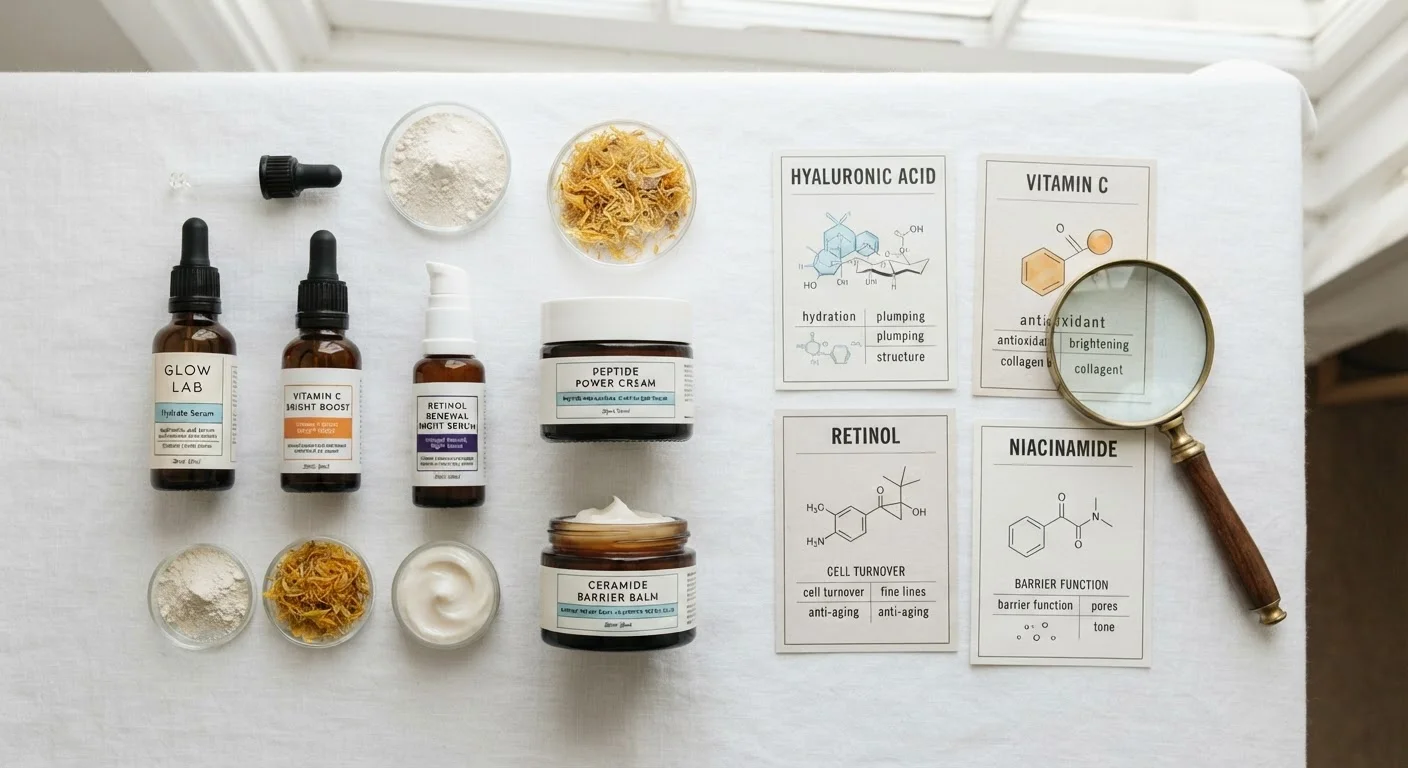
Why Mapping Ingredients to Concerns Matters
Walk into any drugstore or scroll through a skincare brand's website and you'll encounter dozens of ingredients promising clearer, brighter, smoother skin. The challenge isn't finding options — it's knowing which ingredient actually corresponds to your specific concern, and why.
Active ingredients are the components in a formula that produce a measurable change in the skin. Unlike base ingredients that primarily deliver texture or hydration, actives interact with skin cells, enzymes, or pigment-producing processes in targeted ways. Matching the right active to the right concern is the single most efficient way to build a routine that works — without wasting money on products that aren't designed for what you're trying to address.
This guide maps the most common skin concerns to the ingredient categories most associated with addressing them, based on widely referenced dermatological evidence. For reading ingredient lists with confidence, understanding how actives appear on a label is equally useful context.
This article is for general educational purposes only and is not a substitute for personalized advice from a licensed dermatologist or healthcare provider. Individual skin responses vary, and a professional can help you determine what's appropriate for your skin type and health history.
Acne and Breakouts: Salicylic Acid and Benzoyl Peroxide
Two ingredients dominate acne treatment for well-established reasons. Salicylic acid is a beta-hydroxy acid (BHA) that dissolves inside pores, loosening the plug of dead skin cells and sebum that leads to blackheads and non-inflamed blemishes. It also has mild anti-inflammatory properties.
Benzoyl peroxide works differently — it introduces oxygen into the pore environment, which is toxic to the primary bacteria (Cutibacterium acnes) associated with inflammatory acne. It's particularly effective for red, pustular breakouts.
For mild, non-inflammatory acne, salicylic acid is generally the gentler starting point. For persistent or inflamed blemishes, benzoyl peroxide is more directly antibacterial. Both can cause dryness, so moisturizer is essential in any acne routine.
Salicylic acid clears inside pores; benzoyl peroxide targets the bacteria that cause inflammation.
Hyperpigmentation and Dark Spots: Vitamin C, Niacinamide, and Azelaic Acid
Hyperpigmentation — including post-acne marks, sun spots, and melasma — results from excess melanin production. Several ingredients interrupt different stages of this process.
Vitamin C (typically as L-ascorbic acid) inhibits the enzyme tyrosinase, which is central to melanin synthesis. It also neutralizes free radicals, making it a useful antioxidant in morning routines alongside sunscreen.
Niacinamide (vitamin B3) works by reducing the transfer of melanin from pigment-producing cells (melanocytes) to surrounding skin cells. It's notably well-tolerated across most skin types, including sensitive skin.
Azelaic acid also targets tyrosinase and has the added benefit of being anti-inflammatory, making it a reasonable option for people dealing with both acne and pigmentation simultaneously. It's available over the counter at lower concentrations and by prescription at higher strengths.
Consistent daily sunscreen use is essential alongside any pigmentation treatment — UV exposure continuously stimulates the same melanin pathways these ingredients are trying to quiet.
No pigmentation treatment works in isolation — daily sunscreen is a non-negotiable partner to every brightening ingredient.
Fine Lines and Loss of Firmness: Retinoids and Peptides
Retinoids — the umbrella term for vitamin A derivatives including retinol, retinal, and prescription tretinoin — remain among the most studied anti-aging active ingredients available. They work by binding to receptors in skin cells that stimulate collagen production and accelerate cell turnover. Over time, this process can reduce the depth of fine lines and improve overall skin texture.
Retinoids require a gradual introduction. Starting two or three nights per week and slowly increasing frequency allows skin to adapt without excessive dryness, peeling, or irritation. Prescription-strength retinoids should only be used under the supervision of a dermatologist.
Peptides are short chains of amino acids that signal skin cells to produce more structural proteins, including collagen and elastin. While research on specific peptide blends varies in strength, peptides are generally well-tolerated and can be used alongside retinoids on alternating nights. They offer a gentler entry point for those who find retinoids too irritating.
Retinoids are among the most evidence-backed options for fine lines, but gradual introduction is essential to avoid irritation.
Dryness and Compromised Barrier: Hyaluronic Acid, Ceramides, and Glycerin
Dry skin and a damaged skin barrier are related but not identical concerns. The skin barrier — largely composed of lipids, including ceramides — prevents moisture loss and keeps environmental irritants out. When it's compromised, skin feels tight, may appear flaky, and is more reactive to other ingredients.
Ceramides directly replenish the lipid matrix of the barrier. Moisturizers containing ceramides are widely used in dermatology for conditions involving barrier dysfunction, such as eczema. They're appropriate for all skin types as a foundational moisturizer component.
Hyaluronic acid is a humectant — it draws water toward the skin from the environment and deeper skin layers. It works best when applied to slightly damp skin and sealed with a moisturizer, because in very dry conditions it can draw moisture from inside the skin instead of the air.
Glycerin is another highly effective, inexpensive humectant with a strong track record. It's found in countless formulas across price points and is suitable for sensitive skin.
Ceramides rebuild the skin barrier while humectants like hyaluronic acid and glycerin draw in and hold moisture.
Rough Texture and Dullness: AHAs and Enzymatic Exfoliants
Uneven texture and a dull, tired-looking complexion often stem from an accumulation of dead skin cells on the surface that haven't shed naturally. Chemical exfoliation addresses this more evenly than physical scrubs, which can create micro-tears with rough particles.
Alpha-hydroxy acids (AHAs) — including glycolic acid, lactic acid, and mandelic acid — work at the surface level, loosening the bonds between dead skin cells so they shed more readily. Glycolic acid has the smallest molecular size and penetrates most deeply; lactic acid is milder and also hydrating; mandelic acid is gentlest and well-suited for sensitive or darker skin tones.
Enzymatic exfoliants, often derived from papaya (papain) or pineapple (bromelain), digest the proteins holding dead cells together. They're among the gentlest exfoliating options available and may suit those who find AHAs too reactive.
Exfoliation frequency is individual — some skin types can tolerate daily AHA use; others do better once or twice a week. Over-exfoliation damages the barrier, so start conservatively and observe how your skin responds.
Chemical exfoliation with AHAs produces more even results than physical scrubs and carries less risk of micro-abrasion.
Sensitivity and Redness: Centella Asiatica and Allantoin
Reactive, easily flushed, or consistently red skin benefits from ingredients that calm inflammation rather than stimulate further cell activity. Two options with reliable safety profiles are worth knowing.
Centella asiatica (also labeled as cica, or by its active compounds madecassoside and asiaticoside) has been used in wound healing and is associated with soothing irritated skin and supporting barrier recovery. It's found in a wide range of formulas marketed to sensitive skin.
Allantoin is a synthetic compound (also found in comfrey) that promotes skin cell regeneration and has a soothing, anti-irritant effect. It's commonly added to formulas to offset the potential irritation of other actives — a useful ingredient to look for when introducing exfoliating acids or retinoids into a routine.
For persistent redness or rosacea, individual triggers and appropriate treatments vary significantly — a dermatologist consultation provides guidance that general product choices cannot replicate.
Centella asiatica and allantoin help calm reactive skin and support barrier recovery without introducing further irritation.
Putting It Together: Practical Next Steps
Knowing which ingredients address which concerns is useful — but knowing how to combine them safely is what separates a thoughtful routine from an irritating one. Some actives complement each other; others compete or cause sensitivity when layered together. See which ingredient pairs work well and which to separate before adding multiple actives to your routine at once.
Application order also matters more than most labels suggest. Layering products in the correct sequence ensures actives aren't blocked or diluted by heavier formulas applied first. And because skin needs can shift significantly with the seasons, revisiting your ingredient choices as climate changes — drier air, higher humidity — helps maintain consistent results. Adjusting your routine when the weather shifts is a practical extension of any ingredient-focused approach.
Start with one new active at a time, introduce it gradually, and give it at least four to six weeks of consistent use before evaluating results. Patience and simplicity consistently outperform routines packed with too many actives fighting for the same real estate.
Introduce One Active at a Time
When adding a new active ingredient to your routine, introduce it alone — not alongside another new product — so you can accurately identify what's working or causing a reaction. Patch test on a small area of skin for a few days before applying to your full face. Give each new addition at least four to six weeks of consistent use before judging its effectiveness.
The content on this site is for informational purposes only and is not a substitute for professional advice. Always consult a qualified professional for guidance specific to your situation.