

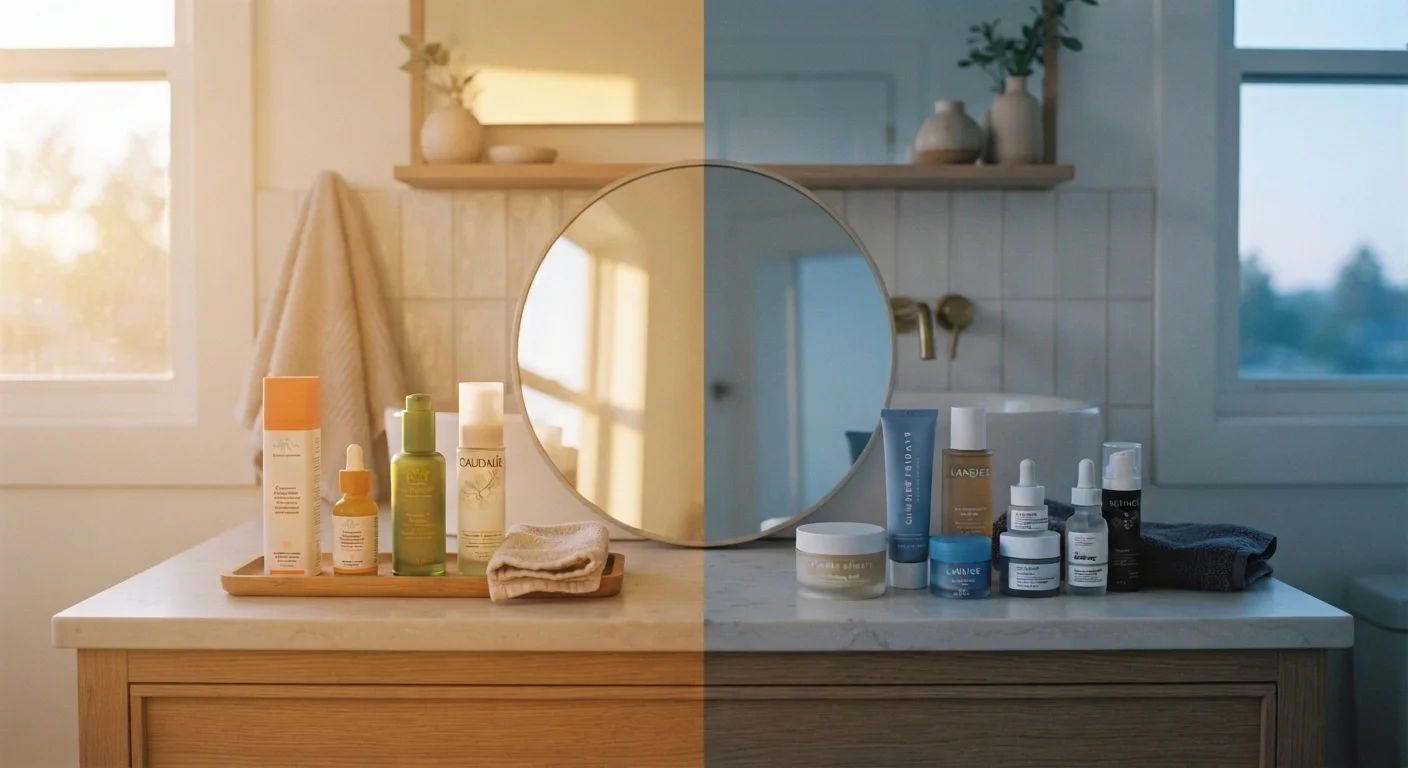
Option A
Morning Skincare Routine
The protective, prep-focused start to your skin's day.
Best for: Anyone who wants to shield their skin from UV exposure, environmental pollutants, and daily stressors before stepping outside.
Option B
Evening Skincare Routine
The restorative, treatment-focused close to your skin's day.
Best for: Anyone looking to repair daily damage, support cell turnover overnight, and apply active ingredients that work best without sun interference.
Why Your Skin Operates on a Clock
Skin is not a passive barrier — it follows a biological rhythm tied to your body's circadian cycle. During daylight hours, skin shifts into a defensive mode: sebum production increases, the skin barrier tightens, and the body prioritizes shielding against UV radiation, pollution, and oxidative stress. At night, that defensive posture relaxes and the skin enters a repair phase, accelerating cell turnover and boosting the production of collagen and other structural proteins.
Research published in dermatology literature consistently shows that skin permeability — how readily it absorbs and loses substances — is higher at night. That means your evening products have a real opportunity to penetrate more effectively, and it also means water loss (called transepidermal water loss, or TEWL) is elevated overnight, making a good evening moisturizer genuinely important rather than optional.
Understanding this rhythm is the foundation of building two routines that actually complement your skin's biology rather than fight against it. If you're curious how morning consistency shapes other areas of health, see our guide to what a morning routine does to your brain.
The Morning Routine: Protect and Prepare
An effective AM routine has one overarching job: get your skin ready to face external stressors. That means a gentle cleanse (or simply rinsing with water if your skin is dry or sensitive), followed by an antioxidant serum — vitamin C being the most researched option — and, critically, a broad-spectrum sunscreen with SPF 30 or higher.
Antioxidants in the morning serve a specific purpose: they neutralize free radicals generated by UV light and pollution before those molecules can damage collagen and DNA. Layering an antioxidant serum beneath your SPF is a well-supported pairing that amplifies your sun protection strategy. For a deeper look at why sunscreen earns its non-negotiable status, see our article on why dermatologists treat sunscreen as non-negotiable.
What to leave out of your morning routine: retinoids, high-concentration exfoliating acids (like glycolic or lactic acid), and physical scrubs. These ingredients either degrade in sunlight, increase photosensitivity, or temporarily compromise the barrier — all counterproductive before a day of sun exposure.
| Criterion | Morning Routine | Evening Routine |
|---|---|---|
| Primary goal | Protection from UV & pollution | Repair, renewal, and treatment |
| Cleansing approach | Gentle rinse or light cleanse | Thorough cleanse (double-cleanse if needed) |
| Key actives | Antioxidants (vitamin C), SPF | Retinoids, exfoliating acids, peptides |
| Skin state | Defensive mode, tighter barrier | Repair mode, higher permeability |
| Retinol use | Not recommended | Appropriate and effective |
| SPF required | Yes — essential step | No — skip at night |
| Time investment | Typically shorter (3–5 minutes) | Typically longer (5–10 minutes) |
The Evening Routine: Repair and Treat
The PM routine is where the real therapeutic work happens. Start with a thorough cleanse — if you wore sunscreen or makeup, a double-cleanse (an oil-based cleanser followed by a water-based one) ensures you're not leaving residue that can clog pores or blunt the effectiveness of what follows.
This is the time to introduce active ingredients. Retinoids (vitamin A derivatives) stimulate cell turnover and collagen production, but they degrade in UV light and increase sun sensitivity — making nighttime the only appropriate slot. Similarly, exfoliating acids like glycolic, lactic, and mandelic acid are better suited to evenings for the same photosensitivity reason. Finish with a moisturizer that supports overnight barrier repair; look for ingredients like ceramides, peptides, or hyaluronic acid.
One important caution: more is not better. Layering multiple actives on the same night — retinol, a strong acid, and a potent vitamin C, for example — can trigger irritation. The right ingredient pairings and separations are worth understanding before building your PM stack. And getting the application order right matters just as much — see our guide to layering skincare products in the right order.
~30%
Higher nighttime skin permeability
Dermatology research indicates skin absorption capacity is meaningfully elevated at night compared to daytime, supporting the effectiveness of evening treatments.
90%
Of visible skin aging linked to UV exposure
According to widely cited dermatological consensus, the majority of premature skin aging — including wrinkles and pigmentation — is attributable to cumulative sun damage.
2x
Cell turnover rate during sleep
Studies on circadian skin biology suggest cell renewal accelerates significantly during nighttime hours, reinforcing the repair-focused role of the PM routine.
Adjusting Both Routines for Your Skin Type and Season
No routine is truly one-size-fits-all. Oily skin types may tolerate a gel cleanser in the morning, while dry or mature skin often does better with just water or a cream cleanser. People with sensitive skin should keep active ingredients minimal and space out any exfoliation to once or twice weekly at night, not daily.
Seasons add another layer. Cold, dry winter air depletes the skin barrier more aggressively, meaning your evening moisturizer may need to be richer, and you may need to pull back on strong actives temporarily. Humid summer conditions, meanwhile, can trigger increased congestion — a reason to keep morning products lightweight and ensure evening cleansing is especially thorough. Our guide to seasonal skin changes walks through these shifts in detail.
This article is for informational purposes only and does not constitute medical or dermatological advice. If you have specific skin concerns or conditions, consult a licensed dermatologist or healthcare provider.
The content on this site is for informational purposes only and is not a substitute for professional advice. Always consult a qualified professional for guidance specific to your situation.