

Start here
Why Most Skincare Advice Overcomplicates Things
Core knowledge
The Three Non-Negotiables
Personalize it
Adapting the Basics to Your Skin Type
Level up
When (and How) to Add More
Commit
Consistency Beats Complexity Every Time
Why Most Skincare Advice Overcomplicates Things
Walk into any beauty aisle and you'll find serums for every concern, toners with ten-step promises, and entire systems marketed as essential. The skincare industry thrives on complexity — but your skin doesn't require it. Dermatologists and estheticians broadly agree that the fundamentals of healthy skin come down to a very short list of actions, not a very long shelf of products.
The good news: a simple, consistent routine outperforms an elaborate one that gets skipped because it takes too long. If complexity is what's standing between you and starting, this guide is for you. Think of it like building any healthy daily habit — the simpler it is, the more likely it sticks.
Skin barrier
The outermost layer of your skin that acts as a protective shield, keeping moisture in and irritants out. Disrupting it can cause dryness, sensitivity, and breakouts.
Broad-spectrum SPF
Sunscreen that protects against both UVA rays (linked to aging) and UVB rays (linked to burning). The SPF number measures UVB protection; 'broad-spectrum' confirms UVA coverage is also included.
Non-comedogenic
A label indicating a product is formulated to avoid blocking pores. Relevant for anyone prone to blackheads or acne, though it doesn't guarantee a product won't cause breakouts for everyone.
Humectant
An ingredient that draws moisture from the environment or deeper skin layers toward the surface. Common examples include hyaluronic acid and glycerin, both widely used in moisturizers.
Active ingredient
An ingredient in a skincare product that has a documented effect on the skin, such as retinol for cell turnover or niacinamide for tone. Actives require more care when layering with other products.
The Three Non-Negotiables
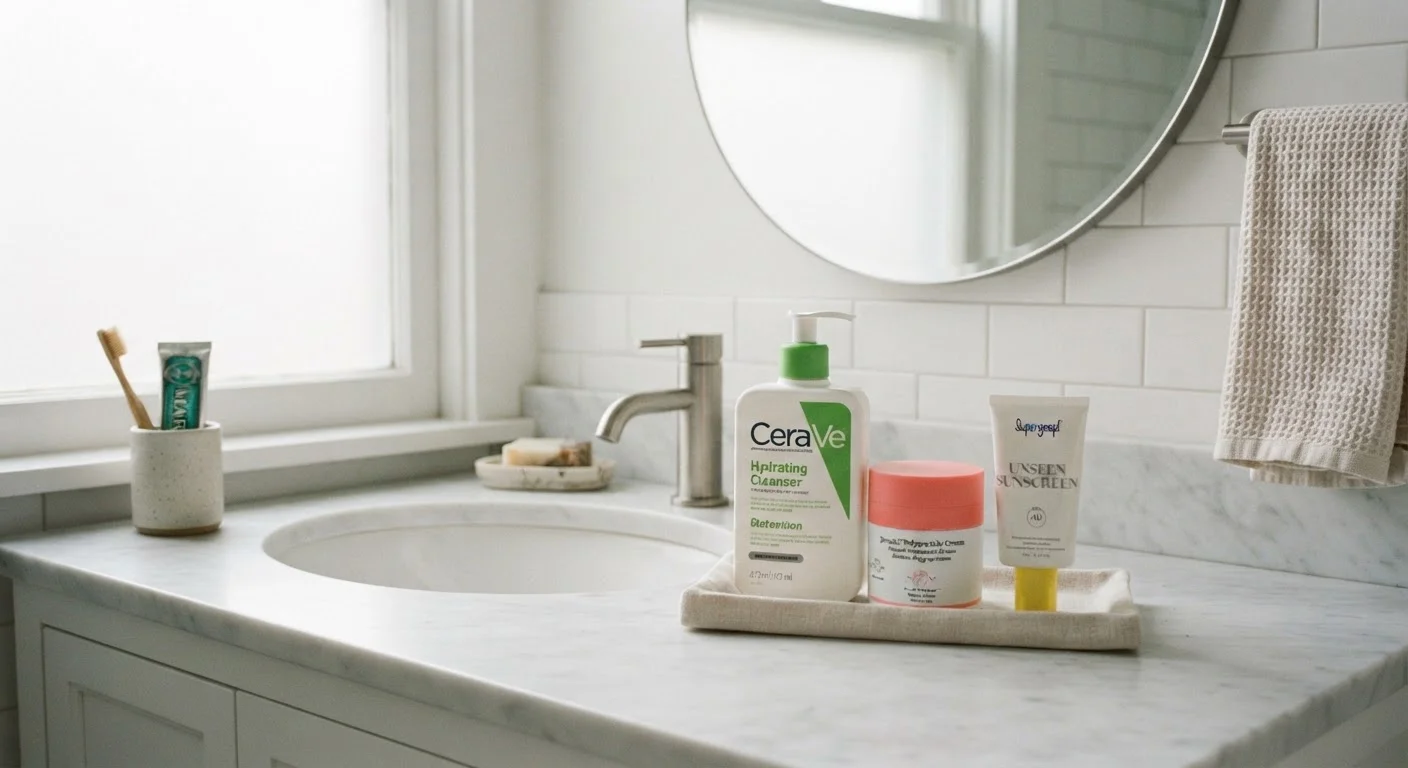
Regardless of skin type, budget, or age, every effective routine rests on three pillars:
- Cleanse — Remove dirt, oil, sweat, and environmental debris accumulated on the skin's surface. Choose a gentle, pH-balanced cleanser that doesn't strip the skin. Harsh soaps disrupt the skin barrier, which can trigger dryness, irritation, or excess oil production.
- Moisturize — Replenish water content and seal in hydration to support the skin barrier. Every skin type benefits from moisturizer, including oily skin. The formulation (gel, lotion, cream) varies, but the step itself does not.
- Protect with SPF — Broad-spectrum sunscreen at SPF 30 or higher applied every morning is the most evidence-supported step for preventing premature skin aging and protecting against UV damage. It belongs in every daytime routine, year-round.
That's it. For a deeper look at what each of these products is doing at a mechanical level, see what each step is actually doing.
Make SPF the Last Step in Your Morning Routine
Sunscreen works best when it's the final product applied to clean skin in the morning, after moisturizer has absorbed. Applying it before other products can dilute its protective layer. If you prefer a moisturizer-SPF combination, that can simplify the step — just ensure the SPF rating meets the broad-spectrum SPF 30 minimum.
Adapting the Basics to Your Skin Type
The three-step framework stays the same — the product formulations shift. Here's how to adjust:
- Dry skin: Look for cream-based or hydrating cleansers, and richer moisturizers that contain ingredients like ceramides, hyaluronic acid, or shea butter. Avoid foaming cleansers that leave skin feeling tight.
- Oily or acne-prone skin: Gel or foaming cleansers work well. Choose a lightweight, oil-free, non-comedogenic moisturizer. A gel-based or fluid SPF tends to sit more comfortably on oily skin.
- Combination skin: You may need to use different products on different zones, or opt for a balanced, water-based moisturizer that doesn't overload oilier areas while still hydrating drier patches.
- Sensitive skin: Fragrance-free, dye-free formulas reduce the risk of irritation. Fewer ingredients generally means fewer potential triggers. When in doubt, simpler is safer.
Not sure which skin type you have? Cleanse your face, wait one hour without applying anything, and observe: tightness suggests dry skin, shine across the whole face suggests oily, and shine only in the T-zone points to combination.
This article is for general informational purposes and does not constitute medical or dermatological advice. If you have persistent skin concerns, consult a licensed dermatologist.
When (and How) to Add More
Once your core three-step routine feels stable — meaning your skin isn't reacting and you're using it consistently — you can consider adding targeted treatments. Common additions include exfoliants (chemical or physical), serums with active ingredients like vitamin C or retinol, or eye creams.
The critical rule: introduce one new product at a time, and wait at least two to four weeks before adding another. This makes it possible to identify what's helping or causing a reaction. Layering several new products at once makes troubleshooting nearly impossible.
Reading Ingredient Labels Pays Off
Skincare labels can list 20 or more ingredients, making it hard to know what you're actually applying. Ingredient order matters — items listed first appear in the highest concentrations. If you want to get more out of your product choices, learning how to read a skincare label is a practical next step once your routine is established.
When you're ready to layer products, understanding the correct application sequence matters. Applying products in the right order ensures actives absorb properly rather than getting blocked. And if you're curious which ingredients play well together, this guide to ingredient pairing covers which combinations to embrace and which to separate.
Consistency Beats Complexity Every Time
The most sophisticated 10-step routine used sporadically will deliver worse results than a three-step routine used twice daily, every day. Skin health is cumulative — protection, hydration, and gentle cleansing compound over time. There is no single product that substitutes for daily habit.
If you find even the basics hard to sustain, treat it like any other daily routine — attach it to an existing habit, like brushing your teeth, so it becomes automatic rather than intentional effort. And if you're also trying to simplify your hair care at the same time, the approach is identical: building a low-maintenance hair routine from scratch follows the same philosophy of doing less, better.
You don't need more products. You need the right ones, used reliably. Start with three. Stay consistent. Adjust only when you've given each change enough time to show results.
Frequently Asked Questions
The minimum effective routine is cleanser, moisturizer, and broad-spectrum sunscreen (SPF 30 or higher) applied every morning. At night, cleansing and moisturizing are sufficient. These three steps address the skin's core needs without overwhelming it.
Toner is optional and not essential for most people. It can help balance skin pH and add hydration, but a well-formulated cleanser and moisturizer typically cover those bases. Skip it until your basics are dialed in.
Yes — a single, well-suited moisturizer can work for both AM and PM routines. The main difference is that morning moisturizer should be followed by sunscreen. Many people use the same product twice daily without issue.
Skin cell turnover takes roughly four to six weeks, so most changes become visible after about a month of consistent use. Hydration improvements can appear sooner, within days, while concerns like uneven tone take longer.
Dermatologists generally recommend daily sunscreen use because UV light can penetrate windows and cause cumulative skin damage even with limited outdoor exposure. The evidence for SPF as a protective measure is well established.
Yes. Many people with acne-prone skin do well starting with a gentle, non-comedogenic cleanser, a lightweight oil-free moisturizer, and a non-comedogenic sunscreen. Over-treating with too many actives at once can sometimes worsen breakouts.
The content on this site is for informational purposes only and is not a substitute for professional advice. Always consult a qualified professional for guidance specific to your situation.