

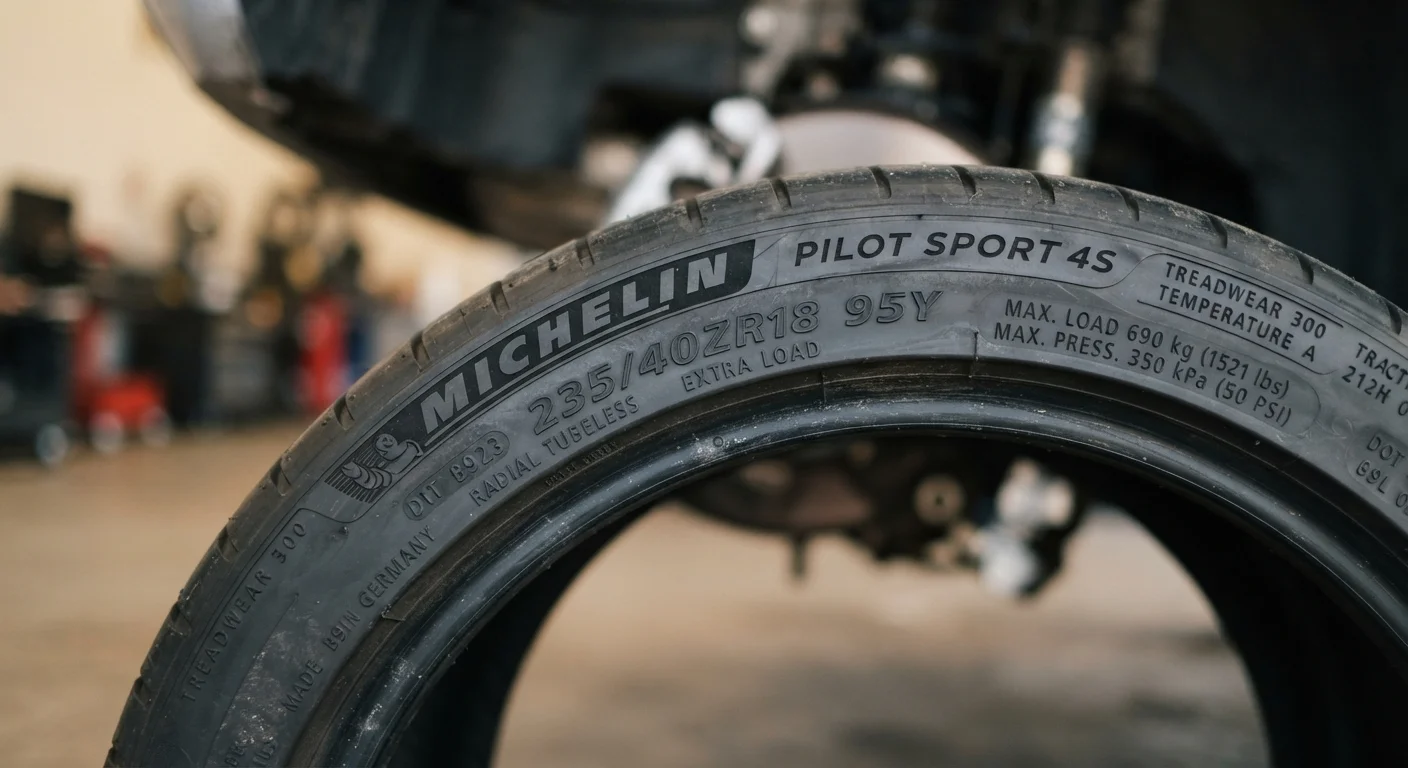
What That String of Numbers and Letters Actually Means
Flip to the side of any tire and you'll find a stamped sequence that looks something like P215/65R16 98H. It's not random — every character describes a specific physical or performance attribute of that tire. Once you know the pattern, you can read any passenger tire in under a minute.
| Standard tire code example | P215/65R16 98H |
| Section width unit | Millimeters |
| Rim diameter unit | Inches |
| DOT date code format | Last 4 digits = week + year (e.g., 2319 = week 23, 2019) |
| Typical tire replacement age guideline | 6–10 years from manufacture date (General industry and manufacturer guidance) |
| UTQG traction ratings (best to lowest) | AA, A, B, C (U.S. Department of Transportation) |
Here's how to break down the code, character by character:
- Letter prefix (P, LT, ST): The service type. P stands for passenger vehicle, LT for light truck, and ST for special trailer. Some European-style tires skip this prefix entirely.
- Three-digit number (e.g., 215): Section width — how wide the tire is from sidewall to sidewall, measured in millimeters.
- Two-digit number after the slash (e.g., 65): Aspect ratio — the tire's sidewall height expressed as a percentage of its section width. A lower number means a shorter, sportier sidewall.
- Construction letter (R, D, B): Almost always R for radial, which is standard on modern vehicles. D (diagonal/bias-ply) appears on older vehicles and some trailers.
- Two-digit rim diameter (e.g., 16): The wheel size this tire fits, measured in inches.
- Load index (e.g., 98): A number that corresponds to the maximum weight each tire can safely support. A load index of 98 equals roughly 1,653 lbs per tire.
- Speed rating (e.g., H): The maximum sustained speed the tire is designed to handle. H = up to 130 mph; V = up to 149 mph; T = up to 118 mph.
Always replace tires with ones that match or exceed the load index and speed rating specified in your owner's manual or on the driver's door jamb sticker — never go lower.
Other Markings Worth Knowing
Beyond the main size code, tire sidewalls carry several other stamped markings that provide safety and manufacturing data.
Aspect ratio
The tire sidewall height expressed as a percentage of the tire's section width. A ratio of 65 means the sidewall height is 65% of the section width.
Load index
A standardized number stamped on the tire that corresponds to the maximum weight the tire can safely carry. Higher numbers indicate greater load capacity.
Speed rating
A letter code indicating the maximum sustained speed a tire is designed to handle safely. Common ratings include T (118 mph), H (130 mph), and V (149 mph).
UTQG
Uniform Tire Quality Grading — a U.S. DOT system that rates tires on treadwear, traction, and temperature resistance using standardized test conditions.
Three-Peak Mountain Snowflake (3PMSF)
A symbol on a tire sidewall certifying that the tire meets specific winter snow traction performance standards, stricter than the basic M+S designation.
Radial construction
The dominant modern tire construction type, indicated by the letter R, in which internal cord plies run perpendicular to the direction of travel for improved flexibility and durability.
DOT Code and Manufacturing Date
Look for a string beginning with DOT followed by a series of characters. The last four digits are the most useful: they indicate the week and year the tire was manufactured. For example, 2319 means the 23rd week of 2019. Most tire manufacturers and safety experts consider tires older than six years to be candidates for inspection regardless of tread depth, and tires beyond ten years should typically be replaced — even if they look fine on the surface.
UTQG Ratings
The Uniform Tire Quality Grading (UTQG) system, required by the U.S. Department of Transportation, gives you three standardized scores:
- Treadwear: A comparative index. A tire rated 400 should last roughly twice as long as one rated 200 under the same test conditions.
- Traction: Rated AA, A, B, or C — reflects wet stopping performance. AA is the highest.
- Temperature: Rated A, B, or C — indicates how well the tire dissipates heat at sustained speeds. A is the highest.
UTQG grades are measured under controlled government test conditions, so treat them as comparative guides rather than absolute guarantees of real-world performance.
M+S and the Three-Peak Mountain Snowflake
An M+S (mud and snow) stamp indicates basic all-season capability. The Three-Peak Mountain Snowflake (3PMSF) symbol — a snowflake inside a mountain outline — is a stricter certification indicating the tire meets specific snow traction standards. If you drive in regions with serious winter weather, look for the 3PMSF symbol rather than relying on M+S alone.
Understanding your tire's sidewall makes it easier to shop for replacements confidently and to spot mismatches before they become problems. Pair this knowledge with routine checks — see our guide on why tire pressure matters more than most drivers realize — and you'll stay ahead of most common tire issues. For related dashboard alerts, decoding your car's warning lights is a useful companion read.
The content on this site is for informational purposes only and is not a substitute for professional advice. Always consult a qualified professional for guidance specific to your situation.