

What a Maintenance Record Actually Is
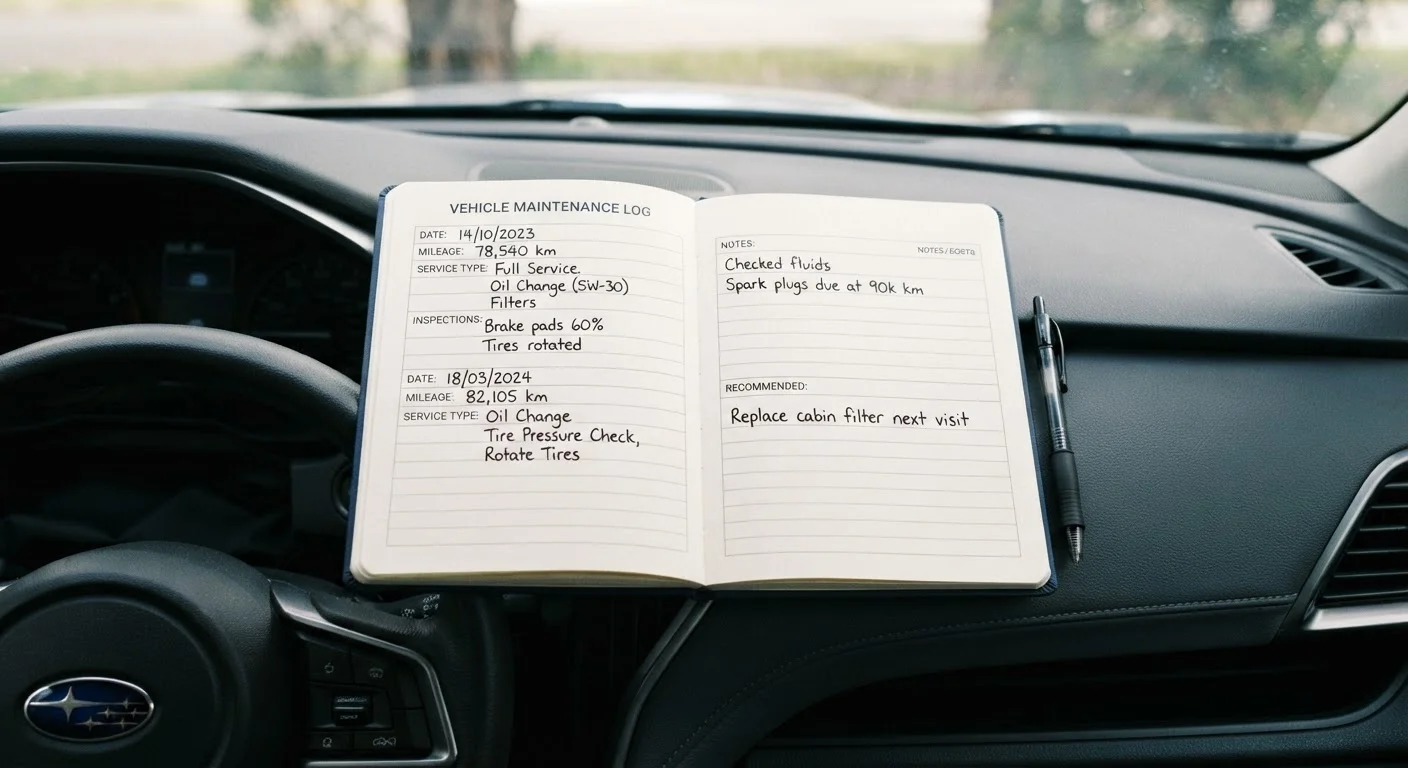
A vehicle maintenance record is simply a log of every service your car has received — oil changes, tire rotations, brake inspections, fluid top-offs, and any repairs. It doesn't need to be elaborate. A dated list that notes the service performed, the mileage at the time, and who did the work is all you need.
Most dealerships and repair shops provide a receipt or work order after every visit. Keeping those in a folder — physical or digital — is the foundation of a solid record. For services you handle yourself, jotting the date, mileage, and task in a notebook or spreadsheet is equally valid.
Think of it as a health chart for your car. Just as a doctor benefits from seeing your medical history, a mechanic diagnosing a problem benefits from knowing what's been done and when. See our first-time car owner's guide for a broader look at the habits that keep a vehicle running reliably.
The Practical Payoffs of Keeping Good Records
Records pay off in three concrete ways:
- Resale value: A documented service history signals to buyers that the vehicle was maintained consistently. Private buyers and dealerships are more confident — and often willing to pay more — for a car with proof of upkeep versus one sold on the seller's word alone.
- Warranty protection: Many manufacturer and extended warranties require proof that maintenance was performed on schedule. Without receipts, a claim could be denied. This is a real risk, not a theoretical one.
- Smarter scheduling: When you can see at a glance that your last brake inspection was 18 months ago, you avoid both over-maintaining and neglecting services. That translates to fewer surprises and more predictable expenses.
It's also worth noting that good records help you spot patterns. If you're replacing the same part repeatedly or if a problem keeps recurring, the log surfaces that — which is useful information when talking to a mechanic. Learn more about how common maintenance oversights snowball into costly repairs.
How to Set Up a System You'll Actually Stick To
The most effective record-keeping system is the simplest one you'll maintain consistently. Here are a few approaches that work for different habits:
- Paper folder: Keep a manila envelope or accordion folder in the glove box or at home. Drop every receipt in after each visit. Label it by year if needed. See our guide on documents every car owner should keep in the glove box for related essentials.
- Spreadsheet: A simple sheet with columns for date, mileage, service type, cost, and shop name covers everything. Store it in cloud storage so it's always accessible.
- Mobile apps: Several apps designed for vehicle tracking let you log services, set reminders for upcoming intervals, and store photos of receipts. Search your phone's app store for "vehicle maintenance log" to find options.
Whatever method you choose, the habit that matters most is logging the service the same day it happens — or at minimum the same week. Waiting months means details get forgotten or receipts get lost.
Pair record-keeping with a consistent maintenance routine. Our article on building a maintenance routine that actually sticks offers practical scheduling strategies that complement a good log.
Common Mistakes That Undermine Your Records
Even well-intentioned record-keepers make a few predictable missteps:
- Keeping only dealer records and ignoring independent shops: Every qualified shop's work counts. If you had a tire rotation at an independent garage, that receipt belongs in your log too.
- Forgetting self-performed maintenance: DIY oil changes are legitimate — but only if you log them. Note the date, mileage, oil type used, and filter replaced.
- Tossing records after a few years: For warranty purposes, records should be kept for at least as long as any active warranty. For resale, the full service history of your ownership is worth keeping.
- Not noting the mileage: A receipt that shows only a date but not the odometer reading is less useful. Mileage is the real benchmark for service intervals, not calendar time alone.
It's also worth double-checking that the work reflected on a receipt matches what was actually performed. Errors happen occasionally, and catching them at the time of service is far easier than sorting them out later. For a reality check on which maintenance advice is actually accurate, see our piece on car maintenance myths that cost drivers real money.
The content on this site is for informational purposes only and is not a substitute for professional advice. Always consult a qualified professional for guidance specific to your situation.