

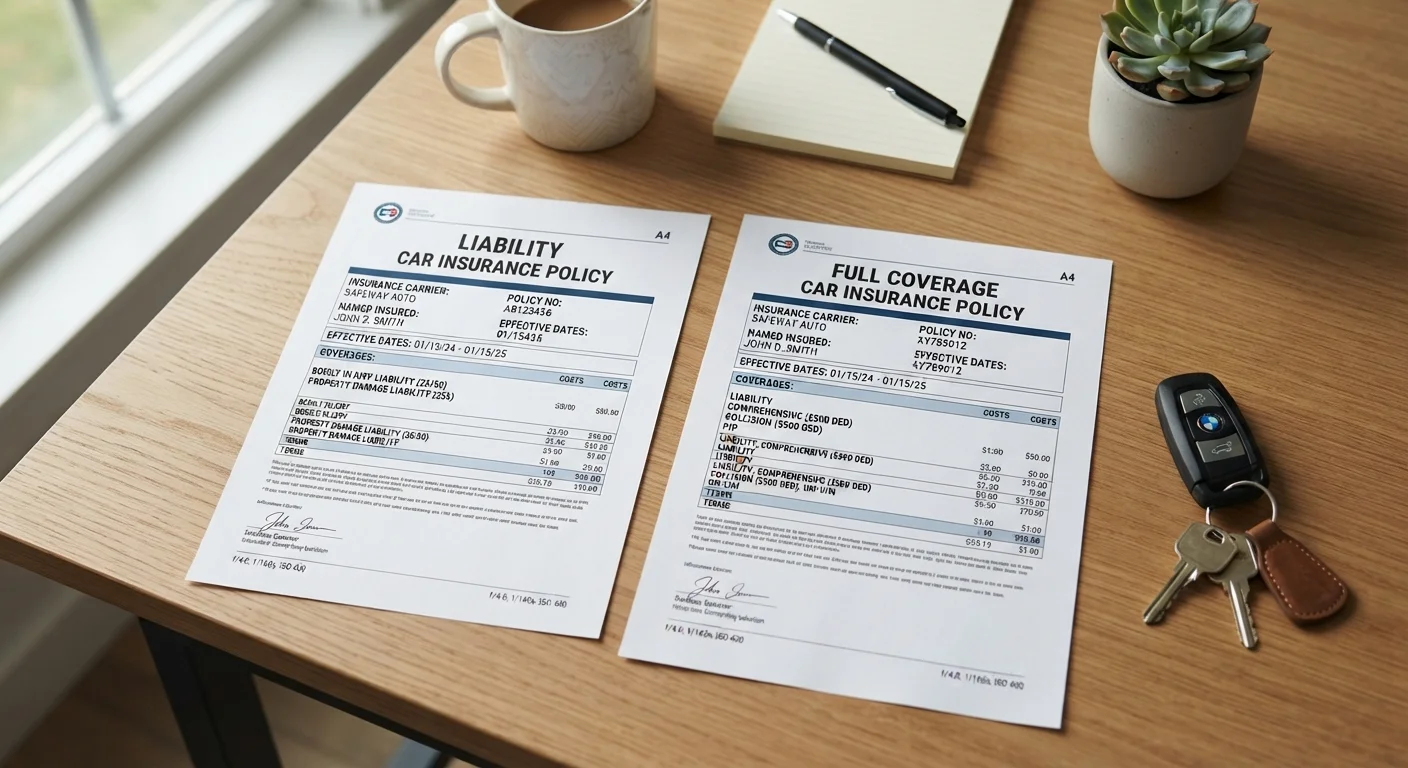
Option A
Liability-Only Coverage
The legally required minimum that protects others — not your car.
Best for: Owners of older, lower-value vehicles who can absorb out-of-pocket repair or replacement costs.
Option B
Full Coverage
Broader protection that also covers damage to your own vehicle.
Best for: Drivers with newer, financed, or high-value vehicles who want protection from a wide range of losses.
What Each Coverage Type Actually Does
Before comparing the two, it helps to understand what you're actually buying. For a full breakdown of all coverage types, see Car Insurance Explained: What You're Actually Paying For.
Liability-only coverage is the legal floor in nearly every U.S. state. It covers bodily injury and property damage you cause to other people in an at-fault accident. If you rear-end another driver, liability pays for their repairs and medical bills — up to your policy limits. It does nothing for your own vehicle.
Full coverage is not a single product but a combination of liability, collision, and comprehensive. Collision pays for damage to your car when it hits another vehicle or object. Comprehensive covers losses from theft, fire, flooding, hail, and animal strikes. Together, they create a much wider safety net — at a meaningfully higher premium.
| Criterion | Liability-Only | Full Coverage |
|---|---|---|
| Covers damage to others | Yes | Yes |
| Covers your own vehicle (collision) | No | Yes |
| Covers theft, weather, fire | No | Yes (comprehensive) |
| Required by lenders | No | Yes |
| Typical premium cost | Lower | Higher |
| Best suited for | Older, low-value vehicles | Newer, financed, or high-value vehicles |
The Key Decision Factors
No formula fits every driver, but three variables do most of the work in this decision.
1. Your Vehicle's Current Market Value
Insurance pays out actual cash value — what your car is worth today, not what you paid for it. If your vehicle's market value is low, a full-coverage payout after a total loss may not justify the added annual premium. As a general reference point, many financial educators suggest reconsidering full coverage when the annual premium difference exceeds roughly 10% of the car's value — though your own risk tolerance matters too.
2. Whether You Have a Loan or Lease
Lenders have a financial stake in the vehicle until it's paid off. Virtually all auto loans and leases require comprehensive and collision coverage. Dropping to liability-only on a financed car isn't just risky — it typically violates the loan agreement.
3. Your Financial Cushion
Liability-only is a calculated bet that you can self-insure the vehicle. If your car were totaled tomorrow, could you cover replacement costs without financial strain? If the honest answer is no, full coverage reduces that exposure. The true annual cost of owning a vehicle often surprises drivers, and uninsured repair bills are one of the bigger shocks.
~$685
Average annual liability-only premium (U.S.)
The National Association of Insurance Commissioners reported average liability premium figures in the low-to-mid hundreds annually, though rates vary widely by state and driver profile.
~$1,300+
Average annual full coverage premium (U.S.)
Full coverage premiums vary significantly by location, vehicle type, and driving record; estimates from industry sources suggest roughly double the cost of liability-only on average.
~1 in 4
U.S. drivers estimated to be uninsured or underinsured
The Insurance Research Council has periodically estimated that a significant share of drivers on U.S. roads carry insufficient coverage, underscoring why coverage decisions matter.
Situations Where Dropping Down Can Backfire
Switching to liability-only to save money is a reasonable move in some cases — but it can leave gaps that catch drivers off guard. Situations Where Skipping Comprehensive Coverage Can Backfire in ways that aren't always obvious upfront.
Common scenarios where liability-only falls short:
- Hail or flood damage: Extreme weather can total a car with no other driver involved — liability won't help at all.
- Theft: If your vehicle is stolen, only comprehensive coverage reimburses you. Liability pays nothing.
- Single-car accidents: Hitting a guardrail, a pothole, or an animal is a collision or comprehensive event. Without those coverages, the repair bill is entirely yours.
For a deeper look at where collision and comprehensive diverge, the Comprehensive vs. Collision Coverage walks through common scenarios clearly.
This article is for general informational purposes only and does not constitute insurance or financial advice. Coverage needs vary by individual situation. Consult a licensed insurance professional before making changes to your policy.
The content on this site is for informational purposes only and is not a substitute for professional advice. Always consult a qualified professional for guidance specific to your situation.