

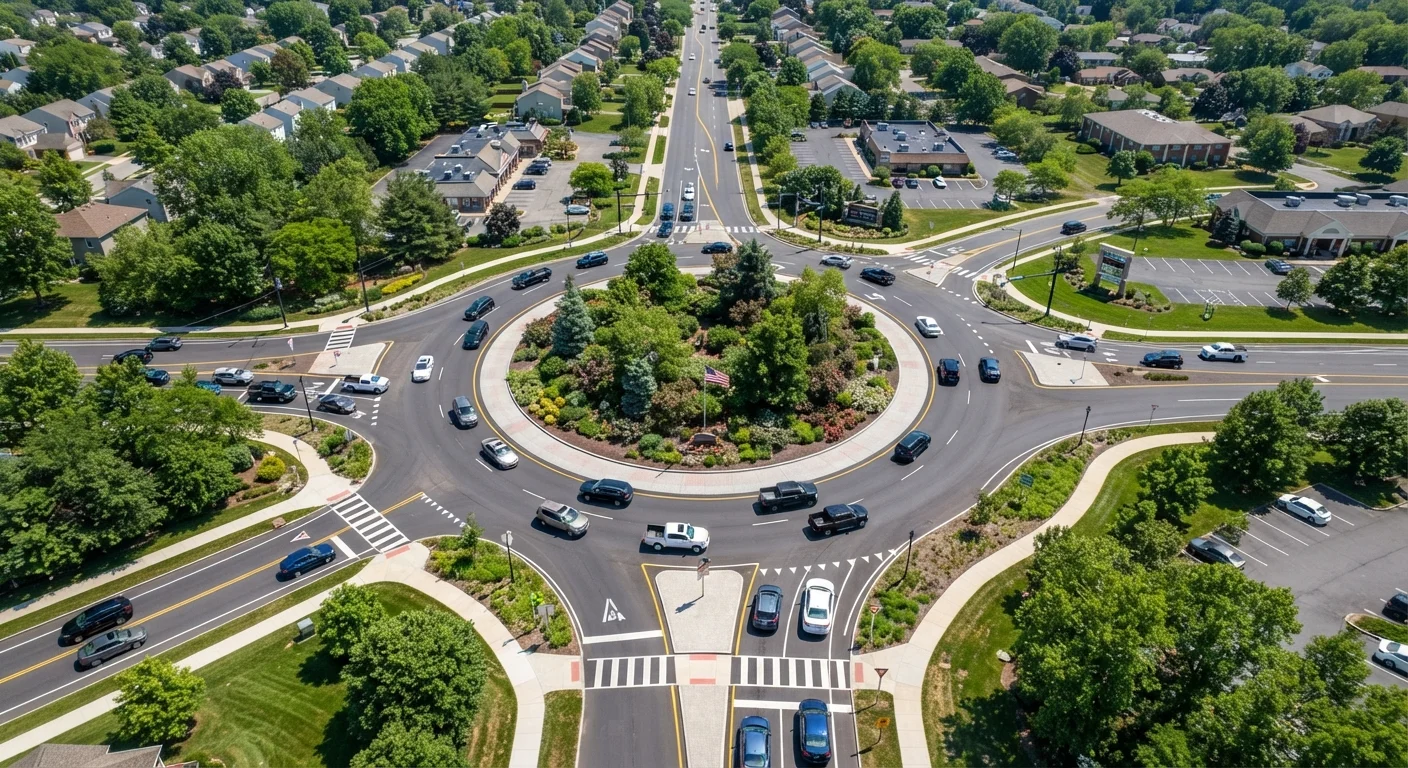
Why Roundabouts Trip Up So Many American Drivers
Roundabouts are still a relatively recent addition to the American road landscape. For decades, the U.S. relied almost exclusively on four-way stops and traffic signals, so most drivers learned to navigate intersections by waiting for a green light or taking turns. The roundabout asks for something different: an active, real-time judgment call about whether the path is clear.
That shift in responsibility is exactly where confusion sets in. Many drivers either stop completely when they don't need to — causing delays and rear-end risks — or enter without yielding, which creates dangerous conflicts with circulating traffic. Both errors come from the same source: not fully understanding one foundational rule.
Roundabouts vs. Traffic Circles: Not the Same Thing
Older-style traffic circles and rotaries — found in some northeastern cities — operate under different rules than modern roundabouts. Some give priority to entering traffic; others have traffic signals within the circle itself. If you're traveling through an unfamiliar region, check local signage rather than assuming the same rules apply. Modern roundabouts built to Federal Highway Administration standards will always post a yield sign at entry.
If you're working on broader situational awareness behind the wheel, the principles behind roundabout navigation connect directly to defensive driving habits — reading the road ahead and making proactive decisions rather than reactive ones.
The One Rule That Governs Every Roundabout
The entire logic of a roundabout rests on a single rule: yield to traffic already in the circle. Vehicles circulating inside have the right of way. You, as the entering driver, must wait at the yield line until there is a safe gap — then merge smoothly at a low speed.
This is the opposite of what many older traffic circles required, where entering vehicles sometimes had priority. In modern U.S. roundabouts, the person already going around always goes first. Internalizing this one principle removes most of the hesitation drivers feel.
~90%
Reduction in fatal crashes at converted intersections
According to the Insurance Institute for Highway Safety, roundabouts reduce fatal crashes by roughly 90% compared with traditional signalized intersections.
~75%
Reduction in injury crashes at roundabouts
The same IIHS research found injury-producing crashes drop by approximately 75% when intersections are converted to roundabouts.
8 conflict points
Conflict points in a roundabout vs. 32 at a 4-way stop
Transportation engineers note that the circular geometry of a roundabout reduces vehicle conflict points from 32 (at a typical four-way signalized intersection) to just 8.
Once you understand who yields, the physical navigation becomes straightforward. Slow down on the approach, scan left for circulating traffic (since that's the direction it will come from), and enter when there's a clear gap. You do not need to come to a complete stop unless traffic actually prevents entry.
How to Navigate a Single-Lane Roundabout Step by Step
For most drivers, the single-lane roundabout is the most common type encountered on U.S. surface roads. Here's how it works in practice:
- Slow down on approach — posted speeds at roundabout entries are typically 15–25 mph.
- Watch for pedestrians in the crosswalk before the yield line; they have priority.
- Yield at the dashed line to any vehicle already inside the circle.
- Enter when there's a gap, keeping to the right of the central island.
- Signal your exit with your right turn signal just before your intended road.
- Exit smoothly, watching again for pedestrians crossing your exit road.
If you miss your exit, don't panic or reverse. Simply continue around the circle and exit on the next pass. That's the system working as designed.
Multi-Lane Roundabouts: Choose Your Lane Early
Two- and three-lane roundabouts follow the same yielding rule but add a lane-selection challenge. The key is to make your decision before you reach the entry, using the advance signage posted on the approach road.
As a general guide: the right lane is used for the first one or two exits (right turns and straight-through movements). The left lane is used for exits further around the circle — left turns and U-turns. Once you're in the roundabout, stay in your lane and don't weave. Side-by-side crashes in multi-lane roundabouts almost always happen when a driver drifts lanes mid-circle.
Approach signage typically shows a small diagram of the roundabout with lane assignments. Take a moment to read it — it's there specifically to guide you.
Read Approach Signs Before You Reach the Entry
Roundabout approach signage — typically posted 100–200 feet before the entry — shows a diagram of which lane leads to which exits. Glancing at this sign as you slow down gives you time to position correctly without last-second lane changes. If you're unsure, the right lane is always a safe default for the first two exits.
Safety Gains That Make the Learning Curve Worth It
Roundabouts eliminate several of the most dangerous conflict types found at traditional intersections: right-angle T-bone crashes and head-on collisions. Because all traffic moves in the same direction at low speed, the worst-case impact scenario shifts from a broadside hit to a glancing sideswipe — dramatically less likely to be fatal.
Research published by the Insurance Institute for Highway Safety has consistently found that converting a conventional intersection to a roundabout produces large reductions in serious injury and fatal crashes. Beyond safety, roundabouts also reduce idling time, which lowers fuel consumption and emissions at that location.
Navigating unfamiliar intersections is just one piece of building confidence on the road. Whether you're heading through active construction zones or merging onto a busy freeway, the same underlying habit applies: read the situation early and make your move deliberately.
Frequently Asked Questions
Vehicles already circulating inside the roundabout always have the right of way. Drivers entering from any approach must yield to that traffic before merging in. This single rule governs almost every roundabout in the United States.
Yes — use your right turn signal to indicate you are exiting the roundabout. Activate it just before your exit, not while still in the circle. Some drivers also use a left signal when entering if turning left, though requirements vary by state.
Choose your lane before entering based on your destination exit. The right lane is typically used for right turns and straight-through movements to the first or second exit. The left lane is used for left turns or U-turns — exits further around the circle. Lane markings and advance signage on the approach will guide you.
You should only stop inside a roundabout to avoid an imminent collision. Stopping unnecessarily inside the circle disrupts traffic flow and can create a rear-end hazard. If you miss your exit, complete another loop rather than reversing or stopping abruptly.
Research from the Insurance Institute for Highway Safety indicates roundabouts reduce fatal crashes at intersections by roughly 90% and injury crashes by about 75% compared with traditional stop-sign or signal-controlled intersections. The main reason is the elimination of high-speed right-angle and head-on conflicts.
Many roundabouts include a raised truck apron — a slightly elevated ring around the central island — that large vehicles can mount with their rear wheels to complete the turn. Drivers of long vehicles should watch for this feature and use it as intended. Go slowly and follow any posted guidance for oversized vehicles.
The content on this site is for informational purposes only and is not a substitute for professional advice. Always consult a qualified professional for guidance specific to your situation.