

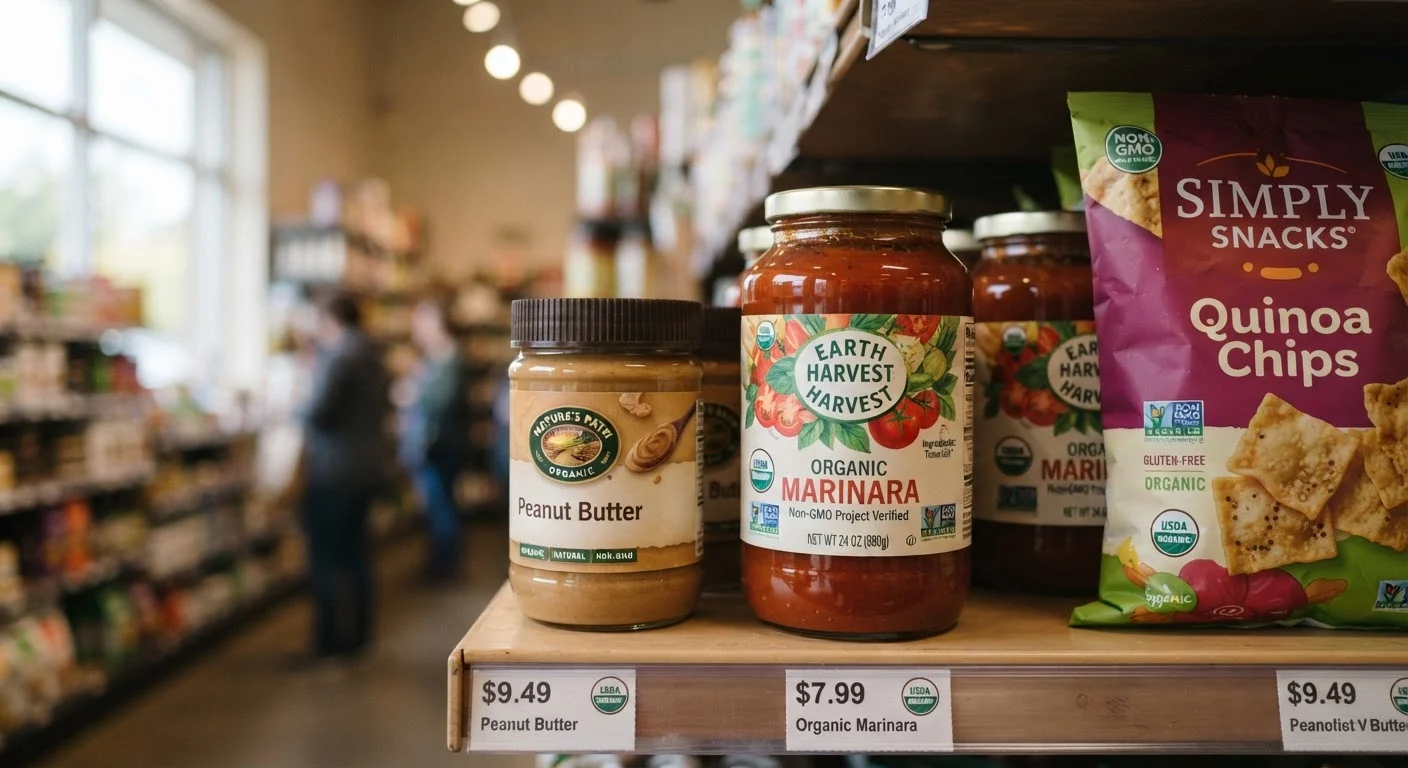
Why These Three Terms Create So Much Confusion
Walk down any grocery aisle and you'll encounter a near-constant stream of reassuring words: natural, organic, non-GMO. They're strategically placed on front panels precisely because they signal something healthy, clean, or trustworthy. But these three terms are not created equal under U.S. federal law — and treating them as interchangeable can lead to genuinely misleading purchase decisions.
The confusion is understandable. All three claims can appear on the same box of crackers, yet each is governed — or not governed — by a completely different set of rules. Food manufacturers understand how label placement shapes perception, and these three terms are among the most effective tools in that toolkit. Here's what federal standards actually back up — and where the gaps are.
Myth
"Natural" on a food label means the product is minimally processed and free of artificial ingredients — essentially close to nature.
Fact
The FDA has no formal regulatory definition for "natural" on most food labels, meaning manufacturers apply it with significant discretion.
The FDA has informally stated it considers "natural" to mean a food contains nothing artificial or synthetic that wouldn't normally be found in that food — but this is guidance, not a legal standard. No pre-market approval or third-party verification is required. That means a product labeled "natural" can contain high-fructose corn syrup, be heavily processed, or include ingredients that many consumers would not consider natural. The agency has received public comments about formalizing a definition but had not finalized one as of this writing. Bottom line: "natural" is largely a marketing term, not a regulated certification.
Myth
"USDA Organic" and "natural" are essentially the same thing — both signal a cleaner, less chemically treated product.
Fact
USDA Certified Organic is a rigorously defined, federally enforced standard with mandatory third-party verification. "Natural" is not.
The USDA's National Organic Program (NOP) sets specific requirements: certified organic crops must be grown without most synthetic pesticides or fertilizers; certified organic livestock must have access to the outdoors and cannot be given antibiotics or growth hormones. Products labeled "USDA Organic" must be certified by an accredited certifying agent and contain at least 95% organically produced ingredients. Products labeled "made with organic [ingredient]" must contain at least 70% organic ingredients. This is a meaningful, auditable distinction — something "natural" cannot claim. A glossary of confusing food label terms can help you parse other organic sub-claims you may encounter on packaging.
Myth
"Non-GMO" is a federally certified claim, just like USDA Organic.
Fact
There is no federal non-GMO certification program. Most non-GMO claims on labels come from voluntary third-party programs with their own standards.
The most widely recognized non-GMO seal in the U.S. — the Non-GMO Project Verified butterfly — is issued by a private nonprofit organization, not a government agency. While the USDA does administer a voluntary National Bioengineered Food Disclosure Standard that requires labeling of certain bioengineered (BE) foods, the rules around what must be disclosed, and how, differ from what many consumers expect. Notably, highly refined ingredients derived from GMO crops — such as some oils and sugars — may not trigger disclosure if the modified genetic material is undetectable in the final product. So a product can carry a non-GMO seal from a third party while also not being required to carry a USDA BE label. Understanding which organization issued a non-GMO claim and what their testing protocols involve is key.
Myth
If a food is labeled organic or non-GMO, it's automatically healthier and more nutritious than conventional alternatives.
Fact
Organic and non-GMO certifications address production methods, not nutritional content. A certified organic cookie is still a cookie.
Certification programs for organic and non-GMO status evaluate how food is produced — what pesticides or genetic modifications were used — not how much sugar, sodium, saturated fat, or total calories a product contains. Research on whether organic foods deliver meaningfully different nutritional profiles compared to conventional equivalents is mixed and ongoing; no scientific consensus supports a blanket nutritional superiority claim for organic foods. For shoppers who prioritize reducing pesticide residue exposure or supporting certain farming practices, organic certification provides meaningful information. But for managing nutrient intake, the Nutrition Facts panel remains the most direct tool. Learning to read nutrition labels covers how to use that panel effectively.
The Regulatory Landscape at a Glance
Three agencies are primarily involved in food label oversight in the U.S.: the FDA, the USDA, and the FTC. Their jurisdictions don't always overlap cleanly, which is part of why label literacy requires knowing who is doing the regulating.
95%
Organic ingredient threshold for 'USDA Organic' seal
Per USDA National Organic Program rules, products bearing the USDA Organic seal must contain at least 95% certified organic ingredients by weight, excluding water and salt.
0
Federal definitions for 'natural' on most food labels
The FDA has not finalized a regulatory definition for 'natural' on packaged food labels, leaving manufacturers to apply the term largely at their discretion.
70%+
Organic content required for 'made with organic' claim
USDA rules require at least 70% certified organic ingredients for a 'made with organic [ingredient]' front-label claim, though these products cannot display the USDA Organic seal.
The USDA's National Organic Program has the clearest, most enforceable framework of the three claims discussed here. The FDA's position on "natural" remains informal. Non-GMO verification largely depends on which third-party organization issued the certification. If you want a full breakdown of how these claims compare to other front-of-package language, many common front-of-package claims carry no regulatory definition at all.
Don't Rely on the Front Panel Alone
Front-of-package claims like "natural," "organic," and "non-GMO" are designed to attract attention — not to give you a complete picture of a product's nutritional value. Always flip the package and check the Nutrition Facts panel and ingredients list before making assumptions about healthfulness. A certified organic product can still be high in added sugars or sodium. Regulatory labels tell you about production; only the nutrition panel tells you what you're actually eating.
Being label-literate doesn't require memorizing every federal regulation. It means knowing the right questions: Who defined this term? Who verified it? What does it actually restrict? That's the framework that protects you from paying a premium for a claim that means less than it appears. For a broader decoding of the Nutrition Facts panel itself, see what nutrition labels are actually telling you.
This article is for general informational and educational purposes only. It is not intended as medical, dietary, or legal advice. Consult a qualified healthcare professional or registered dietitian for guidance specific to your health needs.
The content on this site is for informational purposes only and is not a substitute for professional advice. Always consult a qualified professional for guidance specific to your situation.