

Why a Meal Rotation Works Better Than Starting Fresh Each Week
Most people approach dinner planning by staring at a blank week and asking, "What should we eat?" That question, asked seven times a week, 52 weeks a year, creates real cognitive strain. Researchers call it decision fatigue — the mental depletion that comes from making too many choices, which leads to worse decisions over time or simply giving up and ordering delivery.
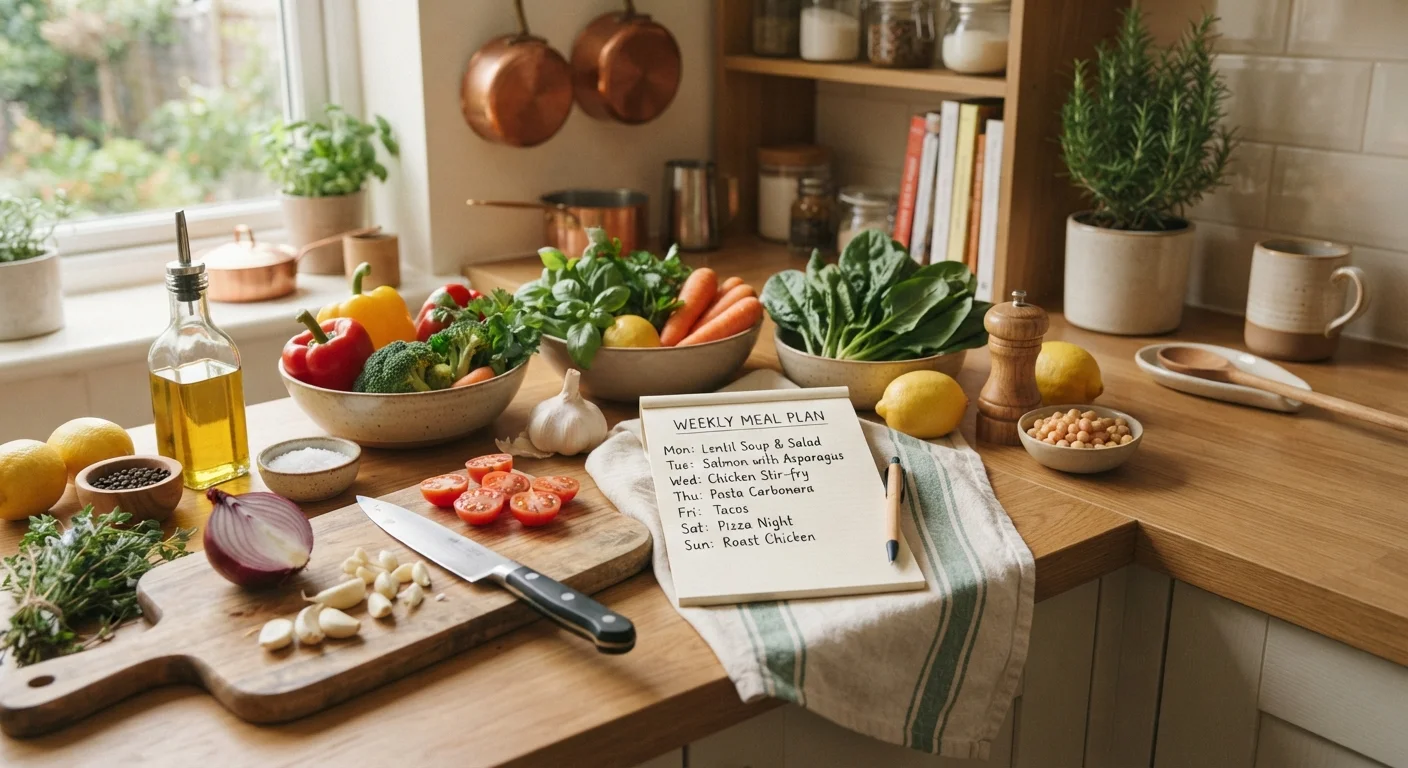
A meal rotation sidesteps the problem entirely. Instead of choosing from an open-ended universe of possibilities, you're selecting from a curated set of meals your household already knows and likes. The cognitive work happens once, upfront, and then the system runs itself.
Beyond mental ease, rotations also support better healthy eating basics because they make nutritional balance a structural feature rather than a nightly improvisation. When your rotation is mapped out, you can look across the whole week and confirm you're hitting a reasonable spread of proteins, vegetables, and grains — rather than noticing on Friday that you've eaten pasta every night.
A rotation also complements whichever cooking style fits your schedule. Whether you batch-cook on weekends or prefer fresh meals each evening, the rotation gives both approaches a clear direction. For a comparison of those two styles, see batch cooking vs. daily cooking.
Notebook or index cards
Write out your recipe list and weekly rotation schedule in a format you can reference easily.
Meal planning app or spreadsheet
Digitally organize your rotation cycle and generate a repeatable shopping list automatically.
Recipe collection (physical or digital)
Reference your go-to recipes when building and expanding the rotation over time.
How to Build and Run Your Rotation
Building a rotation takes one focused planning session — usually 20 to 45 minutes. The steps below walk you through the process from a blank page to a running system.
What you will need
List every meal your household already likes
Open a notebook or document and write down every dinner your household genuinely enjoys — not aspirational recipes you've bookmarked but never cooked, but the meals that actually land on the table regularly. Aim for at least 10 to 14 entries. These become the core of your rotation.
Group them loosely by type: pasta dishes, one-pan proteins, soups, grain bowls, tacos. This grouping will help you spot gaps or imbalances before you finalize the cycle.
Decide on a two- or three-week cycle length
A two-week rotation gives you 14 dinner slots. A three-week rotation gives you 21. Most households find a two-week cycle hits the sweet spot — enough variety to avoid boredom, tight enough to keep the shopping list familiar and predictable.
If your list from Step 1 has fewer than 10 strong meals, start with a two-week cycle and leave one or two nights as wildcards where you try something new or order out guilt-free.
Map meals to nights, balancing effort and nutrition
Assign your meals to specific nights with two factors in mind: how much time and energy that night typically demands, and how the week's nutrition adds up overall. Put your quickest meals on your busiest days — Wednesday and Thursday are notoriously hectic for most households.
Spread protein sources across the week rather than clustering all chicken dishes together. Aim to include at least two or three nights with substantial plant-based components. For a visual guide to what a nutritionally complete dinner looks like, see what a balanced plate actually looks like.
Build a master shopping list from the full cycle
Once your rotation is mapped, write out a consolidated shopping list covering all ingredients for the entire cycle. Identify which staples — olive oil, canned tomatoes, dried pasta, broth — carry across multiple meals and buy them in quantities that last.
This master list becomes the backbone of your grocery routine. Over time, you'll memorize most of it, making shopping faster and reducing impulse purchases that go unused. Weekly meal planning from scratch covers shopping list organization in more detail if you're new to the process.
Schedule seasonal swaps every 6–8 weeks
A rotation only feels stale if it never changes. Every six to eight weeks, retire one or two meals that feel repetitive and replace them with something new — ideally something using produce that's in season, which tends to taste better and cost less.
This also gives you a built-in moment to reflect on what's working. Did the whole family eat the grain bowl without complaint? Keep it. Did the fish tacos consistently get skipped? Swap them out without guilt.
Run the rotation for two full cycles before adjusting
Resist the urge to tinker after a single week. Give the rotation two full passes — roughly four weeks for a two-week cycle — before making changes. This gives you enough data to tell whether a meal genuinely doesn't work or whether it just landed on a stressful night.
Track simple notes: "kids liked this," "too time-consuming on Tuesdays," "needs a vegetable side." Those observations guide smart, targeted adjustments rather than wholesale restarts. For broader perspective on making healthy habits stick over time, see building healthier eating habits without overhauling your life.
Use Themes to Stay Creative Without Overthinking
Assigning loose themes to each night — such as "pasta night," "stir-fry night," or "grain bowl night" — gives structure without locking you into one specific recipe. You can swap proteins, vegetables, or sauces freely within the theme, keeping meals fresh week after week. See theme nights and protein swap strategies for a deeper look at this approach.
Nutrition Balance Matters in Every Rotation
A rotation that repeats the same heavy, low-vegetable meals every cycle can quietly undercut your nutritional goals. Aim to include a variety of protein sources, vegetables, and whole grains across your weekly cycle. If you're unsure whether your rotation covers your nutritional needs, a registered dietitian can provide personalized guidance — this article offers general educational information, not medical or dietary advice.
Once your rotation is running smoothly, you'll find that the anatomy of a balanced weekly meal plan becomes much easier to maintain — because the structure is already built into your cycle rather than recreated from scratch each week.
This article is for general informational and educational purposes only. It is not a substitute for personalized advice from a registered dietitian or other qualified health professional.
The content on this site is for informational purposes only and is not a substitute for professional advice. Always consult a qualified professional for guidance specific to your situation.