

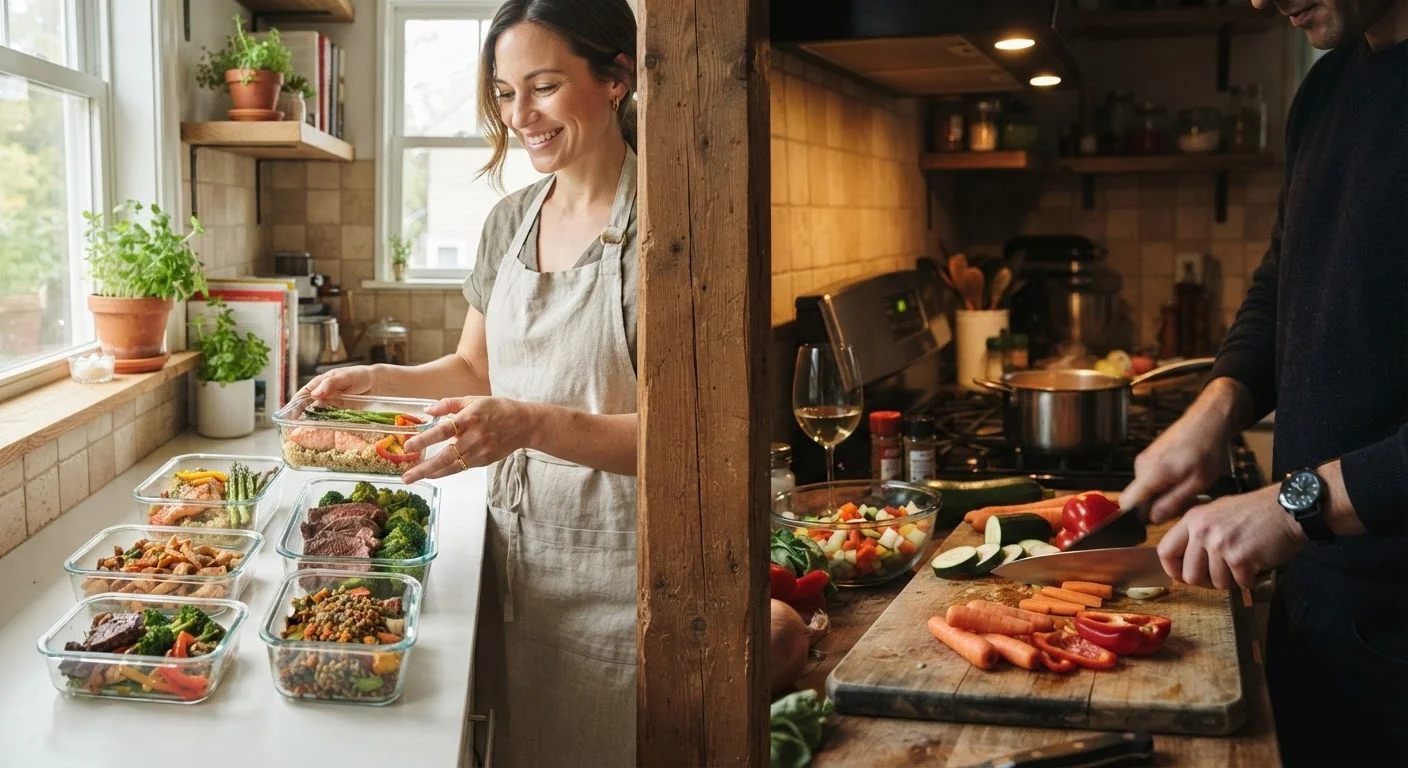
Option A
Batch Cooking
The structured, plan-ahead approach.
Best for: People with predictable weekends and limited time on busy weekday evenings.
Option B
Daily Cooking
The flexible, cook-as-you-go method.
Best for: People who prefer fresh meals and can carve out time most evenings.
What Each Approach Actually Looks Like
Batch cooking means setting aside one or two blocks of time — often over the weekend — to cook large quantities of food that will carry you through several days. Think a big pot of grains, roasted vegetables, marinated proteins, and a pot of soup, all done in a couple of hours. From there, weeknight meals become assembly rather than cooking.
Daily cooking, by contrast, means preparing each meal close to when you'll eat it. You might chop vegetables, cook a protein, and build a meal from scratch on Tuesday evening just as you would on Saturday. The kitchen is active most nights, but every meal is as fresh as it gets.
If you're new to either method and want a structured framework first, the weekly meal planning guide walks through how to organize a full week of home-cooked meals from scratch.
| Criterion | Batch Cooking | Daily Cooking |
|---|---|---|
| Time investment | Heavy upfront, light daily | Spread across each evening |
| Meal freshness | Lower — reheated most nights | Higher — cooked to order |
| Flexibility | Lower — plan must hold | Higher — easily adjusted |
| Food waste risk | Higher if plans change | Lower — shop and cook as needed |
| Best for busy weeknights | Yes — food is ready to go | Only if evenings allow time |
| Variety across the week | Limited without extra effort | Easier to vary each night |
| Suits large households | Yes — scales well | Can be time-consuming for groups |
The Real Trade-Offs: Time, Freshness, and Flexibility
The core tension between these two styles comes down to when you spend your time and what you're willing to trade for convenience.
Batch cooking compresses effort. You might spend two to three hours on a Sunday, but your weeknights become nearly effortless. The downside is that reheated food can lose texture and sometimes flavor — particularly delicate proteins, leafy salads, or anything crispy. There's also the commitment factor: a batch requires you to actually want to eat what you prepared days later.
Daily cooking preserves quality. A just-seared piece of fish or a fresh stir-fry is almost always more satisfying than its reheated counterpart. But it demands consistent time and energy on evenings when you may have neither. Missed cooking sessions can derail your eating habits quickly.
~1 hr
Average daily time Americans spend on food prep and cooking
According to the U.S. Bureau of Labor Statistics American Time Use Survey, Americans spend roughly an hour per day on food preparation and cleanup combined.
30–40%
Share of food wasted at the consumer level in the U.S.
The USDA estimates that between 30 and 40 percent of the U.S. food supply is wasted, much of it at the household level due to unused ingredients and forgotten leftovers.
For households with varied dietary needs, batch cooking often wins on practicality — prepped base ingredients let everyone customize their plate. The article meal planning for families with mixed dietary preferences explores this dynamic in more detail.
Food Safety: A Non-Negotiable for Both Methods
Whichever approach you choose, safe food handling is essential. The USDA recommends refrigerating cooked food within two hours of cooking and consuming refrigerated leftovers within three to four days. For batch cooking specifically, this means dividing large quantities into shallow containers so food cools quickly and evenly.
Freezing extends your options considerably. Many batch-cooked items — soups, grains, cooked beans, certain proteins — freeze well for up to three months. Label containers with the date so nothing is guessed at later.
Daily cooking carries fewer food-safety concerns around storage, but cross-contamination risks during prep still apply. Keep raw proteins separate from produce, and wash hands and surfaces thoroughly between tasks.
This article is for general informational purposes only and is not a substitute for advice from a qualified nutrition or healthcare professional.
Finding Your Fit — or Building a Hybrid
The cleanest insight here: neither method is objectively better. The best cooking strategy is the one you'll actually stick with.
Many people land on a hybrid approach — batch-prepping a few foundational components (a cooked grain, a roasted vegetable tray, a versatile protein) while leaving room for fresh cooking on nights when time allows. This keeps meals varied without requiring a daily commitment.
It also pays to stay flexible. A batch-cooking habit that works in winter may feel burdensome in summer when schedules shift. Revisiting your approach seasonally — or even just when life changes — is a sign of good planning, not inconsistency. For more on adapting meal strategies to real-world time limits, see meal planning on a realistic schedule.
If you want to keep meals interesting regardless of which method you use, building a rotating meal rotation can help you cycle through familiar recipes without the dinnertime boredom that often leads to ordering out.
The content on this site is for informational purposes only and is not a substitute for professional advice. Always consult a qualified professional for guidance specific to your situation.