

What Makes a Meal Plan Actually 'Balanced'
The word balanced gets thrown around a lot in nutrition conversations, but it has a practical meaning: your meals, taken together across the week, should deliver the full range of nutrients your body needs to function well. That means adequate protein for muscle maintenance and satiety, fiber-rich carbohydrates for energy and digestive health, healthy fats for hormone function and nutrient absorption, and a wide variety of vitamins and minerals — most of which come from vegetables and fruits.
The USDA's Dietary Guidelines offer a useful visual framework: roughly half your plate at each meal should be vegetables and fruit, a quarter lean protein, and a quarter whole grains or starchy vegetables. This isn't a rigid rule for every single bite — it's a useful target to aim for most of the time. Balance accumulates across the week, which means one heavy or light day doesn't derail anything.
For a deeper look at the core principles underpinning this, the Healthy Eating Basics hub covers foundational nutrition concepts in plain language.
~$1,500
Annual food waste per average U.S. household
According to USDA Economic Research Service estimates, the average American household wastes a significant portion of purchased food — much of which meal planning can help reduce.
1 in 3
Americans who report difficulty eating healthy consistently
Surveys consistently find that time constraints and lack of planning are among the top barriers Americans cite for not eating as well as they'd like.
Half
Of your plate should be vegetables and fruit
Per the USDA Dietary Guidelines for Americans, filling half the plate with produce at most meals is a central recommendation for a balanced diet.
The Four Pillars of a Functional Plan
A meal plan that only optimizes for nutrition but ignores your Tuesday schedule will fail by Wednesday. A truly workable plan rests on four pillars simultaneously:
- Nutrition: Covering the major food groups across the week, with an emphasis on whole foods, lean proteins, and plenty of vegetables.
- Variety: Rotating proteins, grains, and vegetables prevents nutritional gaps and keeps meals interesting enough that you actually want to follow the plan.
- Time: Matching meal complexity to the time you realistically have. Quick assembly meals on busy nights; more involved cooking on days you have bandwidth.
- Budget: Building around affordable staples — dried beans, eggs, seasonal produce, whole grains — and using higher-cost items like fish or lean meats as components rather than centerpieces.
When any one of these pillars is ignored, the plan becomes fragile. A nutritionally ideal plan that costs too much will be abandoned. One that fits the budget but offers no variety creates meal fatigue. Why meal plans fall apart by Wednesday explores exactly how this plays out in practice.
Audit Your Week Before You Plan
Before writing a single meal down, look at your actual calendar for the week. Identify your two or three busiest evenings and assign your fastest, simplest meals to those nights. Saving more involved recipes for days when you genuinely have time prevents the plan from feeling like a burden.
Building the Structure: Protein, Produce, and Grains
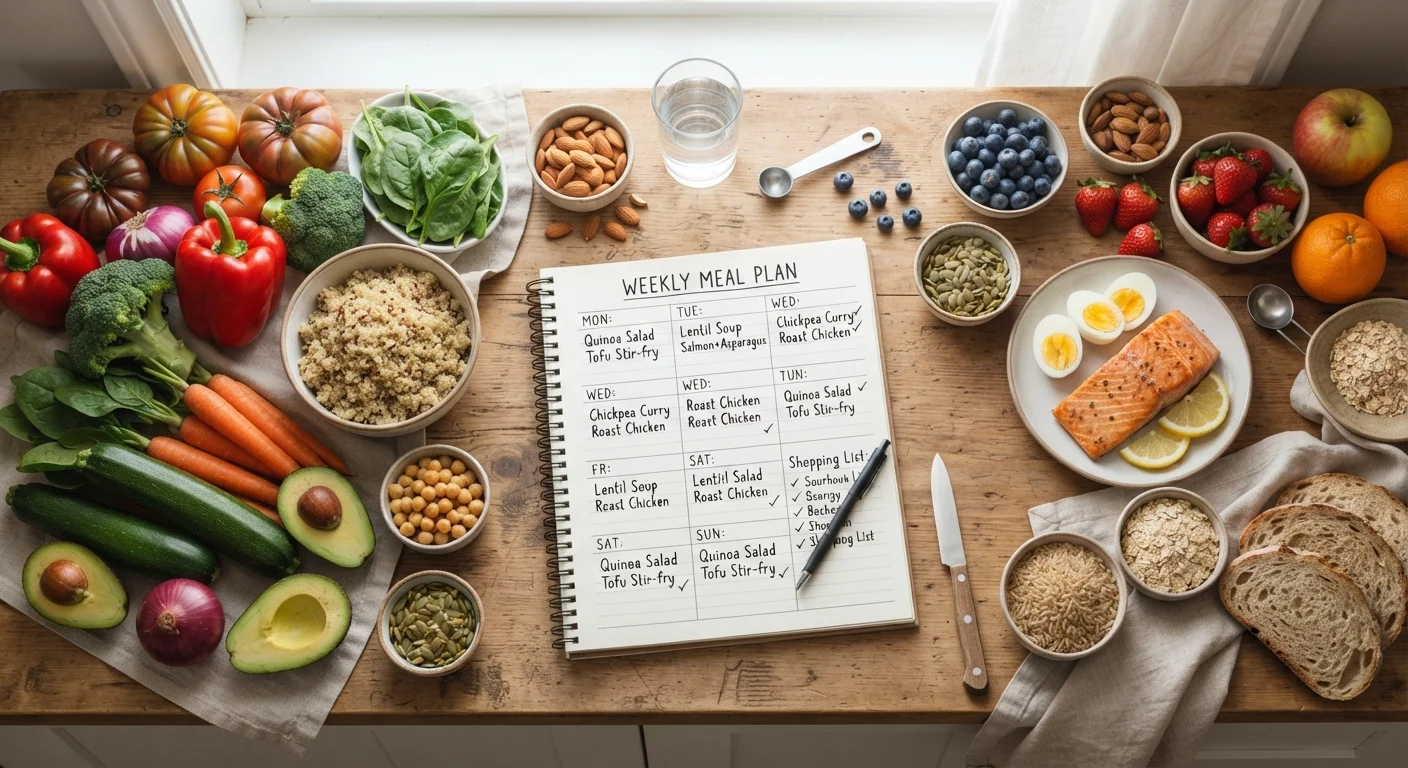
Think of your weekly plan as having three recurring anchors: a protein rotation, a produce rotation, and a grain rotation. Choosing two or three options in each category gives you the raw material to mix and match into varied meals without starting from scratch every day.
Protein rotation examples: chicken thighs, canned salmon, eggs, black beans, tofu, or ground turkey. Rotating these across the week ensures variety and covers different amino acid profiles.
Produce rotation: Aim for at least four to five different vegetables across the week, mixing cooked and raw. Leafy greens, cruciferous vegetables like broccoli, and colorful options like bell peppers or carrots each bring distinct micronutrients.
Grain rotation: Whole grains — brown rice, quinoa, oats, whole-grain bread — provide fiber and B vitamins that refined grains largely lack. Preparing a batch of grains at the start of the week makes building quick meals significantly easier.
This modular approach is what separates a sustainable plan from a rigid script. For a step-by-step walkthrough of putting these elements together for the first time, see Weekly Meal Planning from Scratch.
Flexibility Is a Feature, Not a Flaw
The most common mistake new meal planners make is over-planning — assigning a specific meal to every day with no margin for error. When life intervenes (and it always does), the whole plan feels broken. A resilient plan builds flexibility in deliberately.
Practical ways to do this include: designating one or two nights as 'open' for leftovers or simple fallbacks; planning meals that share ingredients so a swap is easy; and keeping two or three reliable 15-minute meals in your mental toolkit for genuinely chaotic days. These might be scrambled eggs with roasted vegetables, a grain bowl with whatever's in the fridge, or a simple bean and rice combination.
If your schedule is genuinely unpredictable, a loose framework — deciding protein and vegetable categories rather than specific meals — often works better than a day-by-day script. Planning meals around a tight schedule offers practical frameworks designed specifically for variable weeks.
This article is for general informational and educational purposes only and is not a substitute for personalized advice from a registered dietitian or qualified healthcare professional. Individual nutrition needs vary. Consult a qualified professional for guidance tailored to your specific health circumstances.
Frequently Asked Questions
Most plans cover three main meals per day, which totals 21 meals over seven days. Many people also include planned snacks. You don't have to plan every single meal — even planning dinners and lunches consistently produces meaningful results.
No. Repeating meals is a perfectly valid strategy and often makes planning and grocery shopping simpler. Nutritional balance is measured across the whole week, so eating the same lunch three times is fine as long as your overall diet covers a variety of food groups.
Build meals around affordable staples like dried legumes, whole grains, eggs, and seasonal produce. Planning before you shop prevents impulse purchases and reduces food waste — both of which save money. See <a href="/food-nutrition/healthy-eating-basics/meal-planning-on-a-realistic-schedule">meal planning on a realistic schedule</a> for budget-conscious strategies.
That's normal and expected. Build in at least one 'flex' night — a meal slot reserved for takeout, leftovers, or a simple fallback like eggs and toast. A plan that accommodates life's unpredictability is far more sustainable than one that falls apart the moment things deviate.
They're related but different. Meal planning is deciding what you'll eat. Meal prepping is preparing ingredients or full meals in advance. Planning always comes first; prepping is an optional step that makes executing the plan easier during the week.
For most people, 20–30 minutes of focused planning time per week is enough once you've established a routine. The first few weeks take longer as you build a mental library of go-to meals. Tools like planning apps or a simple notebook can speed up the process considerably.
The content on this site is for informational purposes only and is not a substitute for professional advice. Always consult a qualified professional for guidance specific to your situation.