

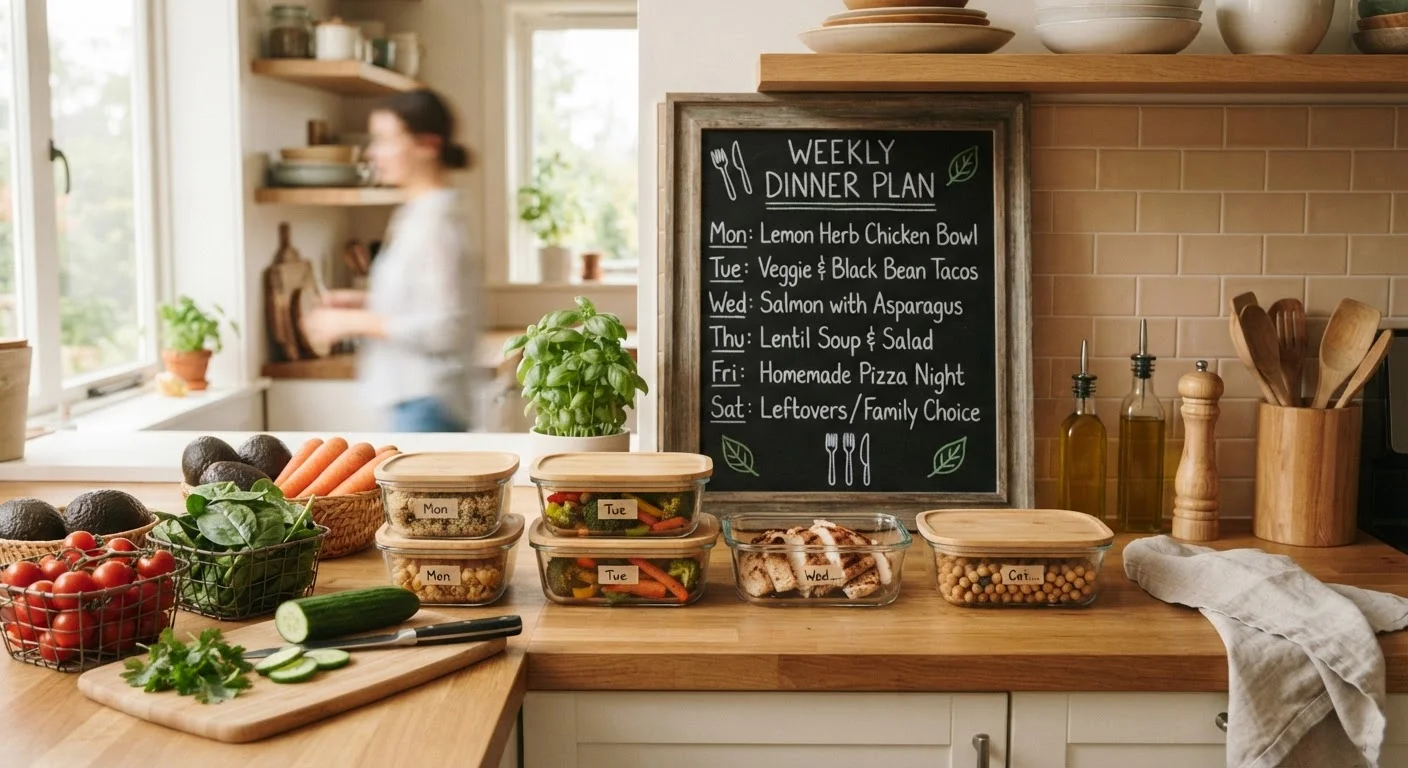
Why Dinner Decisions Feel So Exhausting
By the time dinner rolls around, most Americans have already made hundreds of small decisions throughout the day. Choosing what to cook shouldn't require the same mental energy as a work presentation — but without any system in place, that's often exactly what happens.
Decision fatigue is a well-documented psychological phenomenon: the quality of decisions tends to decline after a long stretch of choosing. Dinner lands at the worst possible time. The good news is that a modest amount of upfront structure eliminates most of that friction. You don't need a rigid meal plan or elaborate prep routine — just a few reliable strategies that narrow your options without killing variety.
If you're starting from zero, our practical guide to weekly meal planning walks through the foundational steps. This article focuses on specific tactics that make the day-to-day execution feel almost automatic.
Assign a Theme to Each Weeknight
Theme nights are the single most effective way to collapse an open-ended question — "What should I make tonight?" — into a manageable one: "What's a good pasta dish for Tuesday?" Common themes include Meatless Monday, Taco Tuesday, Stir-Fry Wednesday, or Soup Sunday. The theme provides the container; the specific recipe can change week to week.
This approach works because it uses a category constraint, not a rigid recipe, which preserves variety while eliminating the blank-page problem. Over time, you'll naturally accumulate a mental library of go-to meals within each theme, making the decision even faster.
A theme night turns an open-ended question into a simple, manageable category choice.
Use Protein Swaps to Multiply Your Recipe Library
Many home cooks underestimate how far a single recipe framework stretches when you swap the protein. A sheet-pan dinner built around roasted vegetables works with chicken thighs, salmon fillets, chickpeas, or tofu — each producing a meaningfully different meal with the same basic technique and cleanup.
Keeping two or three proteins in your freezer at all times means you can stick to a familiar format while varying the actual dish. This is particularly useful when you're short on planning time: the recipe is already known, the process is already practiced, and the substitution is low-stakes.
One recipe framework can produce four distinct dinners simply by switching the protein.
Build a Short Rotating Meal List
A rotating meal list is a curated set of 10 to 15 dinners your household genuinely enjoys and you know how to make confidently. You cycle through it over several weeks, which makes grocery shopping predictable and reduces cognitive load substantially. It's not about eating the same things forever — you can retire meals and add new ones as tastes evolve.
For a deeper look at structuring this kind of system, our article on building a meal rotation that stays interesting covers how to keep the list from feeling stale over time.
A curated list of 10–15 trusted dinners makes grocery shopping predictable and planning nearly automatic.
Batch One Foundational Ingredient Per Week
Rather than full meal prep, consider batch-cooking just one versatile ingredient: a pot of whole grains, a tray of roasted vegetables, a large batch of seasoned ground meat, or a slow-cooker full of legumes. This single step gives you a ready-made foundation that plugs into multiple dinners throughout the week without locking you into a specific meal.
Cooked farro, for example, works in a grain bowl on Monday, alongside roasted chicken on Wednesday, and stirred into a vegetable soup on Friday. The cooking time is consolidated; the flexibility remains intact.
Batch-cooking one foundational ingredient each week quietly accelerates three or four dinners.
Keep a Running 'What Worked' List
Every time a dinner lands well — everyone ate it, it came together without stress, it reheated decently — write it down. A simple note in your phone or a sticky note on the fridge is sufficient. Over a few months, this list becomes an invaluable reference when energy is low and inspiration is thinner.
This habit also counteracts a common planning trap: spending time researching new recipes each week when reliable options already exist. Novelty has value, but so does a dependable roster of dinners that require no mental setup to execute.
Logging meals that work builds a personal dinner library you can draw on without extra research.
Separate Planning From Shopping From Cooking
Trying to decide what to make, figure out what you need, and execute it all in the same evening is an unnecessarily heavy lift. Treating these as three distinct activities — even if each takes only a few minutes — makes the whole process feel lighter.
A brief weekly planning moment (Sunday morning, a lunch break, whenever it fits) sets the week's direction. A consolidated grocery run eliminates mid-week scrambles. Cooking then becomes a straightforward execution task rather than a multi-layered puzzle. This separation is one of the underappreciated trade-offs discussed in our piece on the real trade-offs of weekly meal planning.
Separating planning, shopping, and cooking into distinct steps removes compounded evening stress.
Putting It All Together Without Overcomplicating It
None of these strategies requires a personality transplant or hours of Sunday prep. The goal is to reduce the number of open-ended questions you face at 5:30 p.m. — not to script every meal in advance. Even adopting two or three of these approaches can meaningfully cut the friction around dinner.
Start With Just One or Two Strategies
Trying to implement all of these tactics at once is likely to feel overwhelming rather than helpful. Pick the one or two that address your most common dinner friction point — whether that's the blank-page problem, inconsistent grocery runs, or repeating the same three meals — and let those take hold before adding more. Small, sustained changes tend to outlast ambitious overhauls.
For households with different tastes and dietary needs, these strategies pair especially well with the ideas in our article on meal planning for families with mixed dietary preferences. And if you're cooking for just one or two people, the same core tactics apply — with some adjustments for smaller-scale meal planning around portions and batch sizes.
Structure doesn't mean boredom. It means spending your creative energy on the meal itself — not on whether to make it in the first place.
This article is for general informational and educational purposes only. It is not a substitute for personalized nutrition or medical advice. Consult a qualified healthcare professional for guidance specific to your health needs.
The content on this site is for informational purposes only and is not a substitute for professional advice. Always consult a qualified professional for guidance specific to your situation.