

Option A
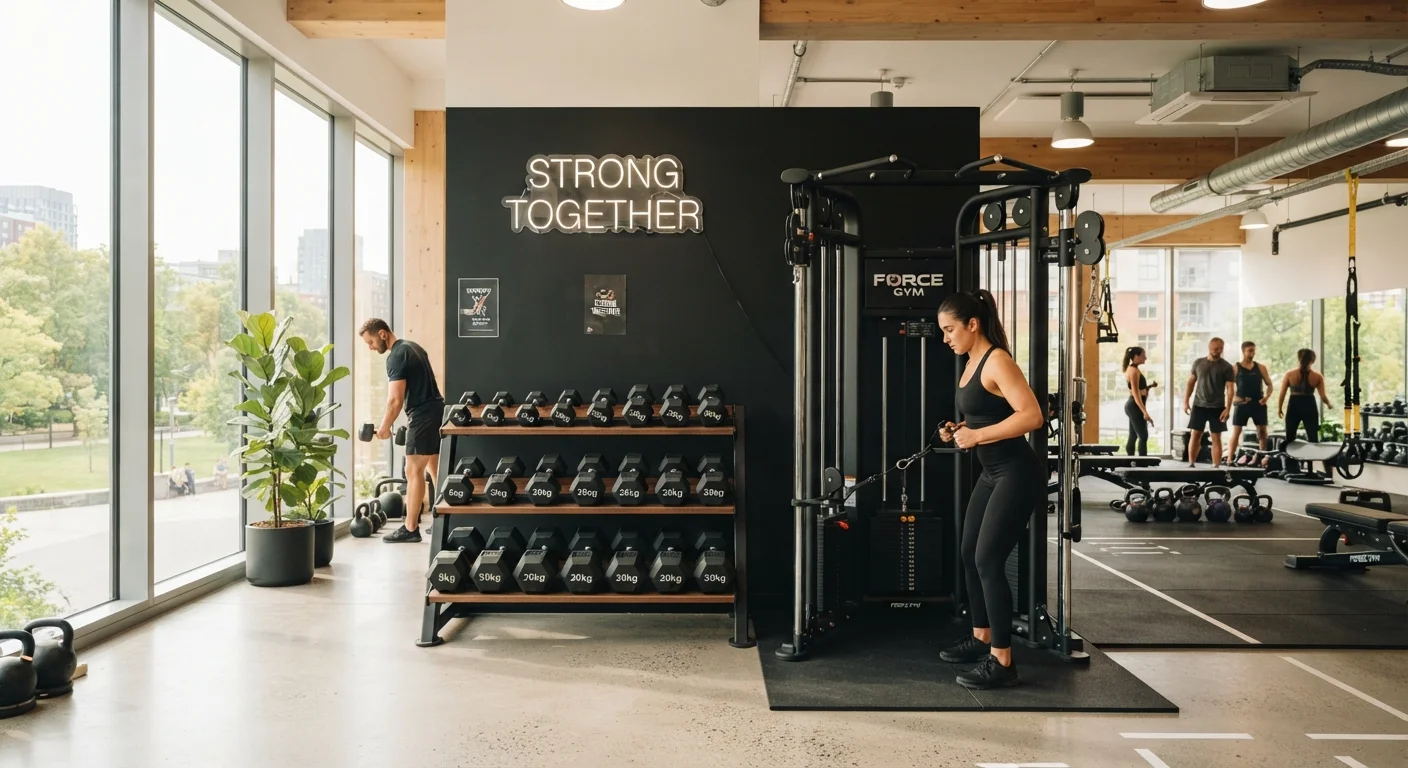
Free Weights
The versatile, functional-movement classic.
Best for: People who want to build functional strength, train multiple muscle groups simultaneously, and progress at their own pace.
Option B
Resistance Machines
The guided, controlled path to targeted strength.
Best for: Beginners learning movement patterns, people rehabilitating from injury, or anyone isolating a specific muscle group safely.
What Each Tool Actually Does
Walk into most gyms and you'll find two distinct zones: racks of dumbbells and barbells on one side, and a circuit of weight machines on the other. If you're just getting started, understanding the basic terminology helps make sense of what you're looking at and why each piece of equipment exists.
Free weights — including dumbbells, barbells, and kettlebells — are simply weighted objects you move through space. Because nothing guides or constrains the movement, your muscles must coordinate to control the load in all directions. This recruits what are called stabilizing muscles: smaller supporting muscles that work alongside the primary movers.
Resistance machines use cables, pulleys, or lever arms to move weight along a fixed path. A leg press, chest fly, or lat pulldown machine each locks you into a specific range of motion designed to target a particular muscle group. That constraint is the defining feature — and depending on your situation, it can be either an advantage or a limitation.
| Criterion | Free Weights | Resistance Machines |
|---|---|---|
| Learning curve | Steeper — technique takes practice | Gentler — guided movement path |
| Muscles engaged | Primary + stabilizing muscles | Primarily target muscle |
| Functional carry-over | High — mirrors real-world movement | Moderate — more isolated |
| Injury risk (beginner) | Higher without proper form | Lower due to controlled path |
| Exercise variety | Very high from one set of dumbbells | Limited to machine's design |
| Isolation ability | Moderate | High — excellent for targeting |
| Best for beginners? | With guidance, yes | Yes — a natural starting point |
| Suitability for rehabilitation | Depends on condition and form | Often preferred — controlled load |
The Case for Free Weights
Free weights shine when the goal is functional strength — the kind that carries over into daily life. Squatting with a barbell, pressing dumbbells overhead, or hinging with a kettlebell trains your body to produce and control force in patterns that mirror real-world demands.
Research in exercise science consistently shows that multi-joint, free-weight movements produce significant gains in overall muscle mass and strength across a wide population. They also offer more flexibility: one pair of adjustable dumbbells can be used for dozens of exercises, making them an efficient investment in variety.
That said, free weights come with a steeper learning curve. If you've never lifted a weight before, the coordination demands of a barbell back squat or overhead press can feel overwhelming — and poor form under load increases injury risk. Starting with lighter weights and prioritizing technique over load is essential.
~80%
Of gym injuries linked to improper technique
Exercise science reviews consistently identify poor form — not equipment type — as the primary driver of resistance training injuries.
2–3x/week
Recommended strength sessions for most adults
The U.S. Department of Health and Human Services Physical Activity Guidelines recommend adults engage in muscle-strengthening activities at least two days per week.
~8–12 weeks
Typical window to notice early strength gains
Early strength improvements in beginners are largely driven by neuromuscular adaptations — the brain learning to recruit muscle fibers more efficiently — before significant muscle growth occurs.
The Case for Resistance Machines
Machines have a reputation for being the "beginner option," but that undersells their genuine value. The guided range of motion they provide isn't just a training wheel — it's a meaningful feature for specific contexts.
For someone new to the gym, a machine removes the coordination barrier and allows the target muscle to be loaded safely while movement patterns are still being learned. For someone managing a joint issue or working through rehabilitation, a machine lets them strengthen a muscle without demanding stabilization that might stress an injured area. Always check with a qualified healthcare professional before beginning any exercise program following an injury or diagnosis.
Machines also excel at isolation. If you want to specifically develop a lagging muscle group — say, the hamstrings or rear deltoids — a focused machine movement lets you target it directly with less compensatory involvement from neighboring muscles. This makes them a smart complement rather than a replacement for free-weight training.
It's worth noting that not every belief about machines versus free weights holds up under scrutiny. Some common fitness myths — like the idea that machines never build "real" strength — misrepresent how both tools actually work.
How to Choose — and How to Combine
The most practical approach for most people isn't an either/or decision. A routine that builds around a few foundational free-weight movements and fills in gaps with targeted machine exercises captures the strengths of both.
A reasonable framework: use free weights for compound, multi-joint movements early in a session when your energy and focus are highest. Follow with machine exercises to isolate specific muscles or safely accumulate additional training volume. This structure is common in both beginner and intermediate programs for good reason.
If you're training at home rather than a gym, the calculus shifts. Home workouts typically rely on free weights and bodyweight movements, which is another reason learning to use dumbbells and resistance bands effectively pays long-term dividends.
Finally, whichever tool you favor, strength training fits within a broader fitness picture. Understanding how it relates to cardio — and how to balance both — is a practical next step. Balancing cardio and strength training doesn't have to mean doing more; it means structuring what you already do more thoughtfully.
This article is for general informational purposes only and does not constitute medical or fitness advice. Consult a qualified healthcare or fitness professional before beginning any new exercise program, especially if you have an existing health condition or injury.
The content on this site is for informational purposes only and is not a substitute for professional advice. Always consult a qualified professional for guidance specific to your situation.