

Our Verdict
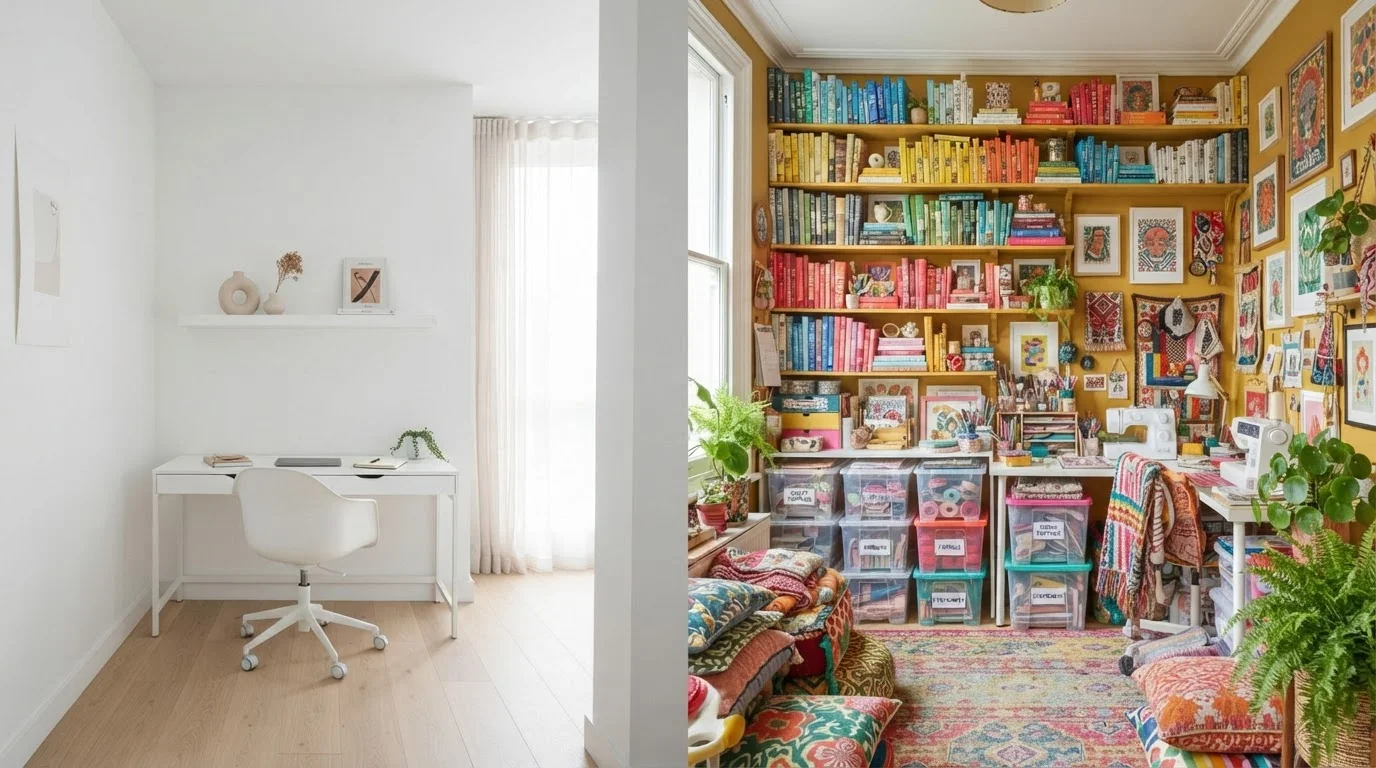
Minimalist organization excels at reducing decision fatigue and visual noise, making it ideal for people who prefer simplicity. Maximalist organization thrives in busy households with many belongings that need a clear, detailed home. Most people will find their sweet spot somewhere in between, mixing strategies based on the room and the people using it.
| Best for | Recommended |
|---|---|
| Those who find clutter mentally draining and prefer fewer possessions | Minimalist Organization |
| Households with many items across diverse categories needing structure | Maximalist Organization |
| Families or roommates with differing tidiness thresholds | Hybrid Approach |
| People living in small apartments with limited storage | Minimalist Organization |
Defining the Two Philosophies
Before comparing systems, it helps to understand what each philosophy actually stands for — because neither is simply about aesthetics.
Minimalist organization is grounded in intentional reduction. The goal is to own only what you genuinely use, store items out of sight, and keep surfaces clear. It doesn't mean living without things you love — it means being deliberate about what earns space in your home. As a guiding idea, minimalist organization asks: Does this item justify its footprint?
Maximalist organization embraces abundance without apology. Rather than owning less, it focuses on creating a thorough, labeled system for everything you have. Open shelving, sorted bins, color-coded folders, and clearly marked containers are hallmarks of this approach. The operating question here is: Does everything have a well-defined, easy-to-find home?
Both philosophies share the same core goal — reducing friction in daily life — but they reach it through opposite means. Understanding that distinction is the first step to choosing what fits your household. For a deeper look at what functional organization actually requires, see what getting organized actually means.
Where Minimalist Organization Shines
Minimalist organization works especially well when the conditions support it. Consider this approach if any of the following ring true for your household:
- Visual clutter causes stress. Research in environmental psychology consistently suggests that cluttered environments can raise perceived stress levels. A pared-down space removes that source of low-grade tension.
- You have limited storage space. Small apartments and compact homes benefit from keeping possessions lean rather than trying to fit everything in. Space-conscious strategies for smaller homes can complement a minimalist approach well.
- Maintenance time is limited. Fewer items means fewer things to put away, clean around, and reorganize after busy weeks.
- You rarely need items you rarely use. If specialty tools, seasonal décor, and rarely touched gadgets pile up without earning their keep, a periodic purge will serve you better than buying more containers.
Start With One Drawer, Not the Whole House
Regardless of which philosophy appeals to you, resist the urge to overhaul everything at once. Pick one drawer, one shelf, or one cabinet and use it as a test case for your chosen approach. If the system holds up after a few weeks of real use, expand it gradually. Small wins build the confidence and clarity needed to tackle larger spaces without burnout.
The main challenge with minimalist organization is the front-end work: deciding what stays. This edit process takes honesty and, sometimes, multiple passes over months rather than a single afternoon.
Where Maximalist Organization Excels
Maximalist organization gets a bad reputation when it's confused with hoarding or disorder — but a well-executed maximalist system is anything but chaotic. It's methodical, detailed, and genuinely functional for the right household.
This philosophy tends to work best when:
- Your household has legitimate volume. Families with children, hobbyists with gear, crafters with supplies, and home cooks with tools often own a lot — and owning a lot doesn't have to mean living in chaos.
- Multiple people need to locate items independently. Labeled bins and visible categories mean a child, a partner, or a roommate can find the tape or the spare batteries without asking.
- You feel anxious when you can't see what you have. Some people actually experience the opposite of calm in sparse spaces — they worry about running out of something or forgetting it exists. For them, visible, organized abundance is genuinely reassuring.
- Purging feels wasteful or impractical. If your cultural background or financial history makes discarding usable items difficult, maximalist organization works with that reality rather than against it.
| Minimalist Organization | Maximalist Organization | |
|---|---|---|
| Core principle | Own and display less | Organize and label more |
| Best suited for | Small spaces, stress-sensitive individuals | Large households, hobbyists, families |
| Upfront effort | High — requires editing possessions | High — requires building detailed systems |
| Ongoing maintenance | Lower once established | Higher — systems need consistent use |
| Works well in shared homes | Only if all occupants agree | Easier to adapt to multiple users |
| Common pitfall | Too sparse to feel livable | Systems collapse without consistent habits |
| Cost to implement | Low — focuses on removing items | Moderate — storage solutions often needed |
Hybrid Approaches and Real-World Households
Most homes don't fall neatly into one camp. A practical middle path is to apply each philosophy by room or zone, based on who uses the space and what happens there.
For example, a kitchen used by the whole family might benefit from maximalist organization — labeled drawer dividers, tiered pantry shelves, and a visible spice rack — while a bedroom might follow minimalist principles with clear nightstands and clothes stored out of sight.
This room-by-room thinking aligns well with the zone method of organizing your home, which assigns each area a purpose and structures storage around actual behavior rather than ideals.
In shared homes, the hybrid approach is often a necessity rather than a preference. When occupants have different organizational instincts, organizing around different household standards requires compromise — typically, more visible organization in shared zones and more personal freedom in private ones.
Whichever system you land on, long-term success depends on maintenance habits. Simple rules like one-in, one-out can prevent either system from gradually unraveling over time.
The content on this site is for informational purposes only and is not a substitute for professional advice. Always consult a qualified professional for guidance specific to your situation.