

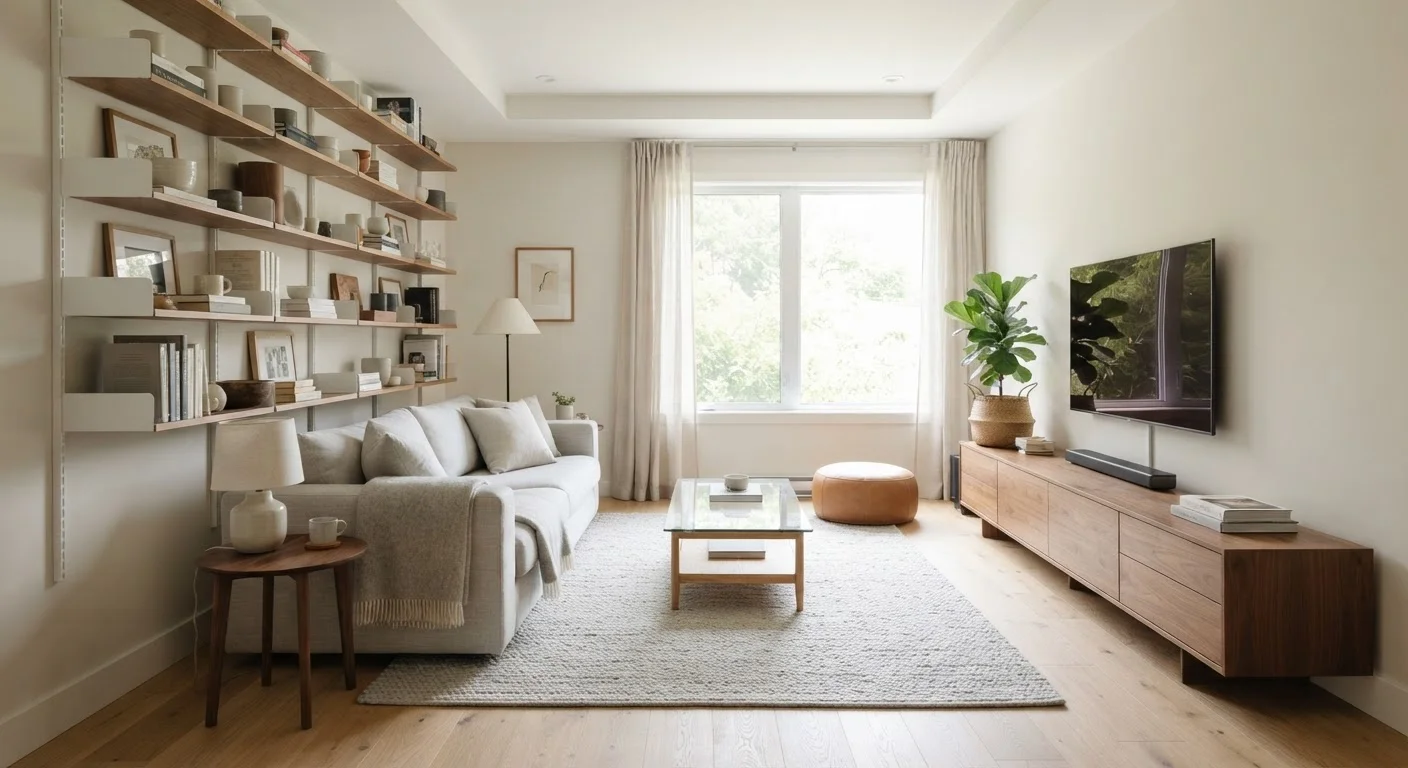
Option A
Vertical Storage
The space-multiplying, wall-climbing approach.
Best for: Homes with limited floor area that need to store a lot without crowding the room.
Option B
Horizontal Storage
The grounded, accessible, and visually stable solution.
Best for: Households prioritizing easy reach, stability for heavy items, or a lower visual profile.
What Each Approach Actually Means
Storage orientation is one of the most consequential — and most overlooked — decisions in home organization. Vertical storage refers to systems that build upward: wall-mounted shelves, tall bookcases, pegboards, over-door organizers, and stacked drawer towers. Horizontal storage refers to systems that spread outward along floor level: low cabinets, ottomans with lids, under-bed bins, wide credenzas, and bench seating with interior compartments.
The choice between them isn't purely aesthetic. It affects how safely items are accessed, how visually calm a room feels, how much floor area remains open, and whether the solution works for every person in your household. Understanding the mechanics of each helps you make a decision based on your actual space — not just what looks good in a design magazine.
| Criterion | Vertical Storage | Horizontal Storage |
|---|---|---|
| Best use of | Wall height and cubic space | Floor-level footprint |
| Ideal room size | Small or narrow spaces | Any size; great in wider rooms |
| Accessibility | May require step stool for high shelves | Easy reach for most users |
| Heavy item suitability | Not ideal above shoulder height | Well-suited for heavy loads |
| Renter-friendliness | Often requires wall anchors | Freestanding; no drilling needed |
| Visual impact | Draws eye upward; can feel bold | Keeps sightlines open; feels airy |
| Child/elder safety | Needs anchoring; high items risky | Safer; items within easy reach |
The Case for Going Vertical
In rooms where floor space is at a premium — a small bedroom, a narrow kitchen, a compact entryway — vertical storage can feel like finding a hidden room. By mounting shelves or installing tall units, you shift storage into the cubic volume of the room rather than its footprint. A wall that might otherwise hold a single low dresser can instead support shelving from baseboard to ceiling, multiplying usable storage several times over.
Vertical systems also tend to keep floors clear, which makes rooms easier to clean and visually less cluttered. This aligns well with activity-based organization approaches — for instance, when you're setting up distinct zones in your home. See our guide to the Zone Method for how vertical storage can anchor a dedicated zone without sprawling into adjacent spaces.
One consideration: items stored above shoulder height can be harder to retrieve safely. Vertical storage works best for things you access infrequently — seasonal items, archival documents, or display objects. For everyday essentials, keep them within the lower two-thirds of any vertical unit.
~350 sq ft
Average size of a U.S. studio apartment
According to U.S. Census Bureau housing data, studio units average around 350 square feet, making vertical storage especially impactful in these settings.
8 ft
Standard U.S. residential ceiling height
Most American homes feature 8-foot ceilings, leaving meaningful unused vertical space above typical furniture that vertical storage systems can utilize.
30%
Estimated floor space freed by vertical systems
Home organization professionals commonly estimate that transitioning low storage to wall-mounted systems can free roughly 20–30% of floor area in small rooms.
The Case for Staying Low
Horizontal storage has practical strengths that vertical setups simply can't match in every scenario. Heavy objects — cast-iron cookware, bulk paper goods, power tools — are far safer stored low to the ground where they're easy to lift without overhead strain. Low storage also eliminates the need for step stools, making it the safer default in homes with young children, older adults, or anyone with mobility limitations.
From a design standpoint, horizontal storage keeps sightlines open across a room. A low credenza along a wall makes a living room feel wider and airier compared with a tall shelving unit that visually segments the space. If you share your home with others who have different tidiness thresholds, horizontal units with doors or lids also make it easier to close things away quickly — a useful tool when you're working out shared organization systems with housemates or family.
For renters in particular, horizontal freestanding units are often the only realistic option. Our renter-friendly organization guide covers how to maximize storage without drilling a single hole.
Mixing Both Orientations Strategically
The most functional homes don't choose one approach exclusively — they combine both intentionally. A kitchen might use tall pantry cabinets for dry goods while keeping a low island or rolling cart for daily-use items. A home office might pair floor-to-ceiling shelving for reference materials with a wide credenza at desk height for active files and supplies.
A useful rule of thumb: apply vertical storage to items you store, and horizontal storage to items you use. If you're also working to maintain long-term organization, pairing this approach with principles like one-in, one-out habits prevents new items from overwhelming either system over time.
For those in compact homes, the combination of vertical and horizontal storage is especially powerful. Our small-space organization strategies offer concrete room-by-room applications of this blended approach, including furniture that does double duty as storage in both orientations.
The content on this site is for informational purposes only and is not a substitute for professional advice. Always consult a qualified professional for guidance specific to your situation.