

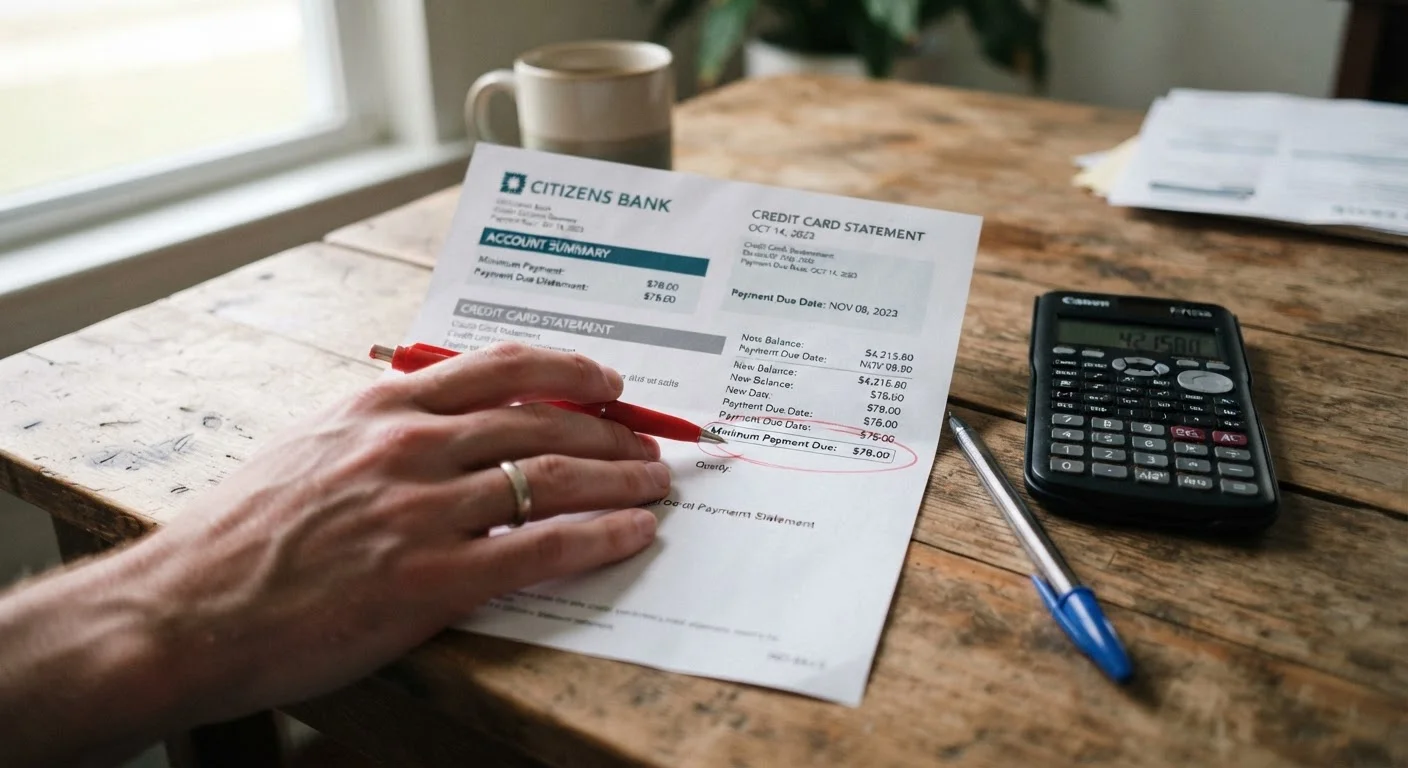
How Minimum Payments Are Actually Calculated
Most people assume a minimum payment is simply a small, fixed amount. In reality, card issuers typically calculate it one of two ways: a flat dollar floor (often around $25–$35), or a percentage of your outstanding balance — commonly 1% to 3% — whichever is greater. Some issuers add that month's interest and fees directly into the minimum formula.
The critical detail here is that as your balance drops, so does the minimum payment. That sounds helpful, but it means you're constantly paying a little less than the month before — which slows your progress to a crawl. On a $5,000 balance at 20% APR, paying only the minimum could keep you in debt for more than 15 years and cost over $6,000 in interest alone. To understand exactly how compounding and daily periodic rates drive those numbers, see how credit card interest actually works.
15+ years
Time to pay off $5,000 at minimum payments
Consumer Financial Protection Bureau (CFPB) educational materials illustrate that a $5,000 balance at roughly 20% APR can take well over a decade to clear on minimum payments alone.
~$6,000+
Estimated interest on a $5,000 balance paid at minimums
Independent repayment calculators and CFPB resources consistently show that interest charges on a minimum-only payoff schedule can equal or exceed the original balance.
The Mistakes That Keep People Stuck on Minimums
Paying the minimum isn't always a conscious choice — it's often the result of specific misunderstandings or financial habits that feel logical in the moment but compound into bigger problems over time.
Treating the minimum payment as the 'correct' payment amount.
Why it happens: Card statements list the minimum prominently, and issuers design that number to look like the intended payment — not the floor it actually is.
Assuming low monthly payments mean the debt is under control.
Why it happens: A payment that fits comfortably in a budget feels manageable, so the underlying balance stops feeling urgent — even as interest accrues daily.
Continuing to use a card while making minimum payments on its existing balance.
Why it happens: People often don't mentally separate 'old' debt from 'new' spending, especially when a card's credit limit is still available.
Prioritizing savings contributions over paying down high-interest debt.
Why it happens: Saving feels responsible and forward-looking, while debt payoff feels like erasing the past. Many people prioritize savings accounts even when carrying 20%+ APR credit card debt.
Not accounting for how new fees and interest reset progress each month.
Why it happens: Because interest compounds and posts monthly, a payment made without enough buffer can leave the balance nearly unchanged — a frustrating surprise that discourages continued effort.
Once you recognize these patterns in your own behavior, you're better positioned to break them. The next step is deciding how much more to pay, and where that money comes from — which is where a structured payoff strategy matters. The debt avalanche and debt snowball methods each offer concrete frameworks for directing extra dollars efficiently.
Your Statement Must Show You the True Cost
Under the Credit CARD Act of 2009, credit card issuers are required to include a minimum payment warning on every monthly statement. This disclosure shows how long it will take to pay off your balance if you make only the minimum payment, and the total interest you will pay. If you've been ignoring that box on your statement, read it closely — it's the clearest signal that minimum payments are not a repayment strategy.
Building a Practical Path Forward
The good news: you don't have to pay off everything at once to make meaningful progress. Even adding $25 or $50 above the minimum each month can cut years off your repayment timeline. Here's how to think about it systematically:
- Read your statement's payoff disclosure. Federal law requires credit card issuers to show you how long it takes to pay off your balance at the minimum, and how much interest you'll pay. Use that number as your baseline — then calculate what happens if you pay 50% more than the minimum each month.
- Treat debt payments as a fixed expense. Set a specific dollar amount — not a percentage — and pay that same amount every month, even as your balance falls. This prevents the slow-motion trap of shrinking minimums.
- Find the extra dollars. Review one month of spending for subscription services, dining, or impulse purchases you wouldn't miss. Redirecting $40–$60 a month toward debt has a far higher guaranteed return than most savings accounts offer at current rates.
If you're also trying to build an emergency fund or other savings while carrying debt, that's a realistic and worthwhile goal — it doesn't have to be either/or. Saving while carrying debt explores the logic of doing both at once. For a complete framework covering the full relationship between saving and debt repayment, the comprehensive guide to managing saving and debt repayment is a strong next read.
This article is for general informational and educational purposes only and does not constitute personalized financial or legal advice. Consult a qualified financial professional for guidance specific to your situation.
The content on this site is for informational purposes only and is not a substitute for professional advice. Always consult a qualified professional for guidance specific to your situation.