

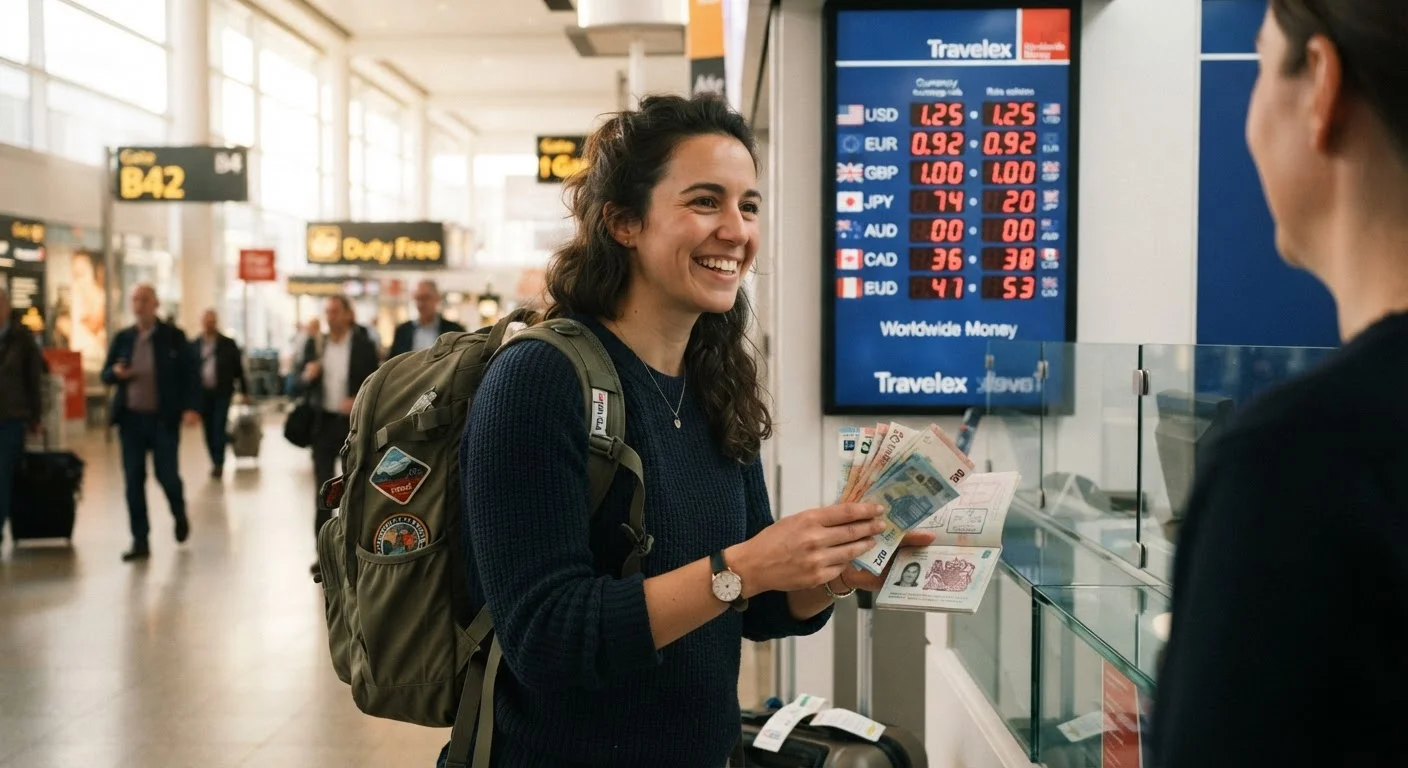
Why the Exchange Rate You See Isn't Always the One You Get
You've probably noticed that the dollar amounts on a currency exchange board don't quite match what you find when you search online. That gap is intentional. Exchange businesses — whether a kiosk, a bank, or an app — buy and sell currency at slightly different rates, and they build their profit into that spread. On top of that, many add flat fees or percentage-based commissions.
The fairest measuring stick is the mid-market rate: the midpoint between global buy and sell prices, with no markup. Before any trip, spend 60 seconds searching the exchange rate between the U.S. dollar and your destination's currency. That number becomes your reference point. Any rate you're offered will sit below it — the question is by how much.
3–15%
Typical markup range at airport kiosks
Consumer finance observers generally estimate airport currency exchange markups fall somewhere in this range above mid-market rates, though they vary by location and operator.
1–3%
Common foreign transaction fee on U.S. cards
Many standard U.S. credit and debit cards charge a percentage-based foreign transaction fee on international purchases; some travel-oriented accounts waive this entirely.
Being a savvy converter doesn't require a finance degree. It just means knowing your benchmark and comparing before you commit. As the lesser-known money drains of international travel article explains, even small gaps in exchange rates add up fast over a full trip.
Your Main Options — and the Trade-Offs of Each
Every method of getting foreign currency has its own mix of convenience and cost. Here's how they generally compare:
- Airport kiosks: The most accessible option the moment you land, but typically the most expensive. Markups can be significant, and some charge additional flat fees. Useful for a small emergency amount, not ideal for your whole trip's cash.
- Local ATMs at your destination: Often the most competitive rates for travelers, since machines pull from interbank-adjacent rates. Your U.S. bank's foreign transaction fee and the local ATM's own fee are the key variables. Withdrawing larger, less frequent amounts reduces per-transaction costs.
- Local banks or post offices: In many countries, walking into a local bank branch can yield solid rates, especially for larger amounts. Patience required — lines can be long — but it's worth knowing this option exists.
- Your U.S. bank before departure: Some banks allow customers to order foreign currency for home delivery or branch pickup. Rates vary, but it's a reliable way to arrive with a usable amount in hand.
Always Pay in Local Currency
Whenever a foreign ATM or card reader asks if you want to pay in U.S. dollars, choose the local currency instead. Dynamic currency conversion is almost always the more expensive option. Your own bank's conversion will typically be more favorable than the rate set by the merchant or ATM operator.
Whatever method you choose, always decline dynamic currency conversion (DCC) when a foreign ATM or card terminal offers to charge you in U.S. dollars. It seems helpful, but the conversion rate they apply is almost always less favorable than what your own bank would use. Opt to pay in the local currency every time.
Practical Steps Before You Board
A little preparation goes a long way toward avoiding the stress of scrambling for cash in an unfamiliar airport. First, notify your U.S. bank and credit card issuers that you're traveling internationally — this reduces the chance of a fraud block freezing your card at the worst possible moment. This is one of those easy wins that first-time travelers often overlook, as outlined in our pre-trip financial checklist.
Second, research your destination's cash culture. Some countries — Japan and Germany, for example — are significantly more cash-dependent than others. Others have moved heavily toward card payments. Knowing this shapes how much local currency you actually need to carry. For broader context on what surprises Americans abroad, see what catches first-time international travelers off guard.
Finally, build in a buffer: aim to arrive with enough local currency to cover your first few hours — transportation from the airport, a meal, a SIM card — without depending on finding a good exchange option immediately. From there, a local ATM becomes your practical home base for cash as needed.
A Note on Cards vs. Cash
Many American travelers find that a combination works well: a travel-friendly credit or debit card (ideally one with no foreign transaction fees) for larger purchases, and local cash for everyday small transactions. Cards offer fraud protection and convenience; cash covers markets, tips, and cash-only establishments.
If you're planning to rent a vehicle or navigate public transit at your destination, factoring in payment methods early is worthwhile — see our overview of ground transportation options abroad for more on how payment typically works in different contexts. And if broader trip-planning decisions feel overwhelming, this guide to navigating common international trip complications is worth a read before you finalize anything.
The bottom line: currency exchange doesn't have to be intimidating. Know your benchmark rate, have a plan for your first few hours, and understand that the most convenient option is rarely the most cost-effective one. A bit of forethought puts you firmly in control.
This article is for general informational purposes only and does not constitute financial advice. Exchange rates, fees, and banking policies vary and change frequently. Verify current terms with your financial institution and check official sources before traveling.
Frequently Asked Questions
Airport kiosks and hotel exchange desks are generally the least favorable spots, often offering rates well below the mid-market benchmark plus additional fees. They're convenient but you'll typically receive noticeably less foreign currency per dollar. If you use them, try to exchange only what you need to get to your first ATM or local bank.
Exchanging a modest emergency amount before you leave can be smart — enough for a taxi or a meal on arrival. However, rates from U.S. sources for foreign currency are often less competitive than what you'd get from a local ATM at your destination. Check with your home bank first, as some offer better rates for account holders.
Dynamic currency conversion (DCC) is when a foreign merchant or ATM offers to charge you in U.S. dollars instead of the local currency. This sounds convenient but their conversion rate is usually unfavorable compared to your own bank's rate. Choosing to pay in the local currency almost always works out better for you.
Local ATMs in your destination country often apply rates close to the mid-market rate, making them a practical option for many travelers. The main variables are your U.S. bank's foreign transaction fee and any fee charged by the overseas ATM operator. Some U.S. bank accounts reimburse these fees — worth checking before you travel.
Carrying some local cash is genuinely useful — many markets, small restaurants, and transit systems are cash-only. The key is moderation: don't carry more than you expect to spend in a day or two, keep it separate from your cards, and use a money belt or hidden pouch in busy tourist areas.
You can look up the current mid-market rate through a quick search or financial data sites. It represents the midpoint between buy and sell rates in the global currency market and is the fairest benchmark to compare against any rate you're being offered. A notable gap between that rate and what a vendor quotes you represents their markup.
The content on this site is for informational purposes only and is not a substitute for professional advice. Always consult a qualified professional for guidance specific to your situation.