

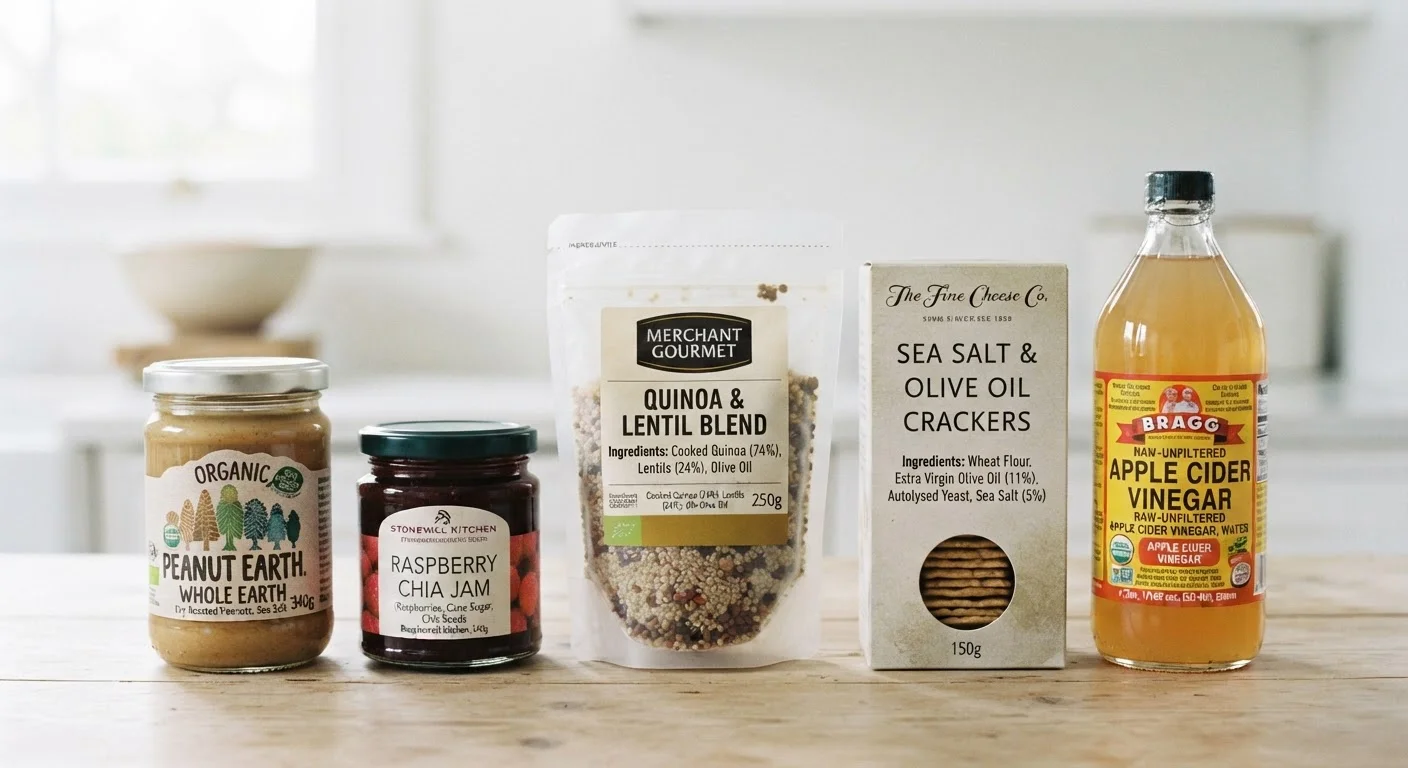
Why Ingredient Labels Feel Like a Foreign Language
You pick up a box of crackers and scan the ingredient list. Somewhere between 'modified food starch' and 'disodium phosphate' you give up and put it back on the shelf — or just buy it anyway without really knowing what's inside. Sound familiar?
Food labels are regulated by the U.S. Food and Drug Administration (FDA), which means many of those confusing words have precise legal definitions. Others are food-science terms that describe how an ingredient was processed. Either way, you don't need a chemistry degree to understand them. This glossary breaks down the terms that stump most shoppers, so you can make more informed decisions the next time you're standing in the aisle.
For a broader walkthrough of how the full Nutrition Facts panel works, see our guide to reading a food label for the first time.
Enriched
Nutrients that were removed during processing have been added back in. For example, enriched white flour has B vitamins and iron added back after they were stripped out during milling. It doesn't mean the food is more nutritious than its whole-grain counterpart — it just means some losses were partially restored.
Fortified
Nutrients have been added that weren't originally present in significant amounts. Milk fortified with vitamin D is a common example. Unlike 'enriched,' fortification adds something new rather than restoring something lost.
Hydrolyzed
A protein that has been broken down into smaller pieces (amino acids and peptides) using water, acids, or enzymes. Hydrolyzed vegetable protein, for instance, is used as a flavor enhancer and contains naturally occurring glutamate, which contributes a savory taste.
Modified Food Starch
A starch derived from corn, wheat, tapioca, or other sources that has been chemically or physically altered to improve its stability, texture, or thickening properties during food processing. The modification is not the same as genetic modification.
Emulsifier
An ingredient that helps oil and water mix together and stay blended. Lecithin (often derived from soy or sunflower) is a common example used to keep salad dressings, chocolates, and spreads from separating.
Natural Flavors
Per FDA rules, 'natural flavors' are derived from plant or animal sources — including fruits, vegetables, spices, meat, seafood, dairy, or fermentation products. However, the term covers hundreds of possible compounds and does not indicate that a product is minimally processed or additive-free.
Artificial Flavors
Flavor compounds synthesized in a lab rather than derived directly from natural sources. They must be approved as safe by the FDA. Some artificial flavors are chemically identical to their natural counterparts but produced more efficiently.
Preservatives
Substances added to slow spoilage, prevent bacterial growth, or maintain color and texture. Common examples include sodium benzoate, BHA (butylated hydroxyanisole), and calcium propionate. The FDA regulates which preservatives are approved for use and at what levels.
Maltodextrin
A mildly sweet powder made from starch (typically corn, rice, or potato) used as a thickener, filler, or carrier for other ingredients. It has a high glycemic index, meaning it can raise blood sugar quickly, despite often appearing in products marketed as 'light' or 'low-fat.'
Invert Sugar
A mixture of glucose and fructose created by splitting apart regular table sugar (sucrose). It's sweeter than sucrose and used in baked goods and candies to retain moisture and slow crystallization. It counts as added sugar on the Nutrition Facts label.
Carrageenan
A thickening and gelling agent derived from red seaweed. It's commonly used in dairy products, plant-based milks, and deli meats to improve texture. It is FDA-approved for use in food.
Autolyzed Yeast Extract
A flavor enhancer produced when yeast cells break down their own proteins. Like hydrolyzed protein, it contains glutamate and imparts a savory, umami-like taste. It is distinct from monosodium glutamate (MSG) but has a similar flavor effect.
Key Terms You'll Encounter Most Often
The ingredient list on a U.S. packaged food is written in descending order by weight — so the first ingredient listed is the most abundant by weight, and the last is the least. That single rule can tell you a lot before you even decode any individual word.
| Ingredient list order | Listed by weight, heaviest first (FDA food labeling regulations) |
| Regulating body for food labels | U.S. Food and Drug Administration (FDA) |
| "Reduced" nutrient claim threshold | At least 25% less than the standard version (FDA nutrient content claim definitions) |
| "Light" or "Lite" claim | One-third fewer calories or 50% less fat than the reference food (FDA nutrient content claim definitions) |
| "Natural flavors" source requirement | Must originate from plant or animal sources (FDA 21 CFR §101.22) |
| Added sugars disclosure required since | 2020 (for large manufacturers) (FDA Nutrition Facts label update) |
Below the ingredient list, you'll often see nutrient claims on the front of the package. Terms like low-fat, reduced sodium, and light each have specific FDA definitions. For example, 'reduced' means the product has at least 25% less of a nutrient compared to a standard version — but it doesn't tell you how much of that nutrient the standard version had. Our companion article on the label language of fat unpacks those distinctions clearly.
Front-of-package claims like natural, organic, and non-GMO carry very different levels of federal oversight. Some are tightly regulated; others are largely unregulated marketing language. For a full breakdown, see our article on what these label claims are actually regulated to mean.
Understanding where a food falls on the processing spectrum — minimally processed versus ultra-processed — can also help contextualize these terms. Our article on whole foods vs. processed foods explains the real differences in plain language.
This article is for general informational and educational purposes only. It is not a substitute for professional dietary or medical advice. If you have specific health concerns or dietary needs, consult a registered dietitian or qualified healthcare provider.
The content on this site is for informational purposes only and is not a substitute for professional advice. Always consult a qualified professional for guidance specific to your situation.